* BUG: ReactPartialRenderer / New Context polutes mutable global state
The new context API stores the provided values on the shared context instance. When used in a synchronous context, this is not an issue. However when used in an concurrent context this can cause a "push provider" from one react render to have an effect on an unrelated concurrent react render.
I've encountered this bug in production when using renderToNodeStream, which asks ReactPartialRenderer for bytes up to a high water mark before yielding. If two Node Streams are created and read from in parallel, the state of one can polute the other.
I wrote a failing test to illustrate the conditions under which this happens.
I'm also concerned that the experimental concurrent/async React rendering on the client could suffer from the same issue.
* Use unique thread ID for each partial render to access Context
This first adds an allocator that keeps track of a unique ThreadID index
for each currently executing partial renderer. IDs are not just growing
but are reused as streams are destroyed.
This ensures that IDs are kept nice and compact.
This lets us use an "array" for each Context object to store the current
values. The look up for these are fast because they're just looking up
an offset in a tightly packed "array".
I don't use an actual Array object to store the values. Instead, I rely
on that VMs (notably V8) treat storage of numeric index property access
as a separate "elements" allocation.
This lets us avoid an extra indirection.
However, we must ensure that these arrays are not holey to preserve this
feature.
To do that I store the _threadCount on each context (effectively it takes
the place of the .length property on an array).
This lets us first validate that the context has enough slots before we
access the slot. If not, we fill in the slots with the default value.
Oopsie!
This could have been avoided if our types were modeled correctly with
Flow (using a disjoint union).
Fuzz tester didn't catch it because it does not generate cases where
a Suspense component mounts with no children. I'll update it.
* Don't warn if an unmounted component is pinged
* Suspense fuzz tester
The fuzzer works by generating a random tree of React elements. The tree
two types of custom components:
- A Text component suspends rendering on initial mount for a fuzzy
duration of time. It may update a fuzzy number of times; each update
supsends for a fuzzy duration of time.
- A Container component wraps some children. It may remount its children
a fuzzy number of times, by updating its key.
The tree may also include nested Suspense components.
After this tree is generated, the tester sets a flag to temporarily
disable Text components from suspending. The tree is rendered
synchronously. The output of this render is the expected output.
Then the tester flips the flag back to enable suspending. It renders the
tree again. This time the Text components will suspend for the amount of
time configured by the props. The tester waits until everything has
resolved. The resolved output is then compared to the expected output
generated in the previous step.
Finally, we render once more, but this time in concurrent mode. Once
again, the resolved output is compared to the expected output.
I tested by commenting out various parts of the Suspense implementation
to see if broke in the expected way. I also confirmed that it would have
caught #14133, a recent bug related to deletions.
* When a generated test case fails, log its input
* Moar fuzziness
Adds more fuzziness to the generated tests. Specifcally, introduces
nested Suspense cases, where the fallback of a Suspense component
also suspends.
This flushed out a bug (yay!) whose test case I've hard coded.
* Use seeded random number generator
So if there's a failure, we can bisect.
* Add failing test for ping on unmounted component
We had a test for this, but not outside of concurrent mode :)
* Don't warn if an unmounted component is pinged
* Parse build script type and package names
This ensures that `yarn build core dom` includes DOM.
It also ensures that spaces like `yarn build "core, dom"` doesn't build EVERYTHING.
* Get rid of label in bundles config
Instead we just use the name from entry using fuzzy search.
There is one special case. If you put in `/index` or `/index.js`.
That allows to build things like `react/index` to only build isomorphic
where as `react` would build everything. Or `react-dom/index` to exclude
the server renderers.
* Instead of matching `/index.js` just append it to the search string
That way things like `yarn build react/` works too.
* Fixed `treeBaseDuration` by propagating its value from the suspended tree to the Fragment React temporarily wraps around it when showing the fallback UI.
* Fixed `actualDuration` by recording elapsed profiler time in the event of an error.
* Fixed `actualDuration` in concurrent mode by propagating the time spent rendering the suspending component to its parent.
Also updated ReactSuspensePlaceholder-test.internal to cover these new cases.
Fixes a bug where deletion effects in the primary tree were dropped
before entering the second render pass.
Because we no longer reset the effect list after the first render pass,
I've also moved the deletion of the fallback children to the complete
phase, after the tree successfully renders without suspending.
Will need to revisit this heuristic when we implement resuming.
* Recover from errors with a boundary in completion phase
* Use a separate field for completing unit of work
* Use a simpler fix with one boolean
* Reoder conditions
* Clarify which paths are DEV-only
* Move duplicated line out
* Make it clearer this code is DEV-only
Adds a check to the existing fuzz tester to confirm that the props are
set to the latest values in the commit phase. Only checks
componentDidUpdate; we already have unit tests for the other lifecycles,
so I think this is good enough. This is only a redundancy.
* Resolve defaultProps for Lazy components
* Make test fail again
* Undo the partial fix
* Make test output more compact
* Add a separate failing test for sync mode
* Clean up tests
* Add another update to both tests
* Resolve props for commit phase lifecycles
* Resolve prevProps for begin phase lifecycles
* Resolve prevProps for pre-commit lifecycles
* Only resolve props if element type differs
* Fix Flow
* Don't set instance.props/state during commit phase
This is an optimization. I'm not sure it's entirely safe. It's probably worth running internal tests and see if we can ever trigger a case where they're different.
This can mess with resuming.
* Keep setting instance.props/state before unmounting
This reverts part of the previous commit. It broke a test that verifies we use current props in componentWillUnmount if the fiber unmounts due to an error.
Setting to null isn't correct; setting to '' is. I opted to use dangerousStyleValue for consistency with the main path that we set things.
Fixes#14114.
Test Plan:
Verified setting to '' works in Chrome and IE11. (Setting to null works in Chrome but not in IE11.)
The `enableHooks` feature flag used to only control whether the API
was exposed on the React package. But now it also determines if the
dispatcher and implementation are included in the bundle.
We're using hooks in www, so I've switched the feature flag to `true`
in the www build.
(Alternatively, we could have two feature flags: one for the
implementation and dispatcher, and one for exposing the API on the
React package.)
* Avoid double commit by re-rendering immediately and reusing children
To support Suspense outside of concurrent mode, any component that
starts rendering must commit synchronously without being interrupted.
This means normal path, where we unwind the stack and try again from the
nearest Suspense boundary, won't work.
We used to have a special case where we commit the suspended tree in an
incomplete state. Then, in a subsequent commit, we re-render using the
fallback.
The first part — committing an incomplete tree — hasn't changed with
this PR. But I've changed the second part — now we render the fallback
children immediately, within the same commit.
* Add a failing test for remounting fallback in sync mode
* Add failing test for stuck Suspense fallback
* Toggle visibility of Suspense children in mutation phase, not layout
If parent reads visibility of children in a lifecycle, they should have
already updated.
This is required to use lazy.
Test Plan:
* Verified lazy works on a real world use case (shows spinner, shows real content).
* Verified that if I change the primary content's styles to have `display: 'none'` then it never appears (i.e., the code in `unhide` reads the styles successfully)
* Add debug tools package
* Add basic implementation
* Implement inspection of the current state of hooks using the fiber tree
* Support useContext hooks inspection by backtracking from the Fiber
I'm not sure this is safe because the return fibers may not be current
but close enough and it's fast.
We use this to set up the current values of the providers.
* rm copypasta
* Use lastIndexOf
Just in case. I don't know of any scenario where this can happen.
* Support ForwardRef
* Add test for memo and custom hooks
* Support defaultProps resolution
Check for existence of `setTimeout` and `clearTimeout` in the runtime
before using them, to ensure runtimes without them (like .NET ClearScript)
do not crash just by importing `react-dom`.
Mostly to catch this:
```js
useEffect(async () => {
// ...
return cleanup;
});
```
Is this too restrictive? Not sure if you would want to do like
```js
useEffect(() => ref.current.style.color = 'red');
```
which would give a false positive here. We can always relax it to only warn on Promises if people complain.
* Simplify imports in ReactChildFiber
* Import type first in ReactCurrentFiber
* Simplify imports in ReactFiberBeginWork
* Simplify imports in ReactFiberScheduler
* Simplify import in ReactFiberTreeReflection
* Simplify import in ReactFiberUnwindWork
* Remove repeated import
* Fix imports from ReactFiberExpirationTime
* Master imports in ReactFiberBeginWork
Removes the `enableDispatchCallback` feature flag and deletes the
associated code. An earlier version of the Hooks proposal included this
feature but we've since decided to remove it.
* [scheduler] Deadline object -> shouldYield
Instead of using a requestIdleCallback-style deadline object, expose a
method Scheduler.shouldYield that returns true if there's a higher
priority event in the queue.
* Nits
Even though we commit the fiber in an incomplete state, we shouldn't
fire any lifecycles or effects.
We already did this for classes, but now with useEffect, the same is
needed for other types of work, too.
Before the fix, the passive effect in the test is never executed.
We were previously waiting until the next commit phase to run effects. Now, we run them before scheduling work.
Effects scheduled by useEffect should not fire until after the browser
has had a chance to paint. However, they should be fired before any
subsequent mutations.
Also adds useMutationEffect and useLayoutEffect. useMutationEffect fires
during the host update phase. useLayoutEffect fires during the post-
update phase (the same phase as componentDidMount
and componentDidUpdate).
* [react-cache] Remove `cache` as argument to `read`
Updated is API is `Resource.read(key)` instead of
`Resource.read(cache, key)`.
The cache is read from context using `readContext`.
This also removes cache invalidation entirely (other than the default
LRU mechanism), as well as the ability to have multiple caches. We'll
add it back once `Context.write` lands and we can implement it the
right way.
Since there's now only a single cache (the global one), we don't
actually need to use context yet, but I've added a dummy context
anyway so the user gets an error if they attempt to read outside the
render phase.
* nits
* Add test for thenables that resolve multiple times
* [Synchronous Suspense] Suspending a class outside concurrent mode
When a class component suspends during mount outside concurrent mode,
change the tag so it's not mistaken for a completed component. For
example, we should not call componentWillUnmount if it is deleted.
* PR nits
We are using it with lazy and the combination Suspense + lazy seems pretty
stable. maxDuration is not but that's only enabled when you're in
ConcurrentMode which is still unstable.
Found a bug related to suspending inside an already mounted tree. While
investigating this I noticed we really don't have much coverage of
suspended updates. I think this would greatly benefit from some fuzz
testing; still haven't thought of a good test case, though.
* Add support for React.pure in ReactDOMServer
* Unwrap pure wrappers by creating an additional element as a single child
This is very slow but meh. We're rewriting this whole thing anyway.
* Allow arbitrary types to be wrapped in pure
This creates an outer fiber that container the pure check and an inner
fiber that represents which ever type of component.
* Add optimized fast path for simple pure function components
Special cased when there are no defaultProps and it's a simple function
component instead of class. This doesn't require an extra fiber.
We could make it so that this also works with custom comparer but that
means we have to go through one extra indirection to get to it.
Maybe it's worth it, donno.
* Introduce elementType field
This will be used to store the wrapped type of an element. E.g. pure and
lazy.
The existing type field will be used for the unwrapped type within them.
* Store the unwrapped type on the type field of lazy components
* Use the raw tags for lazy components
Instead, we check if the elementType and type are equal to test if
we need to resolve props. This is slightly slower in the normal case
but will yield less code and branching.
* Clean up lazy branches
* Collapse work tag numbering
* Split IndeterminateComponent out from Lazy
This way we don't have to check the type in a hacky way in the
indeterminate path. Also, lets us deal with lazy that resolves to
indeterminate and such.
* Missing clean up in rebase
* Always bail out timed out children even if they receive an update
The fragment that wraps timed-out children should always have an
expiration time of NoWork.
* Don't need to set expirationTime, only childExpirationTime
* Move memoizedProps to after beginWork remove memoizeProps helper
We always call this at the end. This is now enforced to line up since
we do the equality check in the beginning of beginWork. So we can't
have special cases.
* Inline the one caller of memoizeState
Outside of concurrent mode, schedules a force update on a suspended
class component to force it to prevent it from bailing out and
reusing the current fiber, which we know to be inconsistent.
Removes support for using arbitrary promises as the type of a React
element. Instead, promises must be wrapped in React.lazy. This gives us
flexibility later if we need to change the protocol.
The reason is that promises do not provide a way to call their
constructor multiple times. For example:
const promiseForA = new Promise(resolve => {
fetchA(a => resolve(a));
});
Given a reference to `promiseForA`, there's no way to call `fetchA`
again. Calling `then` on the promise doesn't run the constructor again;
it only attaches another listener.
In the future we will likely introduce an API like `React.eager` that
is similar to `lazy` but eagerly calls the constructor. That gives us
the ability to call the constructor multiple times. E.g. to increase
the priority, or to retry if the first operation failed.
* Suspense component does not capture if `fallback` is not defined
A missing fallback prop means the exception should propagate to the next
parent (like a rethrow). That way a Suspense component can specify other
props like maxDuration without needing to provide a fallback, too.
Closes#13864
* Change order of checks
This was the original, lower-level API before we landed on `fallback`
instead. (We might add a different lower-level API in the future, likely
alongside a new API for catching errors).
In the default mode, Suspense has special semantics where, in
addition to timing out immediately, we don't unwind the stack before
rendering the fallback. Instead, we commit the tree in an inconsistent
state, then synchronous render *again* to switch to the fallback. This
is slower but is less likely to cause issues with older components that
perform side effects in the render phase (e.g. componentWillMount,
componentWillUpdate, and componentWillReceiveProps).
We should do this in strict mode, too, so that there are no semantic
differences (in prod, at least) between default mode and strict mode.
The rationale is that it makes it easier to wrap a tree in strict mode
and start migrating components incrementally without worrying about new
bugs in production.
* Store the start time on `updateQueue` instead of `stateNode`
Originally I did this to free the `stateNode` field to store a second
set of children. I don't we'll need this anymore, since we use fragment
fibers instead. But I still think using `updateQueue` makes more sense
so I'll leave this in.
* Use fragment fibers to keep the primary and fallback children separate
If the children timeout, we switch to showing the fallback children in
place of the "primary" children. However, we don't want to delete the
primary children because then their state will be lost (both the React
state and the host state, e.g. uncontrolled form inputs). Instead we
keep them mounted and hide them. Both the fallback children AND the
primary children are rendered at the same time. Once the primary
children are un-suspended, we can delete the fallback children — don't
need to preserve their state.
The two sets of children are siblings in the host environment, but
semantically, for purposes of reconciliation, they are two separate
sets. So we store them using two fragment fibers.
However, we want to avoid allocating extra fibers for every placeholder.
They're only necessary when the children time out, because that's the
only time when both sets are mounted.
So, the extra fragment fibers are only used if the children time out.
Otherwise, we render the primary children directly. This requires some
custom reconciliation logic to preserve the state of the primary
children. It's essentially a very basic form of re-parenting.
* Use `memoizedState` to store various pieces of SuspenseComponent's state
SuspenseComponent has three pieces of state:
- alreadyCaptured: Whether a component in the child subtree already
suspended. If true, subsequent suspends should bubble up to the
next boundary.
- didTimeout: Whether the boundary renders the primary or fallback
children. This is separate from `alreadyCaptured` because outside of
strict mode, when a boundary times out, the first commit renders the
primary children in an incomplete state, then performs a second commit
to switch the fallback. In that first commit, `alreadyCaptured` is
false and `didTimeout` is true.
- timedOutAt: The time at which the boundary timed out. This is separate
from `didTimeout` because it's not set unless the boundary
actually commits.
These were previously spread across several fields.
This happens to make the non-strict case a bit less hacky; the logic for
that special case is now mostly localized to the UnwindWork module.
* Hide timed-out Suspense children
When a subtree takes too long to load, we swap its contents out for
a fallback to unblock the rest of the tree. Because we don't want
to lose the state of the timed out view, we shouldn't actually delete
the nodes from the tree. Instead, we'll keep them mounted and hide
them visually. When the subtree is unblocked, we un-hide it, having
preserved the existing state.
Adds additional host config methods. For mutation mode:
- hideInstance
- hideTextInstance
- unhideInstance
- unhideTextInstance
For persistent mode:
- cloneHiddenInstance
- cloneUnhiddenInstance
- createHiddenTextInstance
I've only implemented the new methods in the noop and test renderers.
I'll implement them in the other renderers in subsequent commits.
* Include `hidden` prop in noop renderer's output
This will be used in subsequent commits to test that timed-out children
are properly hidden.
Also adds getChildrenAsJSX() method as an alternative to using
getChildren(). (Ideally all our tests would use test renderer #oneday.)
* Implement hide/unhide host config methods for DOM renderer
For DOM nodes, we hide using `el.style.display = 'none'`.
Text nodes don't have style, so we hide using `text.textContent = ''`.
* Implement hide/unhide host config methods for Art renderer
* Create DOM fixture that tests state preservation of timed out content
* Account for class components that suspend outside concurrent mode
Need to distinguish mount from update. An unfortunate edge case :(
* Fork appendAllChildren between persistent and mutation mode
* Remove redundant check for existence of el.style
* Schedule placement effect on indeterminate components
In non-concurrent mode, indeterminate fibers may commit in an
inconsistent state. But when they update, we should throw out the
old fiber and start fresh. Which means the new fiber needs a
placement effect.
* Pass null instead of current everywhere in mountIndeterminateComponent
* Deprecate findDOMNode in StrictMode
There are two scenarios. One is that we pass a component instance that is
already in strict mode or the node that we find is in strict mode if
an outer component renders into strict mode.
I use a separate method findHostInstanceWithWarning for this so that
a) I can pass the method name (findDOMNode/findNodeHandle).
b) Can ignore this warning in React Native mixins/NativeComponent that use this helper.
I don't want to expose the fiber to the renderers themselves.
- "Interactive" -> "user-blocking"
- "Whenever" -> "Idle"
These are the terms used by @spanicker in their main-thread scheduling
proposal: https://github.com/spanicker/main-thread-scheduling#api-sketch
That proposal also uses "microtask" instead of "immediate" and "default"
instead of "normal." Not sure about "microtask" because I don't think
most people know what that is. And our implementation isn't a proper
microtask, though you could use it to implement microtasks if you made
sure to wrap every entry point. I don't really have a preference between
"default" and "normal."
These aren't necessarily the final names. Still prefixed by `unstable_`.
We're not planning to encourage legacy context, and without this change, it's difficult to use pure+forwardRef together. We could special-case `pure(forwardRef(...))` but this is hopefully simpler.
```js
React.pure(function(props, ref) {
// ...
});
```
Fixes#13777
As part of #11927 we introduced a regression by adding onclick handler
to the React root. This causes the whole React tree to flash when tapped
on iOS devices (for reasons I outlined in
https://github.com/facebook/react/issues/12989#issuecomment-414266839).
To fix this, we should only apply onclick listeners to portal roots. I
verified that my proposed fix indeed works by checking out our DOM
fixtures and adding regression tests.
Strangely, I had to make changes to the DOM fixtures to see the behavior
in the first place. This seems to be caused by our normal sites (and
thus their React root) being bigger than the viewport:
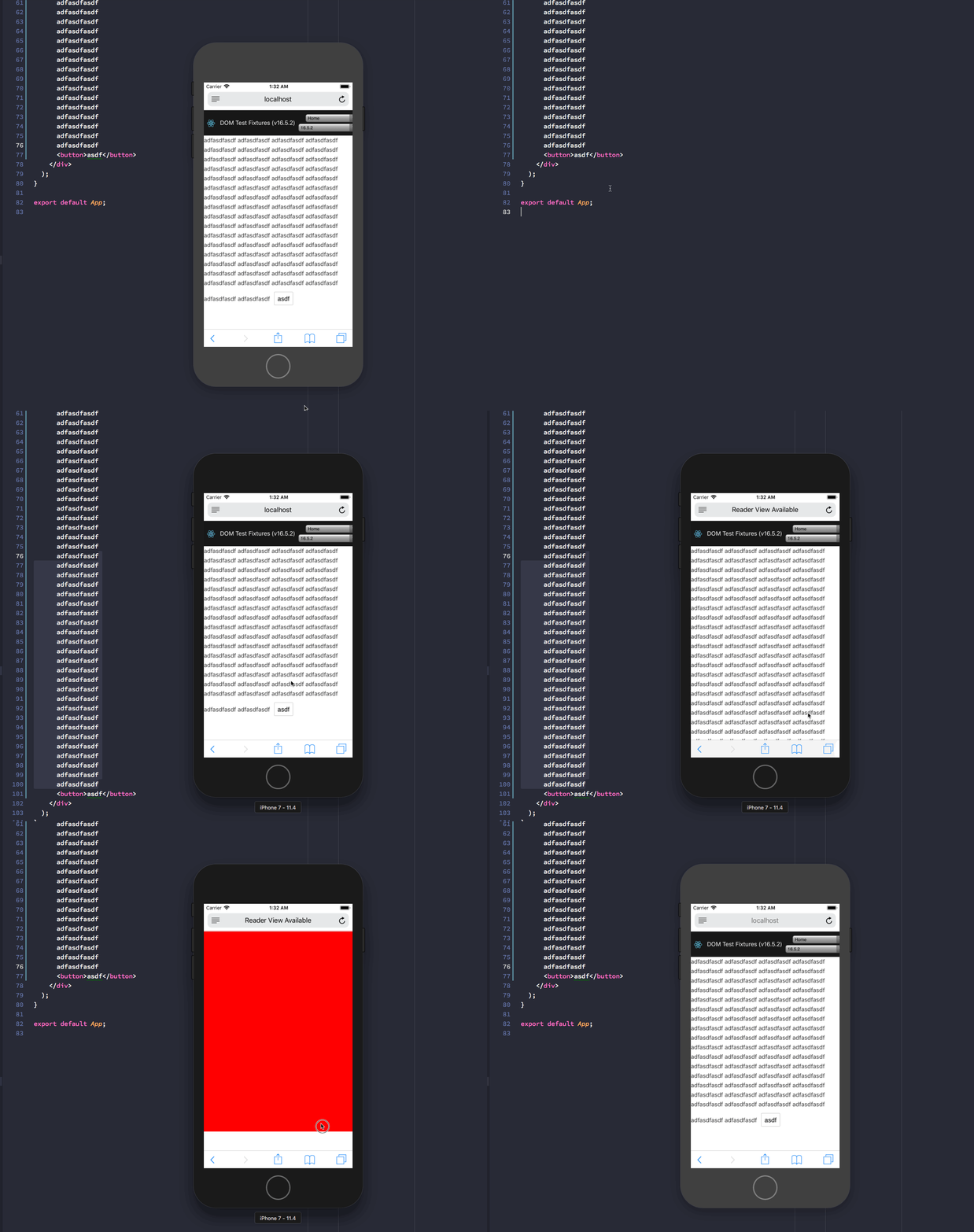
An alternative approach to finding out if we're appending to a React
root would be to add a third parameter to `appendChildToContainer` based
on the tag of the parent fiber.
* [scheduler] Eagerly schedule rAF at beginning of frame
Eagerly schedule the next animation callback at the beginning of the
frame. If the scheduler queue is not empty at the end of the frame, it
will continue flushing inside that callback. If the queue *is* empty,
then it will exit immediately. Posting the callback at the start of the
frame ensures it's fired within the earliest possible frame. If we
waited until the end of the frame to post the callback, we risk the
browser skipping a frame and not firing the callback until the frame
after that.
* Re-name scheduledCallback -> scheduledHostCallback
Previously, we were emptying root.pendingInteractionMap and permanently losing those interactions when applying an unrelated update to a tree that has no scheduled work that is waiting on promise resolution. (That is, one that is showing a fallback and waiting for the suspended content to resolve.)
The logic I'm leaving untouched with `nextRenderIncludesTimedOutPlaceholder` is *not* correct -- what we want is instead to know if *any* placeholder anywhere in the tree is showing its fallback -- but we don't currently have a better replacement, and this should unblock tracing with suspense again.
This package uses `process.env.NODE_ENV` but does not transform its usage during bundling like the rest of the React libraries do. This causes issues when `process` is not defined globally.
* Jest + test renderer helpers for concurrent mode
Most of our concurrent React tests use the noop renderer. But most
of those tests don't test the renderer API, and could instead be
written with the test renderer. We should switch to using the test
renderer whenever possible, because that's what we expect product devs
and library authors to do. If test renderer is sufficient for writing
most React core tests, it should be sufficient for others, too. (The
converse isn't true but we should aim to dogfood test renderer as much
as possible.)
This PR adds a new package, jest-react (thanks @cpojer). I've moved
our existing Jest matchers into that package and added some new ones.
I'm not expecting to figure out the final API in this PR. My goal is
to land something good enough that we can start dogfooding in www.
TODO: Continue migrating Suspense tests, decide on better API names
* Add additional invariants to prevent common errors
- Errors if user attempts to flush when log of yields is not empty
- Throws if argument passed to toClearYields is not ReactTestRenderer
* Better method names
- toFlushAll -> toFlushAndYield
- toFlushAndYieldThrough ->
- toClearYields -> toHaveYielded
Also added toFlushWithoutYielding
* Fix jest-react exports
* Tweak README
`--save` is on by default as of [npm 5](https://blog.npmjs.org/post/161081169345/v500), and `npm install aphrodite` is functionally equivalent to `npm install --save aphrodite` now
* Removed the enableGetDerivedStateFromCatch feature flag (aka permanently enabled the feature)
* Forked/copied ReactErrorBoundaries to ReactLegacyErrorBoundaries for testing componentDidCatch
* Updated error boundaries tests to apply to getDerivedStateFromCatch
* Renamed getDerivedStateFromCatch -> getDerivedStateFromError
* Warn if boundary with only componentDidCatch swallows error
* Fixed a subtle reconciliation bug with render phase error boundary
* pure
A higher-order component version of the `React.PureComponent` class.
During an update, the previous props are compared to the new props. If
they are the same, React will skip rendering the component and
its children.
Unlike userspace implementations, `pure` will not add an additional
fiber to the tree.
The first argument must be a functional component; it does not work
with classes.
`pure` uses shallow comparison by default, like `React.PureComponent`.
A custom comparison can be passed as the second argument.
Co-authored-by: Andrew Clark <acdlite@fb.com>
Co-authored-by: Sophie Alpert <sophiebits@fb.com>
* Warn if first argument is not a functional component
Added some tests for the non-DOM version of Scheduler that is used
as a fallback, e.g. Jest. The tests use Jest's fake timers API:
- `jest.runAllTimers(ms)` flushes all scheduled work, as expected
- `jest.advanceTimersByTime(ms)` flushes only callbacks that expire
within the given milliseconds.
These capabilities should be sufficient for most product tests. Because
jest's fake timers do not override performance.now or Date.now, we
assume time is constant. This means Scheduler's internal time will not
be aligned with other code that reads from `performance.now`. For finer
control, the user can override `window._sched` like we do in our tests.
We will likely publish a Jest package that has this built in.
All of these features are based on features of React's internal
scheduler. The eventual goal is to lift as much as possible out of the
React internals into the Scheduler package.
Includes some renaming of existing methods.
- `scheduleWork` is now `scheduleCallback`
- `cancelScheduledWork` is now `cancelCallback`
Priority levels
---------------
Adds the ability to schedule callbacks at different priority levels.
The current levels are (final names TBD):
- Immediate priority. Fires at the end of the outermost currently
executing (similar to a microtask).
- Interactive priority. Fires within a few hundred milliseconds. This
should only be used to provide quick feedback to the user as a result
of an interaction.
- Normal priority. This is the default. Fires within several seconds.
- "Maybe" priority. Only fires if there's nothing else to do. Used for
prerendering or warming a cache.
The priority is changed using `runWithPriority`:
```js
runWithPriority(InteractivePriority, () => {
scheduleCallback(callback);
});
```
Continuations
-------------
Adds the ability for a callback to yield without losing its place
in the queue, by returning a continuation. The continuation will have
the same expiration as the callback that yielded.
Wrapped callbacks
-----------------
Adds the ability to wrap a callback so that, when it is called, it
receives the priority of the current execution context.
* fix updateWrapper causing re-render textarea, even though their data has not changed
* fix updateWrapper causing re-render textarea, even though their data, prettier-all
* minor changes to updateWrapper, add test
* Do not bind topLevelType to dispatch
A previous change made it such that all top level event types
correspond to their associated native event string values. This commit
eliminates the .bind attached to dispatch and fixes a related flow
type.
* Add note about why casting event.type to a topLevelType is safe
* Move interactiveUpdates comment to point of assignment
* Refactor Schedule, remove React-isms
Once the API stabilizes, we will move Schedule this into a separate
repo. To promote adoption, especially by projects outside the React
ecosystem, we'll remove all React-isms from the source and keep it as
simple as possible:
- No build step.
- No static types.
- Everything is in a single file.
If we end up needing to support multiple targets, like CommonJS and ESM,
we can still avoid a build step by maintaining two copies of the same
file, but with different exports.
This commit also refactors the implementation to split out the DOM-
specific parts (essentially a requestIdleCallback polyfill). Aside from
the architectural benefits, this also makes it possible to write host-
agnostic tests. If/when we publish a version of Schedule that targets
other environments, like React Native, we can run these same tests
across all implementations.
* Edits in response to Dan's PR feedback
* Added UMD_PROFILING type to react-dom and scheduling package. Added UMD shim to schedule package.
* Added new schedule umd prod+prof bundle to API test
* Enhance dev warnings for forwardRef render function
- For 0 parameters: Do not warn because it may be due to usage of the
arguments object.
- For 1 parameter: Warn about missing the 'ref' parameter.
- For 2 parameters: This is the ideal. Do not warn.
- For more than 2 parameters: Warn about undefined parameters.
* Make test cases for forwardRef warnings more realistic
* Add period to warning sentence
* 🔥 Stop syncing the value attribute on inputs
* Eliminate some additional checks
* Remove initialValue and initialWrapper from wrapperState flow type
* Update tests with new sync logic, reduce some operations
* Update tests, add some caveats for SSR mismatches
* Revert newline change
* Remove unused type
* Call toString to safely type string values
* Add disableInputAttributeSyncing feature flag
Reverts tests to original state, adds attribute sync feature flag,
then moves all affected tests to ReactFire-test.js.
* Revert position of types in toStringValues
* Invert flag on number input blur
* Add clarification why double blur is necessary
* Update ReactFire number cases to be more explicite about blur
* Move comments to reduce diff size
* Add comments to clarify behavior in each branch
* There is no need to assign a different checked behavior in Fire
* Use checked reference
* Format
* Avoid precomputing stringable values
* Revert getToStringValue comment
* Revert placement of undefined in getToStringValue
* Do not eagerly stringify value
* Unify Fire test cases with normal ones
* Revert toString change. Only assign unsynced values when not nully
* Fix warning without stack for ie9
Where console methods like log, error etc. don't have 'apply' method.
Because of the lot of tests already expect that exactly console['method']
will be called - had to reapply references for console.error method
https://github.com/facebook/react/issues/13610
* pass parameters explicitly to avoid using .apply
which is not supported for console methods in ie9
* Minor tweaks
* add failing test
* honor displayName set on ForwardRef if available
Since React.forwardRef returns a component object, some users
(including styled-components and react-native) are starting to
decorate them with various statics including displayName.
This adjusts React's various name-getters to honor this if set and
surface the name in warnings and hopefully DevTools.
* fix typing
* Refine later
* Add home component. Async load fixtures.
This commit adds a homepage to the DOM fixtures that includes browser
testing information and asynchronously loads fixtures.
This should make it easier to find DOM testing information and keep
the payload size in check as we add more components to the fixtures.
* Adds experimental hydration fixture
This commit adds a first pass at a fixture that makes it easier to
debug the process of hydrating static markup. This is not complete:
1. It needs to be verified across multiple browsers
2. It needs to render with the current version of react
Still, it at least demonstrates the idea. A fixture like this will
also be helpful for debugging change events for hydrated inputs, which
presently do not fire if the user changes an input's text before
hydration.
* Tweak select width
* Manually join extra attributes in warning
This prevents a bug where Chrome reports `Array(n)` where `n` is the
size of the array.
* Transform with buble
* Eliminate dependencies
* Pull in react-live for better editing
* Handle encoding errors, pass react version
* Load the correct version of React
* Tweaks
* Revert style change
* Revert warning update
* Properly handle script errors. Fix dom-server CDN loading
* Fix 15.x releases
* Use postMessage to reduce latency, support older browsers
This commit makes a few tweaks to support older browsers and updates
the code transition process to use window.postMessage. This avoids
loading React on every single change.
* Fix fixture renamespacing bug
* Gracefully fallback to textarea in React 14
* Replace buble with babel, react-live with codemirror
* Simplify layout to resolve production code-mirror issues
* Tweak height rules for code-mirror
* Update theme to paraiso
* Format Code.js
* Adjust viewport to fix CodeMirror resize issue in production build
* Eliminate react-code-mirror
* Improve error state. Make full stack collapsable
* Add link to license in codemirror stylesheet
* Make code example more concise
* Replace "Hydrate" with "Auto-hydrate" for clarity
* Remove border below hydration header
* Rename query function in render.js
* Use Function(code) to evaluate hydration fixture
For clarity, and so that the Fixture component does not need to be
assigned to the window, this commit changes the way code is executed
such that it evaluates using a Function constructor.
* Extend hydration fixture to fill width. Design adjustments
This commit extends the hydration fixture such that it takes up the
full screen view. To accomplish this, the container that wraps all
fixtures has been moved to the FixtureSet component, utilized by all
other fixtures.
* Improve error scroll state
* Lazy load CodeMirror together before executing
This commit fixes an issue where CodeMirror wouldn't layout correctly
in production builds because the editor executes before the stylesheet
loaded. CodeMirror needs layout information, and was rendering
off-screen without correct CSS layout measurements.
* Fix indentation on error message
* Do not highlight errors from Babel. Add setPrototypeOf polyfill
This commit fixes an error in Safari 7.1 where Chalk highlighted Babel
errors caused a crash when setPrototypeOf was called within the
library.
This is also an issue on IE9, however this fix does not resolve issues
in that browser.
* Increase resilience to bad errors in Hydration fixture
- Reverts highlighting change. Polyfilling Safari 7.1 is sufficient
- Do not render a details tag in IE9
* Add regression test for persistent bailout bug
* Fork more logic into updateHostComponent
This is mostly copy paste. But I added a bailout only to mutation mode. Persistent mode doesn't have that props equality bailout anymore, so the Fabric test now passes.
* Add failing test for persistence host minimalism
* Add bailouts to the persistent host updates
* Added blessed production+profiling entry point for schedule/tracking
* Add invariant when profiling renderer is used with non-profiling schedule/tracking
* Remove injectComponentTree from unstable-native-dependencies, add
EventPluginHub
injectComponentTree was exposed for react-native-web, but wasn't
actually being used by the project. They were using EventPluginHub
through ReactDOM's secret internals, but that was removed in https://github.com/facebook/react/pull/13539
This removes the unused injectComponentTree export, refactors the
ResponderEventPlugin test so it doesn't depend on it, and also adds
EventPluginHub to the exports to unbreak react-native-web
* Re-export injectEventPluginsByName from ReactDOM internals
In https://github.com/facebook/react/pull/13394, I encountered an
issue where the ReactDOMServerIntegrationForm test suite consumed
sufficient memory to crash CircleCI. Breaking up this test suite by
form element type resolved the issue.
This commit performs that change separate from the Symbol/Function
stringification changes in #13394.
* Removed 'private' ref methods from UMD forwarding API
* Replaced getters with exported constants since they were no longer referenced for UMD forwarding
IE 11 parses & normalizes the style attribute as opposed to other
browsers. It adds spaces and sorts the properties in some
non-alphabetical order. Handling that would require sorting CSS
properties in the client & server versions or applying
`expectedStyle` to a temporary DOM node to read its `style` attribute
normalized. Since it only affects IE, we're skipping style warnings
in that browser completely in favor of doing all that work.
Fixes#11807
This is documenting the current order in which events are dispatched
when interacting with native document listeners and other React apps.
For more context, check out #12919.
* Merged interaction-tracking package into react-scheduler
* Add tracking API to FB+www builds
* Added Rollup plugin to strip no-side-effect imports from Rollup bundles
* Re-bundle tracking and scheduling APIs on SECRET_INTERNALS object for UMD build (and provide lazy forwarding methods)
* Added some additional tests and fixtures
* Fixed broken UMD fixture in master (#13512)
* Updated suspense fixture to use new interaction-tracking API
* Integrated Profiler API with interaction-tracking API (and added tests)
* Pass interaction Set (rather than Array) to Profiler onRender callback
* Removed some :any casts for enableInteractionTracking fields in FiberRoot type
* Refactored threadID calculation into a helper method
* Errors thrown by interaction tracking hooks use unhandledError to rethrow more safely.
Reverted try/finally change to ReactTestRendererScheduling
* Added a $FlowFixMe above the FiberRoot :any cast
* Reduce overhead from calling work-started hook
* Remove interaction-tracking wrap() references from unwind work in favor of managing suspense/interaction continuations in the scheduler
* Moved the logic for calling work-started hook from performWorkOnRoot() to renderRoot()
* Add interaction-tracking to bundle externals. Set feature flag to __PROFILE__
* Renamed the freezeInteractionCount flag and replaced one use-case with a method param
* let -> const
* Updated suspense fixture to handle recent API changes
* Add a failing test for deferredUpdates not being respected
* Don't consider deferred updates interactive
* Remove now-unnecessary setTimeout hack in the fixture
* Remove unstable_deferredUpdates
* Remove addEventListener check in isEventSupported
All browsers we support also support addEventListener, so this check is
unncessary
* Remove capture argument from isEventSupported
There's no good reason for this to be an object. This refactors it so
that we just use three variables instead. We can avoid the property reads/writes and also minify better, since property names don't get mangled but variables do.
* Do not toLowerCase lists of lowercase words
* Add notes about downcasing to DOMProperty.js
* Use consistent comment breakout
* Make toLowerCase more obvious
* Removed enableInteractionTrackingObserver as a separate flag; only enableInteractionTracking is used now
* Added interaction-tracking/subscriptions bundle and split tests
* Added multi-subscriber support
* Moved subscriptions behind feature flag
* Fixed bug with wrap() parameters and added test
* Replaced wrap arrow function
* Replace some namespace imports
* Simplify the controlled component injection
* Simplify the batching injection
* Simplify the component tree injection
* Add a regression test for 12643#issuecomment-413727104
* Don't diff memoized host components
* Add regression tests for noop renderer
* No early return
* Strengthen the test for host siblings
* Flow types
Lazily starts loading a component the first time it's rendered. The
implementation is fairly simple and could be left to userspace, but since
this is an important use case, there's value in standardization.
* Accept promise as element type
On the initial render, the element will suspend as if a promise were
thrown from inside the body of the unresolved component. Siblings should
continue rendering and if the parent is a Placeholder, the promise
should be captured by that Placeholder.
When the promise resolves, rendering resumes. If the resolved value
has a `default` property, it is assumed to be the default export of
an ES module, and we use that as the component type. If it does not have
a `default` property, we use the resolved value itself.
The resolved value is stored as an expando on the promise/thenable.
* Use special types of work for lazy components
Because reconciliation is a hot path, this adds ClassComponentLazy,
FunctionalComponentLazy, and ForwardRefLazy as special types of work.
The other types are not supported, but wouldn't be placed into a
separate module regardless.
* Resolve defaultProps for lazy types
* Remove some calls to isContextProvider
isContextProvider checks the fiber tag, but it's typically called after
we've already refined the type of work. We should get rid of it. I
removed some of them in the previous commit, and deleted a few more
in this one. I left a few behind because the remaining ones would
require additional refactoring that feels outside the scope of this PR.
* Remove getLazyComponentTypeIfResolved
* Return baseProps instead of null
The caller compares the result to baseProps to see if anything changed.
* Avoid redundant checks by inlining getFiberTagFromObjectType
* Move tag resolution to ReactFiber module
* Pass next props to update* functions
We should do this with all types of work in the future.
* Refine component type before pushing/popping context
Removes unnecessary checks.
* Replace all occurrences of _reactResult with helper
* Move shared thenable logic to `shared` package
* Check type of wrapper object before resolving to `default` export
* Return resolved tag instead of reassigning
* fix: do not reconcile children that are iterable functions
* fix: remove fit
* Refactor comparison to exclude anything that isnt an object
* Remove redundant undefined check
* Don't stop context traversal at matching consumers
Originally, the idea was to time slice the traversal. This worked when
there was only a single context type per consumer.
Now that each fiber may have a list of context dependencies, including
duplicate entries, that optimization no longer makes sense – we could
end up scanning the same subtree multiple times.
* Remove changedBits from context object and stack
Don't need it anymore, yay
Before this change in development window.event was overridden
in invokeGuardedCallback.
After this change window.event is preserved in the browsers that
support it.
* Warn when the string "false" is the value of a boolean DOM prop
* Only warn on exact case match for "false" in DOM boolean props
* Warn on string "true" as well as "false" in DOM boolean props
* Clarify warnings on "true" / "false" values in DOM boolean props
`flow-coverage-report` stopped working after Flow was set to run for each renderer separately (#12846). As discussed in #13393, this is hard to fix without adding complexity to `.flowconfig`'s generation.
* wip: ignore symbols and functions in select tag
* fix: Use ToStringValue as a maybe type
* refactor: remove unnecessary test
* refactor: remove implicit return from tests
* Add home component. Async load fixtures.
This commit adds a homepage to the DOM fixtures that includes browser
testing information and asynchronously loads fixtures.
This should make it easier to find DOM testing information and keep
the payload size in check as we add more components to the fixtures.
* Update browser support fields
* Tweak select width
* Fix typo
* Report actual error when fixture fails to load
* Update browser information
* Update browserstack subscription info
* English
* Switch let for const in fixture loader
* refactor: move getSafeValue to separate file
* fix(?): ReactDOMFiberTextarea sanitization for symbols and functions
* tests: add TODOs for warnings
* fix: restore accidentally removed test
* fix: remove redundant logic for initialValue
* refactor: integrate SafeValue typings into textarea
* fix: restore stringified newValue for equality check
* fix: remove getSafeValue from hostProps
* refactor: SafeValue -> ToStringValue
* refactor: update TODO comment in test file
* refactor: no need to convert children to ToStringValue
* Manually join extra attributes in warning
This prevents a bug where Chrome reports `Array(n)` where `n` is the
size of the array.
* Prettier
* Stringify all %s replaced symbols in warning
* Eliminate extra string coercion
* Pass args through with spread, convert all arguments to strings
* Rename strings to stringArgs
* Remove e.suppressReactErrorLogging check before last resort throw
It's unnecessary here. It was here because this method called console.error().
But we now rethrow with a clean stack, and that's worth doing regardless of whether the logging is silenced.
* Don't print error addendum if 'error' event got preventDefault()
* Add fixtures
* Use an expando property instead of a WeakSet
* Make it a bit less fragile
* Clarify comments
Following up on the changes I made in #13367, @gaearon suggest that
"safe" could be read as necessary for security. To avoid misleading a
reader, I'm changing the name.
A few names where discussed in the previous PR. I think `ToStringValue`
makes sense since the value itself is not a string yet but an opaque
type that can be cast to a string. For the actual string concatenation,
I've used `toString` now to avoid confusion: `toStringValueToString`
is super weird and it's namespaced anyhow.
Definitely open for suggestions here. :) I'll wait until we wrap up
#13362 and take care of rebase afterwards.
* Improve soundness of ReactDOMFiberInput typings
This is an attempt in improving the soundness for the safe value cast
that was added in #11741. We want this to avoid situations like [this
one](https://github.com/facebook/react/pull/13362#discussion_r209380079)
where we need to remember why we have certain type casts. Additionally
we can be sure that we only cast safe values to string.
The problem was `getSafeValue()`. It used the (deprecated) `*` type to
infer the type which resulted in a passing-through of the implicit `any`
of the props `Object`. So `getSafeValue()` was effectively returning
`any`.
Once I fixed this, I found out that Flow does not allow concatenating
all possible types to a string (e.g `"" + false` fails in Flow). To
fix this as well, I've opted into making the SafeValue type opaque and
added a function that can be used to get the string value. This is sound
because we know that SafeValue is already checked.
I've verified that the interim function is inlined by the compiler and
also looked at a diff of the compiled react-dom bundles to see if I've
regressed anything. Seems like we're good.
* Fix typo
* Bring back onSubmit bubble test
I found a test that was written more than 5 years ago and probably never
run until now. The behavior still works, although the API changed quite
a bit over the years.
Seems like this was part of the initial public release already:
75897c2dcd (diff-1bf5126edab96f3b7fea034cd3b0c742R31)
* Rely on bubbling for submit and reset events
* Update dom fixture lockfile
* Revet rollup results
Whoopsie.
* Simplified profiler actualDuration timing
While testing the new DevTools profiler, I noticed that sometimes– in larger, more complicated applications– the actualDuration value was incorrect (either too large, or sometimes negative). I was not able to reproduce this in a smaller application or test (which sucks) but I assume it has something to do with the way I was tracking render times across priorities/roots. So this PR replaces the previous approach with a simpler one.
* Changed bubbling logic after chatting out of band with Andrew
* Replaced __PROFILE__ with feature-flag conditionals in test
* Updated test comment
Remove 'async', 'bundle-collapser', 'del', 'derequire', 'escape-string-regexp', 'git-branch', 'gzip-js',
'merge-stream', 'platform', 'run-sequence' & 'yargs'.
Most of them were used in the old Grunt build system.
This ends up removing 32 packages, according to yarn.lock.
* Add support for auxclick event
* Add to simpleEventPLugin
* Add auxclick as interactive event type in SimpleEventPlugin
* Update ReactTestUtils fixture to include auxClick
* fix selectedIndex in postMountWrapper in ReactDOMFiberSelected
* comment in ReactDomFiberSelect in postMountWrapper for selectedIndex fix
* test for selectedIndex fix
* set boolean value for multiple
* Revert the fix which has been fixed on master
* Make sure that `select` has `multiple` attribute set to appropriate state before appending options
fixes#13222
* Add dom test fixture to test long multiple select scrolling to the first selected option
fixes#13222
* typo fix
* update comment
remove redundant conversion to bool type
* change a way of assigning property to domElement
* Remove unused ref on select fixture form
* Prefer node’s window and document over globals
* Support active elements in nested browsing contexts
* Avoid invoking defaultView getter unnecessarily
* Prefer node’s window and document over globals
* Support active elements in nested browsing contexts
* Avoid invoking defaultView getter unnecessarily
* Implement selection event fixtures
* Prefer node’s window and document over globals
* Avoid invoking defaultView getter unnecessarily
* Fix react-scripts to work with alphas after 16.0.0
The current logic just checks if the version is an alpha with a major version of 16 to account for weirdness with the 16 RC releases, but now we have alphas for newer minor releases that don't have weirdness
* Run prettier on new selection events fixtures
* Add fixture for onSelect in iframes, remove DraftJS fixture
The DraftJs fixture wasn't really working in all supported browsers anyways, so just drop it and try to cover our bases without using it directly
* Purge remnants of draft.js from fixtures
* Use prop-types import instead of window global
* Make fixtures’ Iframe component Firefox-compatible
* Fix switch case for SelectionEventsFixture
* Remove draft.js / immutable.js dependencies
* Cache owner doc as var to avoid reading it twice
* Add documentation for getActiveElementDeep to explain try/catch
Add documentation for getActiveElementDeep to explain try/catch
* Ensure getActiveElement always returns DOM element
* Tighten up isNode and isTextNode
* Remove ie8 compatibility
* Specify cross-origin example in getActiveElementDeep
* Revert back to returning null if document is not defined
* Add a regression test for #13188
* Replace console.error() with a throw in setTimeout() as last resort
* Fix lint and comment
* Fix tests to check we throw after all
* Fix build tests
* Inject react-art renderer into react-devtools
This commit makes react-art renderer to be injected to react-devtools,
so that component tree of the renderer is presented on debug panel of browser.
* Update ReactART.js
* [#13130] Add a more helpful message when passing an element to createElement()
* better conditional flow
* update after review
* move last condition inside last else clause
* Added test case
* compare 25132typeof to REACT_ELEMENT_TYPE
* runs prettier
* remove unrelated changes
* Tweak the message
* Make option children a text content by default
fix#11911
* Apply requested changes
- Remove meaningless comments
- revert scripts/rollup/results.json
* remove empty row
* Update comment
* Add a simple unit-test
* [WIP: no flow] Pass through hostContext
* [WIP: no flow] Give better description for test
* Fixes
* Don't pass hostContext through
It ended up being more complicated than I thought.
* Also warn on hydration
* Remove 'warning' module from the JS scheduler
**what is the change?:**
See title
**why make this change?:**
Internally the 'warning' module has some dependencies which we want to
avoid pulling in during the very early stages of initial pageload. It is
creating a cyclical dependency.
And we wanted to remove this dependency anyway, because this module
should be kept small and decoupled.
**test plan:**
- Tested the exact same change internally in Facebook.com
- Ran unit tests
- Tried out the fixture
**issue:**
Internal task T31831021
* check for console existence before calling console.error
* Move DEV check into separate block
This is likely the common case because individual component authors
will casually call read on common contexts like the cache, or cache
provider.
Where as libraries like Relay only call read once per fragment and pass
all observed bits at once.
* Store list of contexts on the fiber
Currently, context can only be read by a special type of component,
ContextConsumer. We want to add support to all fibers, including
classes and functional components.
Each fiber may read from one or more contexts. To enable quick, mono-
morphic access of this list, we'll store them on a fiber property.
* Context.unstable_read
unstable_read can be called anywhere within the render phase. That
includes the render method, getDerivedStateFromProps, constructors,
functional components, and context consumer render props.
If it's called outside the render phase, an error is thrown.
* Remove vestigial context cursor
Wasn't being used.
* Split fiber.expirationTime into two separate fields
Currently, the `expirationTime` field represents the pending work of
both the fiber itself — including new props, state, and context — and of
any updates in that fiber's subtree.
This commit adds a second field called `childExpirationTime`. Now
`expirationTime` only represents the pending work of the fiber itself.
The subtree's pending work is represented by `childExpirationTime`.
The biggest advantage is it requires fewer checks to bailout on already
finished work. For most types of work, if the `expirationTime` does not
match the render expiration time, we can bailout immediately without
any further checks. This won't work for fibers that have
`shouldComponentUpdate` semantics (class components), for which we still
need to check for props and state changes explicitly.
* Performance nits
Optimize `readContext` for most common case
* Add a test that StrictMode shows up in the component stack
The SSR test passes. The client one doesn't.
* Include Modes in component stack
* Update other tests to include modes
Adds custom Jest matchers that help with writing async tests:
- `toFlushThrough`
- `toFlushAll`
- `toFlushAndThrow`
- `toClearYields`
Each one accepts an array of expected yielded values, to prevent
false negatives.
Eventually I imagine we'll want to publish this on npm.
* Add a repro case for profiler unwinding
This currently fails the tests due to an unexpected warning.
* Add a regression test for context stack
* Simplify the first test case
* Update nextUnitOfWork inside completeUnitOfWork()
The bug was caused by a structure like this:
</Provider>
</div>
</errorInCompletePhase>
We forgot to update nextUnitOfWork so it was still pointing at Provider when errorInCompletePhase threw. As a result, we would try to unwind from Provider (rather than from errorInCompletePhase), and thus pop the Provider twice.
The `yield` method isn't tied to any specific root. Putting this
on the main export enables test components that are not within scope
to yield even if they don't have access to the currently rendering
root instance. This follows the pattern established by ReactNoop.
Added a `clearYields` method, too, for reading values that were yielded
out of band. This is also based on ReactNoop.
* Revert #5947 and disable the test
* Fix isDefaultPrevented and isPropagationStopped to not get nulled
This was a bug introduced by #5947. It's very confusing that they become nulled while stopPropagation/preventDefault don't.
* Add a comment
* Run Prettier
* Fix grammar
* Fix Portal unmount
Before that change, currentParent is not set as a container even if it should so it break on react-native and probably other custom renderers
* Assert that *ToContainer() methods receive containers
* Add regression tests
* Add comments
This is a leftover from #13161 that I forgot to include.
It ensures we don't accidentally write code in the old way and end up passing the stack twice.
* Use %s in the console calls
* Add shared/warningWithStack
* Convert some warning callsites to warningWithStack
* Use warningInStack in shared utilities and remove unnecessary checks
* Replace more warning() calls with warningWithStack()
* Fixes after rebase + use warningWithStack in react
* Make warning have stack by default; warningWithoutStack opts out
* Forbid builds that may not use internals
* Revert newly added stacks
I changed my mind and want to keep this PR without functional changes. So we won't "fix" any warnings that are already missing stacks. We'll do it in follow-ups instead.
* Fix silly find/replace mistake
* Reorder imports
* Add protection against warning argument count mismatches
* Address review
* Suspending inside a constructor outside of strict mode
Outside of strict mode, suspended components commit in an incomplete
state, then are synchronously deleted in a subsequent commit. If a
component suspends inside the constructor, it mounts without
an instance.
This breaks at least one invariant: during deletion, we assume that
every mounted component has an instance, and check the instance for
the existence of `componentWillUnmount`.
Rather than add a redundant check to the deletion of every class
component, components that suspend inside their constructor and outside
of strict mode are turned into empty functional components before they
are mounted. This is a bit weird, but it's an edge case, and the empty
component will be synchronously unmounted regardless.
* Do not fire lifecycles of a suspended component
In non-strict mode, suspended components commit, but their lifecycles
should not fire.
Instead of wrapping ReactDebugCurrentFrame.getStackAddendum() call into a custom wrapper inside ReactElementValidator, "teach" the main ReactDebugCurrentFrame.getStackAddendum() to take currently validating element into account.
* Fix getComponentName() for types with nested $$typeof
* Temporarily remove Profiler ID from messages
* Change getComponentName() signature to take just type
It doesn't actually need the whole Fiber.
* Remove getComponentName() forks in isomorphic and SSR
* Remove unnecessary .type access where we already have a type
* Remove unused type
* Remove event simulation of onChange events
It’s time to get rid of even more `ReactTestUtils.Simulate`s. In this PR
we remove the event simulation from all onChange tests. To do this, we
have to get a setter to the untracked value/checked props.
All remaining `ReactTestUtils.Simulate` calls are either testing
ReactTestUtils or assert that they do/don't throw.
* Use input instead of change event for all but checkbox, radio, and select
`React$ElementRef<T>` is the type of the ref _instance_ for a component of type T, whereas `React$Ref<T>` is the type of the ref _prop_ for a component of type T, which seems to be the intended type here.
* Refactor ReactDebugCurrentFiber to use named exports
This makes the difference between it and ReactFiberCurrentFrame a bit clearer.
ReactDebugCurrentFiber is Fiber's own implementation.
ReactFiberCurrentFrame is the thing that holds a reference to the current implementation and delegates to it.
* Unify ReactFiberComponentTreeHook and ReactDebugCurrentFiber
Conceptually they're very related.
ReactFiberComponentTreeHook contains implementation details of reading Fiber's stack (both in DEV and PROD).
ReactDebugCurrentFiber contained a reference to the current fiber, and used the above utility.
It was confusing when to use which one. Colocating them makes it clearer what you could do with each method.
In the future, the plan is to stop using these methods explicitly in most places, and instead delegate to a warning system that includes stacks automatically. This change makes future refactorings simpler by colocating related logic.
* Rename methods to better reflect their meanings
Clarify which are DEV or PROD-only.
Clarify which can return null.
I believe the "work in progress only" was a mistake. I introduced it because I wasn't sure what guarantees we have around .return. But we know for sure that following a .return chain gives us an accurate stack even if we get into WIP trees because we don't have reparenting. So it's fine to relax that naming.
* Rename ReactDebugCurrentFiber -> ReactCurrentFiber
It's not completely DEV-only anymore.
Individual methods already specify whether they work in DEV or PROD in their names.
An infinite update loop can occur when an update is scheduled inside a
lifecycle method, which causes a re-render, which schedules another
update, and so on. Before the Fiber rewrite, this scenario resulted in a
stack overflow.
Because Fiber does not use the JavaScript stack, we maintain our own
counter to track the number of nested, synchronous updates. We throw an
error if the limit is exceeded.
The nested update limit is currently 1000. I chose this number
arbitrarily, certain that there was no valid reason for a component to
schedule so many synchronous re-renders.
I think we can go much lower. This commit decreases the limit to 50. I
believe this is still comfortably above the reasonable number of
synchronous re-renders a component may perform.
This will make it easier for developers to debug infinite update bugs
when they occur.
A recent change to the scheduler caused a regression when scheduling
many updates within a single batch. Added a test case that would
have caught this.
This is an unobservable change to all but the (under development) DevTools Profiler plugin. It is being done so that the plugin can safely feature detect a version of React that supports it. The profiler API has existed since the 16.4.0 release, but it did not support the DevTools plugin prior to PR #13058.
Side note: I am not a big fan of the term "base duration". Both it and "actual duration" are kind of awkward and vague. If anyone has suggestions for better names– this is the best time to bikeshed about them.
* Reset ReactProfilerTimer's DEV-only Fiber stack after an error
* Added ReactNoop functionality to error during "complete" phase
* Added failing profiler stack unwinding test
* Potential fix for unwinding time bug
* Renamed test
* Don't record time until complete phase succeeds. Simplifies unwinding.
* Expanded ReactProfilerDevToolsIntegration-test coverage a bit
* Added unstable_flushWithoutCommitting method to noop renderer
* Added failing multi-root/batch test to ReactProfiler-test
* Beefed up tests a bit and added some TODOs
* Profiler timer differentiates between batched commits and in-progress async work
This was a two-part change:
1) Don't count time spent working on a batched commit against yielded async work.
2) Don't assert an empty stack after processing a batched commit (because there may be yielded async work)
This is kind of a hacky solution, and may have problems that I haven't thought of yet. I need to commit this so I can mentally clock out for a bit without worrying about it. I will think about it more when I'm back from PTO. In the meanwhile, input is welcome.
* Removed TODO
* Replaced FiberRoot map with boolean
* Removed unnecessary whitespace edit
Changed the API to match what we've been using in our latest discussions.
Our tentative plans are for <Placeholder> to automatically hide the timed-out
children, instead of removing them, so their state is not lost. This part is
not yet implemented. We'll likely have a lower level API that does not include
the hiding behavior. This is also not yet implemented.
We can support components that suspend outside of an async mode tree
by immediately committing their placeholders.
In strict mode, the Timeout acts effectively like an error boundary.
Within a single render pass, we unwind to the nearest Timeout and
re-render the placeholder view.
Outside of strict mode, it's not safe to unwind and re-render the
siblings without committing. (Technically, this is true of error
boundaries, too, though probably not a huge deal, since we don't support
using error boundaries for control flow (yet, at least)). We need to be
clever. What we do is pretend the suspended component rendered null.*
There's no unwinding. The siblings commit like normal.
Then, in the commit phase, schedule an update on the Timeout to
synchronously re-render the placeholder. Although this requires an extra
commit, it will not be observable. And because the siblings were not
blocked from committing, they don't have to be strict mode compatible.
Another caveat is that if a component suspends during an async render,
but it's captured by a non-async Timeout, we need to revert to sync
mode. In other words, if any non-async component renders, the entire
tree must complete and commit without yielding.
* The downside of rendering null is that the existing children will be
deleted. We should hide them instead. I'll work on this in a follow-up.
* Prepare placeholders before timing out
While a tree is suspended, prepare for the timeout by pre-rendering the
placeholder state.
This simplifies the implementation a bit because every render now
results in a completed tree.
* Suspend inside an already timed out Placeholder
A component should be able to suspend inside an already timed out
placeholder. The time at which the placeholder committed is used as
the start time for a subsequent suspend.
So, if a placeholder times out after 3 seconds, and an inner
placeholder has a threshold of 2 seconds, the inner placeholder will
not time out until 5 seconds total have elapsed.
* Fix crash during server render.
setTimeout and clearTimeout may not be available in some server-render environments (such as ChakraCore in React.NET), and loading ReactScheduler.js will cause a crash unless the existence of the variables are checked via a typeof comparison.
https://github.com/reactjs/React.NET/issues/555
The crash did not occur in 16.4.0, and the change appears to have been introduced here: https://github.com/facebook/react/pull/12931/files#diff-bbebc3357e1fb99ab13ad796e04b69a6L47
I tested this by using yarn link and running it with a local copy of React.NET. I am unsure the best way to unit test this change, since assigning null to `setTimeout` causes an immediate crash within the Node REPL.
* Fix flow errors and log warning if setTimeout / clearTimeout are
not defined / not a function.
* Use invariant to assert setTimeout / clearTimeout are functions
* Remove use of invariant
* Explain
* Add fixture test for schedule running when tab is backgrounded
**what is the change?:**
Just adding a test to the fixture, where we can easily see whether
scheduled callbacks are called after switching away from the fixture
tab.
**why make this change?:**
We are about to fix the schedule module so that it still runs even when
the tab is in the backround.
**test plan:**
Manually tested the fixture, verified that it works as expected and
right now callbacks are not called when the tab is in the background.
**issue:**
Internal task T30754186
* Fall back to 'setTimeout' when 'requestAnimationFrame' is not called
**what is the change?:**
If 'requestAnimationFrame' is not called for 100ms we fall back to
'setTimeout' to schedule the postmessage.
**why make this change?:**
When you start loading a page, and then switch tabs,
'requestAnimationFrame' is throttled or not called until you come back
to that tab. That means React's rendering, any any other scheduled work,
are paused.
Users expect the page to continue loading, and rendering is part of the
page load in a React app. So we need to continue calling callbacks.
**test plan:**
Manually tested using the new fixture test, observed that the callbacks
were called while switched to another tab. They were called more
slowly, but that seems like a reasonable thing.
**issue:**
Internal task T30754186
* make arguments more explicit
* Fixes children when using dangerouslySetInnerHtml in a selected <option>
This fixes an inadvertent cast of undefined children to an empty string when creating an option tag that will be selected:
```
<select defaultValue="test">
<option value='test' dangerouslySetInnerHTML={{ __html: '‏ test'}} />
</select>
```
This causes an invariant error because both children and dangerouslySetInnerHTML are set.
* PR fix and new ReactDOMServerIntegrationForms test
* Account for null case
* Combine test cases into single test
* Add tests for failure cases
* Fix lint
* react-test-renderer injects itself into DevTools if present
* Fibers are always opted into ProfileMode if DevTools is present
* Added simple test for DevTools + always profiling behavior
* Do not add additional work to a batch that is already rendering.
Otherwise, the part of the tree that hasn't rendered yet will receive
the latest state, but the already rendered part will show the state
as it was before the intervening update.
* Reduce non-helpfulness of comments
Expiration times are computed by adding to the current time (the start
time). However, if two updates are scheduled within the same event, we
should treat their start times as simultaneous, even if the actual clock
time has advanced between the first and second call.
In other words, because expiration times determine how updates are
batched, we want all updates of like priority that occur within the same
event to receive the same expiration time. Otherwise we get tearing.
We keep track of two separate times: the current "renderer" time and the
current "scheduler" time. The renderer time can be updated whenever; it
only exists to minimize the calls performance.now.
But the scheduler time can only be updated if there's no pending work,
or if we know for certain that we're not in the middle of an event.
* Inline fbjs/lib/emptyObject
* Explicit naming
* Compare to undefined
* Another approach for detecting whether we can mutate
Each renderer would have its own local LegacyRefsObject function.
While in general we don't want `instanceof`, here it lets us do a simple check: did *we* create the refs object?
Then we can mutate it.
If the check didn't pass, either we're attaching ref for the first time (so we know to use the constructor),
or (unlikely) we're attaching a ref to a component owned by another renderer. In this case, to avoid "losing"
refs, we assign them onto the new object. Even in that case it shouldn't "hop" between renderers anymore.
* Clearer naming
* Add test case for strings refs across renderers
* Use a shared empty object for refs by reading it from React
* Remove string refs from ReactART test
It's not currently possible to resetModules() between several renderers
without also resetting the `React` module. However, that leads to losing
the referential identity of the empty ref object, and thus subsequent
checks in the renderers for whether it is pooled fail (and cause assignments
to a frozen object).
This has always been the case, but we used to work around it by shimming
fbjs/lib/emptyObject in tests and preserving its referential identity.
This won't work anymore because we've inlined it. And preserving referential
identity of React itself wouldn't be great because it could be confusing during
testing (although we might want to revisit this in the future by moving its
stateful parts into a separate package).
For now, I'm removing string ref usage from this test because only this is
the only place in our tests where we hit this problem, and it's only
related to string refs, and not just ref mechanism in general.
* Simplify the condition
In async mode, events are interleaved with rendering. If one of those
events mutates state that is later accessed during render, it can lead
to inconsistencies/tearing.
Restarting the render from the root is often sufficient to fix the
inconsistency. We'll flush the restart synchronously to prevent yet
another mutation from happening during an interleaved event.
We'll only restart during an async render. Sync renders are already
sync, so there's no benefit in restarting. (Unless a mutation happens
during the render phase, but we don't support that.)
* onFatal, onComplete, onSuspend, onYield
For every call to renderRoot, one of onFatal, onComplete, onSuspend,
and onYield is called upon exiting. We use these in lieu of returning a
tuple. I've also chosen not to inline them into renderRoot because these
will eventually be lifted into the renderer.
* Suspended high pri work forces lower priority work to expire early
If an error is thrown, and there is lower priority pending work, we
retry at the lower priority. The lower priority work should expire
at the same time at which the high priority work would have expired.
Effectively, this increases the priority of the low priority work.
Simple example: If an error is thrown during a synchronous render, and
there's an async update, the async update should flush synchronously in
case it's able to fix the error. I've added a unit test for
this scenario.
User provided timeouts should have the same behavior, but I'll leave
that for a future PR.
* Add isUsingKoreanIME function to check if a composition event was triggered by Korean IME
* Add Korean IME check alongside useFallbackCompositionData and disable fallback mode with Korean IME
We need a different "component tree" thingy for Fabric.
A lot of this doesn't really make much sense in a persistent world but
currently we can't dispatch events to memoizedProps on a Fiber since
they're pooled. Also, it's unclear what the semantics should be when we
dispatch an event that happened when the old props were in effect but now
we have new props already.
This implementation tries to use the last committed props but also fails
at that because we don't have a commit hook in the persistent mode.
However, at least it doesn't crash when dispatching. :)
* Remove rAF fork
**what is the change?:**
Undid https://github.com/facebook/react/pull/12837
**why make this change?:**
We originally forked rAF because we needed to pull in a particular
version of rAF internally at Facebook, to avoid grabbing the default
polyfilled version.
The longer term solution, until we can get rid of the global polyfill
behavior, is to initialize 'schedule' before the polyfilling happens.
Now that we have landed and synced
https://github.com/facebook/react/pull/12900 successfully, we can
initialize 'schedule' before the polyfill runs.
So we can remove the rAF fork. Here is how it will work:
1. Land this PR on Github.
2. Flarnie will quickly run a sync getting this change into www.
3. We delete the internal forked version of
'requestAnimationFrameForReact'.
4. We require 'schedule' in the polyfill file itself, before the
polyfilling happens.
**test plan:**
Flarnie will manually try the above steps locally and verify that things
work.
**issue:**
Internal task T29442940
* fix nits
* fix tests, fix changes from rebasing
* fix lint
* Remove enableSuspense flag from PendingPriority module
We're going to use this for suspending on error, too.
* Retry on error if there's lower priority pending work
If an error is thrown, and there's lower priority work, it's possible
the lower priority work will fix the error. Retry at the lower priority.
If an error is thrown and there's no more work to try, handle the error
like we normally do (trigger the nearest error boundary).
* Use native event dispatching instead of Simulate or SimulateNative
In #12629 @gaearon suggested that it would be better to drop usage of
`ReactTestUtils.Simulate` and `ReactTestUtils.SimulateNative`. In this
PR I’m attempting at removing it from a lot of places with only a few
leftovers.
Those leftovers can be categorized into three groups:
1. Anything that tests that `SimulateNative` throws. This is a property
that native event dispatching doesn’t have so I can’t convert that
easily. Affected test suites: `EventPluginHub-test`,
`ReactBrowserEventEmitter-test`.
2. Anything that tests `ReactTestUtils` directly. Affected test suites:
`ReactBrowserEventEmitter-test` (this file has one test that reads
"should have mouse enter simulated by test utils"),
`ReactTestUtils-test`.
3. Anything that dispatches a `change` event. The reason here goes a bit
deeper and is rooted in the way we shim onChange. Usually when using
native event dispatching, you would set the node’s `.value` and then
dispatch the event. However inside [`inputValueTracking.js`][] we
install a setter on the node’s `.value` that will ignore the next
`change` event (I found [this][near-perfect-oninput-shim] article
from Sophie that explains that this is to avoid onChange when
updating the value via JavaScript).
All remaining usages of `Simulate` or `SimulateNative` can be avoided
by mounting the containers inside the `document` and dispatching native
events.
Here some remarks:
1. I’m using `Element#click()` instead of `dispatchEvent`. In the jsdom
changelog I read that `click()` now properly sets the correct values
(you can also verify it does the same thing by looking at the
[source][jsdom-source]).
2. I had to update jsdom in order to get `TouchEvent` constructors
working (and while doing so also updated jest). There was one
unexpected surprise: `ReactScheduler-test` was relying on not having
`window.performance` available. I’ve recreated the previous
environment by deleting this property from the global object.
3. I was a bit confused that `ReactTestUtils.renderIntoDocument()` does
not render into the document 🤷
[`inputValueTracking.js`]: 392530104c/packages/react-dom/src/client/inputValueTracking.js (L79)
[near-perfect-oninput-shim]: https://sophiebits.com/2013/06/18/a-near-perfect-oninput-shim-for-ie-8-and-9.html
[jsdom-source]: 45b77f5d21/lib/jsdom/living/nodes/HTMLElement-impl.js (L43-L76)
* Make sure contains are unlinked from the document even if the test fails
* Remove unnecessary findDOMNode calls
**what is the change?:**
Basically undoes 4b2e65d32e (diff-904ceabd8a1e9a07ab1d876d843d62e1)
**why make this change?:**
We rolled out this fix internally and in open source weeks ago, and now
we're cleaning up.
**test plan:**
Ran tests and lint, and really we have been testing this because the
flag is open internally as of last week or so.
**issue:**
Internal task T29948812 has some info.
* Don’t error when returning an empty Fragment
When a fragment is reconciled, we directly move onto it’s children.
Since an empty `<React.Fragment/>` will have children of `undefined`,
this would always throw.
To fix this, we bail out in those cases.
* Test the update path as well
* Reuse existing code path
* An even more explicit solution that also fixes Flow
It looks like we accidentally removed a fallback condition for the
event target in IE9 when we dropped some support for IE8. This commit
adds the event target specific support code back to getEventTarget.js
Fixes#12506
* Fixed an issue with nested contexts unwinding when server rendering. GitHub issue #12984
* Fixed an issue with search direction and stricter false checking
* Use decrement infix operator
* Streamlined existence checks
* Streamlined assignment. Removed redundant comment. Use null for array values
* Made prettier
* Relaxed type checking and improved comment
* Improve test coverage
This commit removes a reference to inst._wrapperState, which was the
old way of tracking input state in the stack renderer.
This means we no longer need to pass the instance into the associated
function, allowing us to eliminate an exception for IE (and a TODO).
* Fix react-dom ReferenceError requestAnimationFrame in non-browser env (#13000)
The https://github.com/facebook/react/pull/12931 ( 79a740c6e3 ) broke the server-side rendering: in the `fixtures/ssr` the following error appeared from the server-side when `localhost:3000` is requested:
```
ReferenceError: requestAnimationFrame is not defined
at /__CENSORED__/react/build/node_modules/react-dom/cjs/react-dom.development.js:5232:34
at Object.<anonymous> (/__CENSORED__/react/build/node_modules/react-dom/cjs/react-dom.development.js:17632:5)
at Module._compile (module.js:624:30)
at Module._extensions..js (module.js:635:10)
at Object.require.extensions.(anonymous function) [as .js] (/__CENSORED__/react/fixtures/ssr/node_modules/babel-register/lib/node.js:152:7)
at Module.load (module.js:545:32)
at tryModuleLoad (module.js:508:12)
at Function.Module._load (module.js:500:3)
at Module.require (module.js:568:17)
at require (internal/module.js:11:18)
```
The exception pointed to this line:
```js
// We capture a local reference to any global, in case it gets polyfilled after
// this module is initially evaluated.
// We want to be using a consistent implementation.
const localRequestAnimationFrame = requestAnimationFrame;
```
**Test plan**
1. In `react` repo root, `yarn && yarn build`.
2. In `fixtures/ssr`, `yarn && yarn start`,
3. In browser, go to `http://localhost:3000`.
4. Observe the fixture page, not the exception message.
* Move the requestAnimationFrameForReact check and warning to callsites (#13000)
According to the comment by @gaearon: https://github.com/facebook/react/pull/13001#issuecomment-395803076
* Use `invariant` instead of `throw new Error`, use the same message (#13000)
According to the comment by @gaearon: https://github.com/facebook/react/pull/13001#discussion_r194133355
* Set the correct initial value on input range
* Add description and update value diff check for input range
* add isHydrating argument and tests
* update node value according to isHydrating
* Initial failing unit test for error handling in schedule
**what is the change?:**
see title
**why make this change?:**
Adding tests for the error handling behavior we are about to add. This
test is failing, which gives us the chance to make it pass.
Wrote skeletons of some other tests to add.
Unit testing this way is really hacky, and I'm also adding to the
fixture to test this in the real browser environment.
**test plan:**
Ran new test, saw it fail!
* Add fixture for testing error handling in scheduler
**what is the change?:**
Added a fixture which does the following -
logs in the console to show what happens when you use
`requestAnimationFrame` to schedule a series of callbacks and some of
them throw errors.
Then does the same actions with the `scheduler` and verifies that it
behaves in a similar way.
Hard to really verify the errors get thrown at the proper time without
looking at the console.
**why make this change?:**
We want the most authentic, accurate test of how errors are handled in
the scheduler. That's what this fixture should be.
**test plan:**
Manually verified that this test does what I expect - right now it's
failing but follow up commits will fix that.
* Handle errors in scheduler
**what is the change?:**
We set a flag before calling any callback, and then use a 'try/finally'
block to wrap it. Note that we *do not* catch the error, if one is
thrown. But, we only unset the flag after the callback successfully
finishes.
If we reach the 'finally' block and the flag was not unset, then it
means an error was thrown.
In that case we start a new postMessage callback, to finish calling any
other pending callbacks if there is time.
**why make this change?:**
We need to make sure that an error thrown from one callback doesn't stop
other callbacks from firing, but we also don't want to catch or swallow
the error because we want engineers to still be able to log and debug
errors.
**test plan:**
New tests added are passing, and we verified that they fail without this
change.
* Add more tests for error handling in scheduler
**what is the change?:**
Added tests for more situations where error handling may come up.
**why make this change?:**
To get additional protection against this being broken in the future.
**test plan:**
Ran new tests and verified that they fail when error handling fails.
* callSafely -> callUnsafely
* Fix bugs with error handling in schedule
**what is the change?:**
- ensure that we properly remove the callback from the linked list, even
if it throws an error and is timed out.
- ensure that you can call 'cancelScheduledWork' more than once and it
is idempotent.
**why make this change?:**
To fix bugs :)
**test plan:**
Existing tests pass, and we'll add more tests in a follow up commit.
* Unit tests for error handling with timed out callbacks
**what is the change?:**
More unit tests, to cover behavior which we missed; error handling of
timed out callbacks.
**why make this change?:**
To protect the future!~
**test plan:**
Run the new tests.
* Adds fixture to test timed out callbacks with scheduler
**what is the change?:**
See title
In the other error handling fixture we compare 'scheduleWork' error
handling to 'requestAnimationFrame' and try to get as close as possible.
There is no 'timing out' feature with 'requestAnimationFrame' but
effectively the 'timing out' feature changes the order in which things
are called. So we just changed the order in the 'requestAnimationFrame'
version and that works well for illustrating the behavior we expect in
the 'scheduleWork' test.
**why make this change?:**
We need more test coverage of timed out callbacks.
**test plan:**
Executed the fixture manually in Firefox and Chrome. Results looked
good.
* fix rebase problems
* make fixture compensate for chrome JS speed
* ran prettier
* Remove 'cancelled' flag on callbackConfig in scheduler, add test
**what is the change?:**
- Instead of using a 'cancelled' flag on the callbackConfig, it's easier
to just check the state of the callbackConfig inside
'cancelScheduledWork' to determine if it's already been cancelled. That
way we don't have to remember to set the 'cancelled' flag every time we
call a callback or cancel it. One less thing to remember.
- We added a test for calling 'cancelScheduledWork' more than once,
which would have failed before.
Thanks @acdlite for suggesting this in code review. :)
**why make this change?:**
To increase stability of the schedule module, increase test coverage.
**test plan:**
Existing tests pass and we added a new test to cover this behavior.
* fix typo
* Fix for Flow issues in SimpleCacheProvider
**what is the change?:**
- Fixed some flow errors which were somehow swallowed when CI
originally
- Loosen flow types to avoid issue with recursive loop in Flow; https://github.com/facebook/flow/issues/5870
**why make this change?:**
To unbreak master and unblock other changes we want to make.
**test plan:**
Flow passes!
**issue:**
https://github.com/facebook/react/issues/12941
* Fix lints
* [simple-cache-provider] Use LRU cache eviction
Max size is hard-coded to 500. In the future, we should make this
configurable per resource.
* Evict PAGE_SIZE records from cache when max limit is reached
* Do not set selection when prior selection is undefined (#12062)
`restoreSelection` did not account for input elements that have changed
type after the commit phase. The new `text` input supported selection
but the old `email` did not and `setSelection` was incorrectly trying to
restore `null` selection state.
We also extend input type check in selection capabilities to cover cases
where input type is `search`, `tel`, `url`, or `password`.
* Add link to HTML spec for element types and selection
* Add reset button to ReplaceEmailInput
This commit adds a button to restore the original state of the
ReplaceEmailInput fixture so that it can be run multiple times without
refreshing the page.
**what is the change?:**
In a recent PR we were referencing some global variables and storing
local references to them.
To make things more natural, we co-opted the original name of the global
for our local reference. To make this work with Flow, we get the
original reference from 'window.requestAnimationFrame' and assign it to
'const requestAnimationFrame'.
Sometimes React is used in an environment where 'window' is not defined
- in that case we need to use something else, or hide the 'window'
reference somewhere.
We opted to use 'global' thinking that Babel transforms would fill that
in with the proper thing.
But for some of our fixtures we are not doing that transform on the
bundle.
**why make this change?:**
I want to unbreak this on master and then investigate more about what we
should do to fix this.
**test plan:**
run `yarn build` and open the fixtures.
**issue:**
https://github.com/facebook/react/issues/12930
* Use local references to global things inside 'scheduler'
**what is the change?:**
See title
**why make this change?:**
We want to avoid initially calling one version of an API and then later
accessing a polyfilled version.
**test plan:**
Run existing tests.
* Shim ReactScheduler for www
**what is the change?:**
In 'www' we want to reference the separate build of ReactScheduler,
which allows treating it as a separate module internally.
**why make this change?:**
We need to require the ReactScheduler before our rAF polyfill activates,
in order to customize which custom behaviors we want.
This is also a step towards being able to experiment with using it
outside of React.
**test plan:**
Ran tests, ran the build, and ran `test-build`.
* Generate a bundle for fb-www
**what is the change?:**
See title
**why make this change?:**
Splitting out the 'schedule' module allows us to load it before
polyfills kick in for rAF and other APIs.
And long term we want to split this into a separate module anyway, this
is a step towards that.
**test plan:**
I'll run the sync next week and verify that this all works. :)
* ran prettier
* fix rebase issues
* Change names of variables used for holding globals
This commit fixes an issue where assigning an empty string to required
text inputs triggers the invalid state in Firefox (~60.0.1).
It does this by first comparing the initial state value to the current
value property on the text element. This:
1. Prevents the validation issue
2. Avoids an extra DOM Mutation in some cases
CI builds should always use the `--frozen-lockfile` option. It will fail the build if the lockfile is out-of-date:
> If you need reproducible dependencies, which is usually the case with the continuous integration systems, you should pass --frozen-lockfile flag.
(https://yarnpkg.com/en/docs/cli/install/)
* [schedule] Use linked list instead of queue and map for storing cbs
NOTE: This PR depends on https://github.com/facebook/react/pull/12880
and https://github.com/facebook/react/pull/12884
Please review those first, and after they land Flarnie will rebase on
top of them.
---
**what is the change?:**
See title
**why make this change?:**
This seems to make the code simpler, and potentially saves space of
having an array and object around holding references to the callbacks.
**test plan:**
Run existing tests
* minor style improvements
* refactor conditionals in cancelScheduledWork for increased clarity
* Remove 'canUseDOM' condition and fix some flow issues w/callbackID type
**what is the change?:**
- Removed conditional which fell back to 'setTimeout' when the
environment doesn't have DOM. This appears to be an old polyfill used
for test environments and we don't use it any more.
- Fixed type definitions around the callbackID to be more accurate in
the scheduler itself, and more loose in the React code.
**why make this change?:**
To get Flow passing, simplify the scheduler code, make things accurate.
**test plan:**
Run tests and flow.
* Rewrite 'cancelScheduledWork' so that Flow accepts it
**what is the change?:**
Adding verification that 'previousCallbackConfig' and
'nextCallbackConfig' are not null before accessing properties on them.
Slightly concerned because this implementation relies on these
properties being untouched and correct on the config which is passed to
'cancelScheduledWork' but I guess we already rely heavily on that for
this whole approach. :\
**why make this change?:**
To get Flow passing.
Not sure why it passed earlier and in CI, but now it's not.
**test plan:**
`yarn flow dom` and other flow tests, lint, tests, etc.
* ran prettier
* Put back the fallback implementation of scheduler for node environment
**what is the change?:**
We had tried removing the fallback implementation of `scheduler` but
tests reminded us that this is important for supporting isomorphic uses
of React.
Long term we will move this out of the `schedule` module but for now
let's keep things simple.
**why make this change?:**
Keep things working!
**test plan:**
Ran tests and flow
* Shorten properties stored in objects by sheduler
**what is the change?:**
`previousScheduledCallback` -> `prev`
`nextScheduledCallback` -> `next`
**why make this change?:**
We want this package to be smaller, and less letters means less code
means smaller!
**test plan:**
ran existing tests
* further remove extra lines in scheduler
* Moved actual time fields from Profiler stateNode to Fiber
* Record actual time for all Fibers within a ProfileMode tree
* Changed how profiler accumulates time
This change gives up on accumulating time across renders of different priority, but in exchange- simplifies how the commit phase (reset) code works, and perhaps also makes the profiling code more compatible with future resuming behavior
* Adding 'schedule' fixture
**what is the change?:**
We need to test the `schedule` module against real live browser APIs. As
a quick solution we're writing a fixture for using in manual testing.
Later we plan on adding automated browser testing, using this or a
similar fixture as the test page.
**why make this change?:**
To further solidify test coverage for `schedule` before making further
improvements/refactors to the module.
**test plan:**
`open fixtures/schedule/index.html` and inspect the results. It should
be clear that things pass.
We also temporarily broke the scheduler and verified that this fixture
demonstrates the problems.
**issue:**
Internal task T29442940
* Made fixture tests display red or green border depending on pass/fail
**what is the change?:**
Added red/green solid/dashed border for test results when using the
schedule fixture.
We also tweaked the timing of the last test because it was on the line
in terms of whether it passed or failed.
**why make this change?:**
To make it faster to use the fixture - it takes more time to read
through the results line by line and check that they match what is
expected.
**test plan:**
Looked at the fixture, and also tried modifying a test to show what it
looks like when something fails.
**what is the change?:**
Renamed some methods, and made a method to advance a frame in the test
environment.
**why make this change?:**
We often need to simulate a frame passing with some amount of idle time
or lack of idle time, and the new method makes it easier to write that
out.
**test plan:**
Run the updated tests.
Also temporarily tried breaking the scheduler and verified that the
tests will fail.
**issue:**
See internal task T29442940
* add legacy context APIs warning in strict mode
* refactor if statement and the warning message
* add other flags for type check
* add component stack tree and refactor wording
* fix the nits
* Rewrite to a switch
I find it a bit easier to follow than many comparison conditions.
* Remove unnecessary assignments
They are being assigned below anyway. This is likely a copypasta from the FOCUS/BLUR special case (which *does* need those assignments).
* Unify "cancel" and "close" cases
Their logic is identical.
* Don't listen to media events at the top
* Add a unit test for double-invoking form events
* Remove an unused case and document it in a test
The case I added was wrong (just like including this event in the top level list was always wrong).
In fact it never bubbles, even for <img>. And since we don't special case it in the <img> event
attachment logic when we create it, we never supported <img onLoadStart> at all.
We could fix it. But Chrome doesn't support it either: https://bugs.chromium.org/p/chromium/issues/detail?id=458851.
Nobody asked us for it yet. And supporting it would require attaching an extra listener to every <img>.
So maybe we don't need it? Let's document the existing state of things.
* Add a test verifying we don't attach unnecessary listeners
* Add a comment
* Add a test for submit (bubbles: false)
**what is the change?:**
Test coverage checking that callbacks are called when they time out.
This test surfaced a bug and this commit includes the fix.
I want to refine this approach, but basically we can simulate time outs
by controlling the return value of 'now()' and the argument passed to
the rAF callback.
Next we will write a browser fixture to further test this against real
browser APIs.
**why make this change?:**
Better tests will keep this module working smoothly while we continue
refactoring and improving it.
**test plan:**
Run the new tests, see that it fails without the bug fix.
We were adding a listener at the root when we weren't meant to. Blames to e96dc14059.
This now alerts once (at FORM) instead of twice (at FORM, #document):
```
var Hello = class extends React.Component {
render() {
return (
<form onSubmit={(e) => {e.preventDefault(); alert('hi ' + e.nativeEvent.currentTarget.nodeName);}}>
<button>hi</button>
</form>
);
}
};
```
* Added start time parameter to Profiler onRender callback
* Profiler also captures commit time
* Only init Profiler stateNode if enableProfilerTimer feature flag enabled
* Extract base Jest config
This makes it easier to change the source config without affecting the build test config.
* Statically import the host config
This changes react-reconciler to import HostConfig instead of getting it through a function argument.
Rather than start with packages like ReactDOM that want to inline it, I started with React Noop and ensured that *custom* renderers using react-reconciler package still work. To do this, I'm making HostConfig module in the reconciler look at a global variable by default (which, in case of the react-reconciler npm package, ends up being the host config argument in the top-level scope).
This is still very broken.
* Add scaffolding for importing an inlined renderer
* Fix the build
* ES exports for renderer methods
* ES modules for host configs
* Remove closures from the reconciler
* Check each renderer's config with Flow
* Fix uncovered Flow issue
We know nextHydratableInstance doesn't get mutated inside this function, but Flow doesn't so it thinks it may be null.
Help Flow.
* Prettier
* Get rid of enable*Reconciler flags
They are not as useful anymore because for almost all cases (except third party renderers) we *know* whether it supports mutation or persistence.
This refactoring means react-reconciler and react-reconciler/persistent third-party packages now ship the same thing.
Not ideal, but this seems worth how simpler the code becomes. We can later look into addressing it by having a single toggle instead.
* Prettier again
* Fix Flow config creation issue
* Fix imprecise Flow typing
* Revert accidental changes
**what is the change?:**
Fix a typo which caused timed out callbacks to not be called.
**why make this change?:**
This is a bug caught by tests I'm in the process of writing, and we
should fix it asap.
**test plan:**
Tests in a WIP PR - will push and share the WIP test in comments on this
PR.
* Generate Flow config on install
We'll need to do pre-renderer Flow passes with different configs.
This is the first step to get it working. We only want the original version checked in.
* Create multiple Flow configs from a template
* Run Flow per renderer
* Lint
* Revert the environment consolidation
I thought this would be a bit cleaner at first because we now have non-environment files in this directory.
But Sebastian is changing these files at the same time so I want to avoid conflicts and keep the PR more tightly scoped. Undo.
* Misc
* Lint for untyped imports and enable Flow typing in ReactFiber
* Re-enable Flow for ReactFiber and fix Flow issues
* Avoid an invariant in DEV-only code
I just introduced it, but on a second thought, it's better to keep it as a warning.
* Address review
* Temporary fix for grabbing wrong rAF polyfill in ReactScheduler
**what is the change?:**
For now...
We need to grab a slightly different implementation of rAF internally at
FB than in Open Source. Making rAF a dependency of the ReactScheduler
module allows us to fork the dependency at FB.
NOTE: After this lands we have an alternative plan to make this module
separate from React and require it before our Facebook timer polyfills
are applied. But want to land this now to keep master in a working state
and fix bugs folks are seeing at Facebook.
Thanks @sebmarkbage @acdlite and @sophiebits for discussing the options
and trade-offs for solving this issue.
**why make this change?:**
This fixes a problem we're running into when experimenting with
ReactScheduler internally at Facebook, **and* it's part of our long term
plan to use dependency injection with the scheduler to make it easier to
test and adjust.
**test plan:**
Ran tests, lint, flow, and will manually test when syncing into
Facebook's codebase.
**issue:**
See internal task T29442940
* ran prettier
**what is the change?:**
We were setting a flag after some early returns, should have set it
right away.
To be fair, it's not clear how you can hit a problem with the current
state of things. Even if a callback is cancelled, it's still in the
'pendingCallbacks' queue until the rAF runs, and we only schedule a rAF
when there are pendingCallbacks in the queue.
But since this is obviously wrong, going to fix it.
We will be adding a regression test in a follow-up PR.
**why make this change?:**
To fix a random bug which was popping up.
**test plan:**
Adding a regression unit test in a follow-up PR.
**what is the change?:**
In some cases we had defined the 'callback' as taking two arguments,
when really we meant to indicate the second argument passed to
'scheduleWork'.
**why make this change?:**
For correctness and to unblock something @gaearon is working on. A bit
surprised Flow didn't catch this in the first place.
**test plan:**
Ran tests, flow, lint.
* Rename Scheduler methods more accurately
**what is the change?:**
```
rIC -> scheduleCallback
```
We will later expose a second method for different priority level, name
TBD. Since we only have one priority right now we can delay the
bikeshedding about the priority names.
cIC -> cancelScheduledCallback
This method can be used to cancel callbacks scheduled at any priority
level, and will remain named this way.
why make this change?:
Originally this module contained a polyfill for requestIdleCallback
and cancelIdleCallback but we are changing the behavior so it's no
longer just a polyfill. The new names are more semantic and distinguish
this from the original polyfill functionality.
**test plan:**
Ran the tests
**why make this change?:**
Getting this out of the way so things are more clear.
**Coming Up Next:**
- Switching from a Map of ids and an array to a linked list for storing
callbacks.
- Error handling
* callback -> work
* update callsites in new places after rebase
* fix typo
* Add TopLevelEventTypes
* Fix `ReactBrowserEventEmitter`
* Fix EventPluginUtils
* Fix TapEventPlugin
* Fix ResponderEventPlugin
* Update ReactDOMFiberComponent
* Fix BeforeInputEventPlugin
* Fix ChangeEventPlugin
* Fix EnterLeaveEventPlugin
* Add missing non top event type used in ChangeEventPlugin
* Fix SelectEventPlugin
* Fix SimpleEventPlugin
* Fix outstanding Flow issues and move TopLevelEventTypes
* Inline a list of all events in `ReactTestUtils`
* Fix tests
* Make it pretty
* Fix completly unrelated typo
* Don’t use map constructor because of IE11
* Update typings, revert changes to native code
* Make topLevelTypes in ResponderEventPlugin injectable and create DOM and ReactNative variant
* Set proper dependencies for DOMResponderEventPlugin
* Prettify
* Make some react dom tests no longer depend on internal API
* Use factories to create top level speific generic event modules
* Remove unused dependency
* Revert exposed module renaming, hide store creation, and inline dependency decleration
* Add Flow types to createResponderEventPlugin and its consumers
* Remove unused dependency
* Use opaque flow type for TopLevelType
* Add missing semis
* Use raw event names as top level identifer
* Upgrade baylon
This is required for parsing opaque flow types in our CI tests.
* Clean up flow types
* Revert Map changes of ReactBrowserEventEmitter
* Upgrade babel-* packages
Apparently local unit tests also have issues with parsing JavaScript
modules that contain opaque types (not sure why I didn't notice
earlier!?).
* Revert Map changes of SimpleEventPlugin
* Clean up ReactTestUtils
* Add missing semi
* Fix Flow issue
* Make TopLevelType clearer
* Favor for loops
* Explain the new DOMTopLevelEventTypes concept
* Use static injection for Responder plugin types
* Remove null check and rely on flow checks
* Add missing ResponderEventPlugin dependencies
* Use global state for `hasForceUpdate` instead of persisting to queue
Fixes a bug where `hasForceUpdate` was not reset on commit.
Ideally we'd use a tuple and return `hasForceUpdate` from
`processUpdateQueue`.
* Remove underscore and add comment
* Remove temporary variables
Fixes an oversight from #12600. getDerivedStateFromProps should fire
if either props *or* state have changed, but not if *neither* have
changed. This prevents a parent from re-rendering if a deep child
receives an update.
Previously, _owner would be null if you create an element inside forwardRef or inside a context consumer. This is used by ReactNativeFiberInspector when traversing the hierarchy and also to give more info in some warning texts. This also means you'll now correctly get a warning if you call setState inside one of these.
Test Plan: Tim tried it in the RN inspector.
* makes closure compiler threaded
* Dans PR with a closure compiler java version
* Remove unused dep
* Pin GCC
* Prettier
* Nit rename
* Fix error handling
* Name plugins consistently
* Fix lint
* Maybe this works?
* or this
* AppVeyor
* Fix lint
* Support concurrent primary and secondary renderers.
As a workaround to support multiple concurrent renderers, we categorize
some renderers as primary and others as secondary. We only expect
there to be two concurrent renderers at most: React Native (primary) and
Fabric (secondary); React DOM (primary) and React ART (secondary).
Secondary renderers store their context values on separate fields.
* Add back concurrent renderer warning
Only warn for two concurrent primary or two concurrent secondary renderers.
* Change "_secondary" suffix to "2"
#EveryBitCounts
* Timeout component
Adds Timeout component. If a promise is thrown from inside a Timeout component,
React will suspend the in-progress render from committing. When the promise
resolves, React will retry. If the render is suspended for longer than the
maximum threshold, the Timeout switches to a placeholder state.
The timeout threshold is defined as the minimum of:
- The expiration time of the current render
- The `ms` prop given to each Timeout component in the ancestor path of the
thrown promise.
* Add a test for nested fallbacks
Co-authored-by: Andrew Clark <acdlite@fb.com>
* Resume on promise rejection
React should resume rendering regardless of whether it resolves
or rejects.
* Wrap Suspense code in feature flag
* Children of a Timeout must be strict mode compatible
Async is not required for Suspense, but strict mode is.
* Simplify list of pending work
Some of this was added with "soft expiration" in mind, but now with our revised
model for how soft expiration will work, this isn't necessary.
It would be nice to remove more of this, but I think the list itself is inherent
because we need a way to track the start times, for <Timeout ms={ms} />.
* Only use the Timeout update queue to store promises, not for state
It already worked this way in practice.
* Wrap more Suspense-only paths in the feature flag
* Attach promise listener immediately on suspend
Instead of waiting for commit phase.
* Infer approximate start time using expiration time
* Remove list of pending priority levels
We can replicate almost all the functionality by tracking just five
separate levels: the highest/lowest priority pending levels, the
highest/lowest priority suspended levels, and the lowest pinged level.
We lose a bit of granularity, in that if there are multiple levels of
pending updates, only the first and last ones are known. But in practice
this likely isn't a big deal.
These heuristics are almost entirely isolated to a single module and
can be adjusted later, without API changes, if necessary.
Non-IO-bound work is not affected at all.
* ReactFiberPendingWork -> ReactFiberPendingPriority
* Renaming method names from "pending work" to "pending priority"
* Get rid of SuspenseThenable module
Idk why I thought this was neccessary
* Nits based on Sebastian's feedback
* More naming nits + comments
* Add test for hiding a suspended tree to unblock
* Revert change to expiration time rounding
This means you have to account for the start time approximation
heuristic when writing Suspense tests, but that's going to be
true regardless.
When updating the tests, I also made a fix related to offscreen
priority. We should never timeout inside a hidden tree.
* palceholder -> placeholder
Add a new component type, Profiler, that can be used to collect new render time metrics. Since this is a new, experimental API, it will be exported as React.unstable_Profiler initially.
Most of the functionality for this component has been added behind a feature flag, enableProfileModeMetrics. When the feature flag is disabled, the component will just render its children with no additional behavior. When the flag is enabled, React will also collect timing information and pass it to the onRender function (as described below).
* Support using id to cancel scheduled callback
**what is the change?:**
see title
**why make this change?:**
Once we support multiple callbacks you will need to use the id to
specify which callback you mean.
**test plan:**
Added a test, ran all tests, lint, etc.
* ran prettier
* fix lint
* Use object for storing callback info in scheduler
* Wrap initial test in a describe block
* Support multiple callbacks in `ReactScheduler`
**what is the change?:**
We keep a queue of callbacks instead of just one at a time, and call
them in order first by their timeoutTime and then by the order which
they were scheduled in.
**why make this change?:**
We plan on using this module to coordinate JS outside of React, so we
will need to schedule more than one callback at a time.
**test plan:**
Added a boatload of shiny new tests. :)
Plus ran all the old ones.
NOTE: The tests do not yet cover the vital logic of callbacks timing
out, and later commits will add the missing test coverage.
* Heuristic to avoid looking for timed out callbacks when none timed out
**what is the change?:**
Tracks the current soonest timeOut time for all scheduled callbacks.
**why make this change?:**
We were checking every scheduled callback to see if it timed out on
every tick. It's more efficient to skip that O(n) check if we know that
none have timed out.
**test plan:**
Ran existing tests.
Will write new tests to cover timeout behavior in more detail soon.
* Put multiple callback support under a disabled feature flag
**what is the change?:**
See title
**why make this change?:**
We don't have error handling in place yet, so should maintain the old
behavior until that is in place.
But want to get this far to continue making incremental changes.
**test plan:**
Updated and ran tests.
* Hide support for multiple callbacks under a feature flag
**what is the change?:**
see title
**why make this change?:**
We haven't added error handling yet, so should not expose this feature.
**test plan:**
Ran all tests, temporarily split out the tests for multiple callbacks
into separate file. Will recombine once we remove the flag.
* Fix nits from code review
See comments on https://github.com/facebook/react/pull/12743
* update checklist in comments
* Remove nested loop which calls additional timed out callbacks
**what is the change?:**
We used to re-run any callbacks which time out whilst other callbacks
are running, but now we will only check once for timed out callbacks
then then run them.
**why make this change?:**
To simplify the code and the behavior of this module.
**test plan:**
Ran all existing tests.
* Remove feature flag
**what is the change?:**
see title
**why make this change?:**
Because only React is using this, and it sounds like async. rendering
won't hit any different behavior due to these changes.
**test plan:**
Existing tests pass, and this allowed us to recombine all tests to run
in both 'test' and 'test-build' modes.
* remove outdated file
* fix typo
* Mark new component types with PerformedWork effect
* Don't do it for ForwardRef
Since this has some overhead and ForwardRef is likely going to be used around context, let's skip it.
We don't highlight ForwardRef alone in DevTools anyway.
```
$ jest
FAIL scripts/jest/dont-run-jest-directly.js
● Test suite failed to run
Don't run `jest` directly. Run `yarn test` instead.
> 1 | throw new Error("Don't run `jest` directly. Run `yarn test` instead.");
2 |
at Object.<anonymous> (scripts/jest/dont-run-jest-directly.js:1:96)
Test Suites: 1 failed, 1 total
Tests: 0 total
Snapshots: 0 total
Time: 0.866s
Ran all test suites.
```
* Add a failing test for forwardRef memoization
* Memoize forwardRef props and bail out on strict equality
* Bail out only when ref matches the current ref
**what is the change?:**
We had a condition to set either 'performance.now' or 'Date.now' as the
'now' function.
Then later we had another conditional checking again if
'performance.now' was supported, and using it if so, otherwise falling
back to 'Date.now'.
More efficient to just use the 'now' shortcut defined above.
**why make this change?:**
Fewer lines, clearer code.
**test plan:**
Now that we have tests we can run them :)
* Remove the 'alwaysUseRequestIdleCallbackPolyfill' feature flag
**what is the change?:**
Removes the feature flag 'alwaysUseRequestIdleCallbackPolyfill', such
that we **always** use the polyfill for requestIdleCallback.
**why make this change?:**
We have been testing this feature flag at 100% for some time internally,
and determined it works better for React than the native implementation.
Looks like RN was overriding the flag to use the native when possible,
but since no RN products are using 'async' mode it should be safe to
switch this flag over for RN as well.
**test plan:**
We have already been testing this internally for some time.
**issue:**
internal task t28128480
* fix mistaken conditional
* Add mocking of rAF, postMessage, and initial test for ReactScheduler
**what is the change?:**
- In all tests where we previously mocked rIC or relied on native
mocking which no longer works, we are now mocking rAF and postMessage.
- Also adds a basic initial test for ReactScheduler.
NOTE -> we do plan to write headless browser tests for ReactScheduler!
This is just an initial test, to verify that it works with the mocked
out browser APIs as expected.
**why make this change?:**
We need to mock out the browser APIs more completely for the new
'ReactScheduler' to work in our tests. Many tests are depending on it,
since it's used at a low level.
By mocking the browser APIs rather than the 'react-scheduler' module, we
enable testing the production bundles. This approach is trading
isolation for accuracy. These tests will be closer to a real use.
**test plan:**
run the tests :)
**issue:**
internal task T28128480
* Decouple update queue from Fiber type
The update queue is in need of a refactor. Recent bugfixes (#12528) have
exposed some flaws in how it's modeled. Upcoming features like Suspense
and [redacted] also rely on the update queue in ways that weren't
anticipated in the original design.
Major changes:
- Instead of boolean flags for `isReplace` and `isForceUpdate`, updates
have a `tag` field (like Fiber). This lowers the cost for adding new
types of updates.
- Render phase updates are special cased. Updates scheduled during
the render phase are dropped if the work-in-progress does not commit.
This is used for `getDerivedStateFrom{Props,Catch}`.
- `callbackList` has been replaced with a generic effect list. Aside
from callbacks, this is also used for `componentDidCatch`.
* Remove first class UpdateQueue types and use closures instead
I tried to avoid this at first, since we avoid it everywhere else in the Fiber
codebase, but since updates are not in a hot path, the trade off with file size
seems worth it.
* Store captured errors on a separate part of the update queue
This way they can be reused independently of updates like
getDerivedStateFromProps. This will be important for resuming.
* Revert back to storing hasForceUpdate on the update queue
Instead of using the effect tag. Ideally, this would be part of the
return type of processUpdateQueue.
* Rename UpdateQueue effect type back to Callback
I don't love this name either, but it's less confusing than UpdateQueue
I suppose. Conceptually, this is usually a callback: setState callbacks,
componentDidCatch. The only case that feels a bit weird is Timeouts,
which use this effect to attach a promise listener. I guess that kinda
fits, too.
* Call getDerivedStateFromProps every render, even if props did not change
Rather than enqueue a new setState updater for every props change, we
can skip the update queue entirely and merge the result into state at
the end. This makes more sense, since "receiving props" is not an event
that should be observed. It's still a bit weird, since eventually we do
persist the derived state (in other words, it accumulates).
* Store captured effects on separate list from "own" effects (callbacks)
For resuming, we need the ability to discard the "own" effects while
reusing the captured effects.
* Optimize for class components
Change `process` and `callback` to match the expected payload types
for class components. I had intended for the update queue to be reusable
for both class components and a future React API, but we'll likely have
to fork anyway.
* Only double-invoke render phase lifecycles functions in DEV
* Use global state to track currently processing queue in DEV
* checkPropTypes in updateContextProvider
* invalid “prop”
* `type not `types` .. :l
* test
* don’t need extra check with no spelling mistake (:
* change error message to specifically address provider
* don’t need class, add extra render to make sure good props go through
* nitpicky rename
* prettier
* switch to `Context.Provider`
* add stack to warning, add extra undefined check
* separate dev check
* add stack to test
* more efficient
* remove unused function
* prettier
* const to top
This is the first step - pulling the ReactDOMFrameScheduling module out
into a separate package.
Co-authored-by: Brandon Dail <aweary@users.noreply.github.com>
* Installed 3.x release of react-lifecycles-compat
* Updated ReactComponentLifeCycle-test and ReactDOMServerLifecycles-test to cover both polyfilled lifecycles in StrictMode
* Updated StrictMode warnings to not warn about polyfilled getSnapshotBeforeUpdate
* Added new "native-fb" and "native-fabric-fb" bundles.
* Split RN_DEV and RN_PROD bundle types into RN_OSS_DEV, RN_OSS_PROD, RN_FB_DEV, and RN_FB_PROD. (This is a bit redundant but it seemed the least intrusive way of supporting a forked feature flags file for these bundles.)
* Renamed FB_DEV and FB_PROD bundle types to be more explicitly for www (FB_WWW_DEV and FB_WWW_PROD)
* Removed Haste @providesModule headers from the RB-specific RN renderer bundles to avoid a duplicate name conflicts.
* Remove dynamic values from OSS RN feature flags. (Leave them in FB RN feature flags.)
* Updated the sync script(s) to account for new renderer type.
* Move ReactFeatureFlags.js shim to FB bundle only (since OSS bundle no longer needs dynamic values).
* Added new debug performance tests for AsyncMode, StrictMode, forwardRef, and context provider/consumer components.
* Updated performance labels to exclude AsyncMode and StrictMode.
* Added labels for forwardRef (and inner function) that mirror DevTools labels.
* Don't download bundle stats from master on CI
This was temporarily necessary in the past because we didn't have the logic that downloads actual *merge base* stats.
We do have that now as part of the Danger script. So we can remove this.
* Use absolute threshold for whether to show a change
* Download master stats, but only for other master builds
* Rewrite sizes
* Bump expiration for interactive updates to 150ms in production
**what is the change?:**
Changes the expiration deadline from 500ms to 150ms, only in production.
In development it will still be 500ms.
I'm thinking we may want to change the 'bucket size' too, will look into
that a bit.
**why make this change?:**
We need to ensure interactions are responsive enough in order to gather
more test data on async. mode.
**test plan:**
No tests failed - where shall we add a test for this?
* Add comments
* Move findNodeHandle into the renderers and use instantiation
This is just like ReactDOM does it. This also lets us get rid of injection
for findNodeHandle. Instead I move NativeMethodsMixin and ReactNativeComponent
to use instantiation.
* Refactor findHostInstance
The reconciler shouldn't expose the Fiber data structure. We should pass
the component instance to the reconciler, since the reconciler is the
thing that is supposed to be instancemap aware.
* Fix devtools injection
* Move view config registry to shims
This ensures that both Fabric and RN renderers share the same view config
registry since it is stateful.
I had to duplicate in the mocks for testing.
* Move createReactNativeComponentClass to shims and delete internal usage
Since createReactNativeComponentClass is just an alias for the register
there's no need to bundle it. This file should probably just move back
to RN too.
We already have one stateful module that contains all the view config.
We might as well store the event types there too. That way the shared
state is compartmentalized (and I can move it out in a follow up PR).
The view config registry also already has an appropriate place to call
processEventTypes so now we no longer have to do it in RN.
Will follow up with a PR to RN to remove that call.
These don't make much sense in Fabric, since Fabric will be async by default only.
And unmount+remove container is a sketchy API we should remove so we might
as well make sure modern containers enforce that.
This doesn't actually need to share any state because it goes through
the instance to the fiber structure. Since Fabric is on the same version
as RN, calling it on either renderer works.
There are no plans to enable async in the old renderer. In the new renderer
it only really makes sense to do from the main thread and probably from
native since it'll have to yield to native first.
This is not safe in general and therefore shouldn't be exposed to anything
other than React Native internals.
It will also need a different version in Fabric that will not have the
reactTag exposed.
* Don't render consumers that bailed out with bitmask even if there's a deeper matching child
* Use a render prop in the test
Without it, <Indirection> doesn't do anything because we bail out on constant element anyway.
That's not what we're testing, and could be confusing.
Based on a bug found in UFI2.
There have been several bugs related to the update queue (and
specifically baseState) recently, so I'm going to follow-up with some
refactoring to clean it up. This is a quick fix so we can ship a
patch release.
* Add regression tests for error boundary replay bugs
* Ensure the context stack is aligned if renderer throws
* Always throw when replaying a failed unit of work
Replaying a failed unit of work should always throw, because the render
phase is meant to be idempotent, If it doesn't throw, rethrow the
original error, so React's internal stack is not misaligned.
* Reset originalReplayError after replaying
* Typo fix
* Update user timing to record when we are about to commit
**what is the change?:**
After repeatedly logging '(React Tree Reconciliation)' we vary the
message slightly for the last reconciliation, which happens right before
we commit.
**why make this change?:**
When debugging performance in the devtools it will be helpful if we can
quickly see where the 'commit' happens in a potentially long list of
sliced '(React Tree Reconciliation)' logs.
**test plan:**
Built and ran one of the fixtures. Also ran the unit test.
(Flarnie will insert a screenshot)
* Ran prettier
* Fixes in response to code review
* Update snapshot tests
* Move isWorking assignment out of branches to top
* Stricter type for stopWorkLoopTimer args
* Fix DEV performance regression by avoiding Object.assign on Fibers
* Reduce allocations in hot path by reusing the stash
Since performUnitOfWork() is not reentrant, it should be safe to reuse the same stash every time instead of creating a new object.
* Add React.isValidElementType()
Per the conversation on #12453, there are a number of third-party
libraries (particularly those that generate higher-order components)
that are performing suboptimal validation of element types.
This commit exposes a function that can perform the desired check
without depending upon React internals.
* Move isValidElementType to shared/
* Update user timing to record the timeout deadline with 'waiting' events
**what is the change?:**
When we are processing work during reconciliation, we have a "timeout"
deadline to finish the work. It's a safety measure that forces things to
finish up synchronously if they are taking too long.
The "timeout" is different depending on the type of interaction which
triggered the reconciliation. We currently have a shorter "timeout" for
"interactive updates", meaning we will try to finish work faster if the
reconciliation was triggered by a click or other user interaction.
For collecting more data in our logs we want to differentiate the
'waiting for async callback...' events based on the "timeout" so I'm
adding that to the logging.
One interesting note - in one of the snapshot tests the "timeout" was
super high. Going to look into that.
**why make this change?:**
Right now we are debugging cases where an interaction triggers a
reconciliation and the "waiting for async callback...' events are too
long, getting blocked because the main thread is too busy. We are
keeping logs of these user timing events and want to filter to focus on
the reconciliation triggered by interaction.
**test plan:**
Manually tested and also updated snapshot tests.
(Flarnie will insert a screenshot)
* Improve wording of message
* ran prettier
* Test case for React Context bailing out unexpectedly
* This is 💯% definitely not the correct fix at all
* Revert "This is 💯% definitely not the correct fix at all"
This reverts commit 8686c0f6bdc1cba3056fb2212f3f7740c749d33a.
* Formatting + minor tweaks to the test
* Don't bail out on consumer child equality
* Tweak the comment
* Pretty lint
* Silly Dan
* Add a failing test for setState in cDM during batch.commit()
* Copy pasta
* Flush all follow-up Sync work on the committed batch
* Nit: Use performSyncWork
Call performSyncWork right after flushing the batch. Does effectively
the same thing by reusing the existing function.
Also added some comments.
* Delete accidentally duplicated test
These are based on the ReactNoop renderer, which we use to test React
itself. This gives library authors (Relay, Apollo, Redux, et al.) a way
to test their components for async compatibility.
- Pass `unstable_isAsync` to `TestRenderer.create` to create an async
renderer instance. This causes updates to be lazily flushed.
- `renderer.unstable_yield` tells React to yield execution after the
currently rendering component.
- `renderer.unstable_flushAll` flushes all pending async work, and
returns an array of yielded values.
- `renderer.unstable_flushThrough` receives an array of expected values,
begins rendering, and stops once those values have been yielded. It
returns the array of values that are actually yielded. The user should
assert that they are equal.
Although we've used this pattern successfully in our own tests, I'm not
sure if these are the final APIs we'll make public.
* Call getSnapshotBeforeUpdate in separate traversal, before mutation (aka revert db84b9a) and add unit test.
* Added a new timer to ReactDebugFiberPerf for Snapshot effects
* Implemented new getSnapshotBeforeUpdate lifecycle
* Store snapshot value from Fiber to instance (__reactInternalSnapshotBeforeUpdate)
* Use commitAllHostEffects() traversal for getSnapshotBeforeUpdate()
* Added DEV warnings and tests for new lifecycle
* Don't invoke legacy lifecycles if getSnapshotBeforeUpdate() is defined. DEV warn about this.
* Converted did-warn objects to Sets in ReactFiberClassComponent
* Replaced redundant new lifecycle checks in a few methods
* Check for polyfill suppress flag on cWU as well before warning
* Added Snapshot bit to HostEffectMask
Is this necessary? I'd like to use the package in enzyme to avoid having to recopy/paste the symbols for better debugging names, but at hard dep in enzyme proper on a version of react isn't gonna work. This seems safe since nothing explicitly depends on React in here?
* Add a failing test verifying componentInfo is missing
* Pass componentInfo to componentDidCatch and getDerivedStateFromCatch
* Only expect stack in DEV
* Don't pass the stack to getDerivedStateFromCatch()
FiberNode stateNode could be null
So I get TypeError:
```
at performWorkOnRoot (/tmp/my-project/node_modules/react-dom/cjs/react-dom.development.js:11014:24) TypeError: Cannot read property '_warnedAboutRefsInRender' of null
at findDOMNode (/tmp/my-project/node_modules/react-dom/cjs/react-dom.development.js:15264:55)
```
* Add a regression test for the context infinite loop
* Fix the bug
We set .return pointer inside the loop, but the top-level parent-child relationship happens outside.
This ensures the top-level parent's child points to the right copy of the parent.
Otherwise we may end up in a situation where (workInProgress === nextFiber) is never true and we loop forever.
* Support ForwardRef type of work in TestRenderer and ShallowRenderer.
* Release script now updates inter-package dependencies too (e.g. react-test-renderer depends on react-is).
We'll use this in www to test whether the polyfill is better at
scheduling high-pri async work than the native one. My preliminary tests
suggest "yes" but it's hard to say for certain, given how difficult it
is to consistently reproduce the starvation issues we've been seeing.
* Use module pattern so context stack is isolated per renderer
* Unify context implementations
Implements the new context API on top of the existing ReactStack that we
already use for host context and legacy context. Now there is a single
array that we push and pop from.
This makes the interrupt path slightly slower, since when we reset the
unit of work pointer, we have to iterate over the stack (like before)
*and* switch on the type of work (not like before). On the other hand,
this unifies all of the unwinding behavior in the UnwindWork module.
* Add DEV only warning if stack is not reset properly
We have other tests that would have caught this if resuming were enabled
in all cases, but since it's currently only enabled for error
boundaries, the test I've added to prevent a regression is a
bit contrived.
* Context providers and consumers should bail-out on already finished work
Fixes bug where a consumer would re-render even if its props and context
had not changed.
* Encode output as JSON string
* Add weights to random action generator
* Add context to triangle fuzz tester
* Move bailouts to as early as possible
* Bailout if neither context value nor children haven't changed (sCU)
* Change prop type invariant to a DEV-only warning
Using `new Map(iterable)` isn't supported in IE11, so it ends up trying to iterate through an empty map and these attributes don't get defined in properties. Since this is only run once on startup inlining the attributeName array is probably fine.
Changes `createResource` to return an object with `read` and `preload`
methods. Future methods may include `set`, `subscribe`, `invalidate`,
and so on.
* Don't expose ReactGlobalSharedState on React Native renderer
We should just go through the "react" package if need access to this one.
Removed the dependencies in React Native.
* No longer used by InspectorUtils
`oldProps` was null. This went uncaught by the unit tests because
ReactNoop did not use `oldProps` in either `prepareUpdate` or
`completeUpdate`. I added some invariants so we don't regress in
the future.
* Revert "Replace danger token with a refreshed facebook-open-source-bot token (#12295)"
This reverts commit 2d511479c4.
* Revert "Temporarily disable Danger in CI (#12291)"
This reverts commit 925fc93389.
* Add stack unwinding phase for handling errors
A rewrite of error handling, with semantics that more closely match
stack unwinding.
Errors that are thrown during the render phase unwind to the nearest
error boundary, like before. But rather than synchronously unmount the
children before retrying, we restart the failed subtree within the same
render phase. The failed children are still unmounted (as if all their
keys changed) but without an extra commit.
Commit phase errors are different. They work by scheduling an error on
the update queue of the error boundary. When we enter the render phase,
the error is popped off the queue. The rest of the algorithm is
the same.
This approach is designed to work for throwing non-errors, too, though
that feature is not implemented yet.
* Add experimental getDerivedStateFromCatch lifecycle
Fires during the render phase, so you can recover from an error within the same
pass. This aligns error boundaries more closely with try-catch semantics.
Let's keep this behind a feature flag until a future release. For now, the
recommendation is to keep using componentDidCatch. Eventually, the advice will
be to use getDerivedStateFromCatch for handling errors and componentDidCatch
only for logging.
* Reconcile twice to remount failed children, instead of using a boolean
* Handle effect immediately after its thrown
This way we don't have to store the thrown values on the effect list.
* ReactFiberIncompleteWork -> ReactFiberUnwindWork
* Remove startTime
* Remove TypeOfException
We don't need it yet. We'll reconsider once we add another exception type.
* Move replay to outer catch block
This moves it out of the hot path.
* Add test exercising public API to test BeforeInputEventPlugin + FallbackCompositionState
- I've adopted a similar approach to the existing test for BeforeInputEventPlugin
- I've simulated events and then assert the event handler for onBeforeInput is fired or not fired based on the test conditions
- The scenarios are tested against IE11, Webkite and Presto environment simulations
- I've encorporated what I understand to be the functionality in the FallbackCompositionState test
* Prettier
* Linting fixes
* Remove test for contenteditable in Presto - the contenteditable type is not supported in Presto powered browsers (Opera).
* Remove mention of Presto as this explicit condition is no longer handled in BeforeInputEventPlugin.
We still need to exercise usage of FallbackCompositionState though so let's keep a test where the env does not support Composition and Text events.
* Add tests for envs with only CompositionEvent support
* Remove internal tests no longer needed
* Shorten test case names to satisfy lint rules
* Add tests for onCompositionStart and onCompositionUpdte events
The BeforeInputEventPlugin is responsible for emitting these events so we need to add tests for this. This also ensure we exercise the code path that, L207, that was not previously exercised with the public tests.
If we have multiple RN renderers running simultaneously, we should be able to send a single event to all of them and only if it recognizes the event will it do anything with it. Crucially, this avoids the 'Unsupported top level event type "%s" dispatched' invariant in those cases.
* [experimental] simple-cache-provider
Pushing an early version of this for testing and demonstration purposes.
* Change invariant to DEV-only warning
* Use function overloading for createResource type
Expresses that primitive keys do not require a hash function, but
non-primitive keys do.
* More tests
* Use export *
* Make Record type a disjoint union
* Pass miss argument separate from key to avoid a closure
* Additional release script options for publishing canary versions
- `branch` specifies a branch other than master
- `local` skips pulling from the remote branch and checking CircleCI
- `tag` specifies an npm dist tag other than `latest` or `next`
We may add a higher-level `canary` option in the future.
* Address Brian's feedback:
- Updated description of `local` option
- Throws if the `latest` tag is specified for a prerelease version
* Disable DEV-only warnings for RN NativeMethodsMixin/create-react-class
* Tiny bit of cleanup
* Make strict-mode suppression check a little more robust
* [Danger] Use the PR's mergebase for a branch in the dangerfile instead of
the root commit's parent.
* [Danger] Get the full history to find the merge base
When a ref is removed from a class component, React now calls the previous ref-setter (if there was one) with null. Previously this was the case only for host component refs.
A new test has been added.
* add failed tests for <unstable_AsyncMode> with server rendering
* Fix server render with <unstable_AsyncMode> component
* Merge StrictMode and AsyncMode tests into Modes file
* Invoke both legacy and UNSAFE_ lifecycles when both are present
This is to support edge cases with eg create-react-class where a mixin defines a legacy lifecycle but the component being created defines an UNSAFE one (or vice versa).
I did not warn about this case because the warning would be a bit redundant with the deprecation warning which we will soon be enabling. I could be convinced to change my stance here though.
* Added explicit function-type check to SS ReactPartialRenderer
Accounts for the case where an event is dispatched synchronously from
inside another event, like `el.focus`. I've added a test, but in general
we need more coverage around this area.
* Switch to JSX API for context
80% sure this will be the final API. Merging this now so we can get this
into the next www sync in preparation for 16.3.
* Promote context to a stable API
* Updates inside controlled events (onChange) are sync even in async mode
This guarantees the DOM is in a consistent state before we yield back
to the browser.
We'll need to figure out a separate strategy for other
interactive events.
* Don't rely on flushing behavior of public batchedUpdates implementation
Flush work as an explicit step at the end of the event, right before
restoring controlled state.
* Interactive updates
At the beginning of an interactive browser event (events that fire as
the result of a user interaction, like a click), check for pending
updates that were scheduled in a previous interactive event. Flush the
pending updates synchronously so that the event handlers are up-to-date
before responding to the current event.
We now have three classes of events:
- Controlled events. Updates are always flushed synchronously.
- Interactive events. Updates are async, unless another a subsequent
event is fired before it can complete, as described above. They are
also slightly higher priority than a normal async update.
- Non-interactive events. These are treated as normal, low-priority
async updates.
* Flush lowest pending interactive update time
Accounts for case when multiple interactive updates are scheduled at
different priorities. This can happen when an interactive event is
dispatched inside an async subtree, and there's an event handler on
an ancestor that is outside the subtree.
* Update comment about restoring controlled components
* ReactDOM.flushControlled
New API for wrapping event handlers that need to fire before React
yields to the browser. Previously we thought that flushSync was
sufficient for this use case, but it turns out that flushSync is only
safe if you're guaranteed to be at the top of the stack; that is, if
you know for sure that your event handler is not nested inside another
React event handler or lifecycle. This isn't true for cases like
el.focus, el.click, or dispatchEvent, where an event handler can be
invoked synchronously from inside an existing stack.
flushControlled has similar semantics to batchedUpdates, where if you
nest multiple batches, the work is not flushed until the end of the
outermost batch. The work is not guaranteed to synchronously flush, as
with flushSync, but it is guaranteed to flush before React yields to
the browser.
flushSync is still the preferred API in most cases, such as inside
a requestAnimationFrame callback.
* Test that flushControlled does not flush inside batchedUpdates
* Make flushControlled a void function
In the future, we may want to return a thenable work object. For now,
we'll return nothing.
* flushControlled -> unstable_flushControlled
* Replace unstable_AsyncComponent with Unstable_AsyncMode
Mirrors the StrictMode API and uses the new Mode type of work.
* internalContextTag -> mode
Change this now that we have a better name
* Unstable_ -> unstable_
* Suppress unsafe/deprecation warnings for polyfilled components.
* Don't invoke deprecated lifecycles if static gDSFP exists.
* Applied recent changes to server rendering also
A new feature flag has been added, debugRenderPhaseSideEffectsForStrictMode. When enabled, StrictMode subtrees will also double-invoke lifecycles in the same way as debugRenderPhaseSideEffects.
By default, this flag is enabled for __DEV__ only. Internally we can toggle it with a GK.
This breaks several of our incremental tests which make use of the noop-renderer. Updating the tests to account for the double-rendering in development mode makes them significantly more complicated. The most straight forward fix for this will be to convert them to be run as internal tests only. I believe this is reasonable since we are the only people making use of the noop renderer.
Builds on top of PR #12083 and resolves issue #12044.
Coalesces deprecation warnings until the commit phase. This proposal extends the utility introduced in #12060 to also coalesce deprecation warnings.
New warning format will look like this:
> componentWillMount is deprecated and will be removed in the next major version. Use componentDidMount instead. As a temporary workaround, you can rename to UNSAFE_componentWillMount.
>
> Please update the following components: Foo, Bar
>
> Learn more about this warning here:
> https://fb.me/react-async-component-lifecycle-hooks
* New context API
Introduces a declarative context API that propagates updates even when
shouldComponentUpdate returns false.
* Fuzz tester for context
* Use ReactElement for provider and consumer children
* Unify more branches in createFiberFromElement
* Compare context values using Object.is
Same semantics as PureComponent/shallowEqual.
* Add support for Provider and Consumer to server-side renderer
* Store providers on global stack
Rather than using a linked list stored on the context type. The global
stack can be reset in case of an interruption or error, whereas with the
linked list implementation, you'd need to keep track of every
context type.
* Put new context API behind a feature flag
We'll enable this in www only for now.
* Store nearest provider on context object
* Handle reentrancy in server renderer
Context stack should be per server renderer instance.
* Bailout of consumer updates using bitmask
The context type defines an optional function that compares two context
values, returning a bitfield. A consumer may specify the bits it needs
for rendering. If a provider's context changes, and the consumer's bits
do not intersect with the changed bits, we can skip the consumer.
This is similar to how selectors are used in Redux but fast enough to do
while scanning the tree. The only user code involved is the function
that computes the changed bits. But that's only called once per provider
update, not for every consumer.
* Store current value and changed bits on context object
There are fewer providers than consumers, so better to do this work
at the provider.
* Use maximum of 31 bits for bitmask
This is the largest integer size in V8 on 32-bit systems. Warn in
development if too large a number is used.
* ProviderComponent -> ContextProvider, ConsumerComponent -> ContextConsumer
* Inline Object.is
* Warn if multiple renderers concurrently render the same context provider
Let's see if we can get away with not supporting this for now. If it
turns out that it's needed, we can fall back to backtracking the
fiber return path.
* Nits that came up during review
Added new StrictMode component for enabling async warnings (without enabling async rendering). This component can be used in the future to help with other warnings (eg compilation, Fabric).
Update debugRenderPhaseSideEffects behavior
This feature flag no longer double-invokes componentWillMount, componentWillReceiveProps, componentWillUpdate, or shouldComponentUpdate.
It continues to double-invoke the constructor, render, and setState updater functions as well as the recently added, static getDerivedStateFromProps method
Tests have been updated.
While writing tests for unsafe async warnings, I noticed that in certain cases, errors were swallowed by the toWarnDev matcher and resulted in confusing test failures. For example, if an error prevented the code being tested from logging an expected warning- the test would fail saying that the warning hadn't been logged rather than reporting the unexpected error. I think a better approach for this is to always treat caught errors as the highest-priority reason for failing a test.
I reran all of the test cases for this matcher that I originally ran with PR #11786 and ensured they all still pass.
* Added unsafe_* lifecycles and deprecation warnings
If the old lifecycle hooks (componentWillMount, componentWillUpdate, componentWillReceiveProps) are detected, these methods will be called and a deprecation warning will be logged. (In other words, we do not check for both the presence of the old and new lifecycles.) This commit is expected to fail tests.
* Ran lifecycle hook codemod over project
This should handle the bulk of the updates. I will manually update TypeScript and CoffeeScript tests with another commit.
The actual command run with this commit was: jscodeshift --parser=flow -t ../react-codemod/transforms/rename-unsafe-lifecycles.js ./packages/**/src/**/*.js
* Manually migrated CoffeeScript and TypeScript tests
* Added inline note to createReactClassIntegration-test
Explaining why lifecycles hooks have not been renamed in this test.
* Udated NativeMethodsMixin with new lifecycle hooks
* Added static getDerivedStateFromProps to ReactPartialRenderer
Also added a new set of tests focused on server side lifecycle hooks.
* Added getDerivedStateFromProps to shallow renderer
Also added warnings for several cases involving getDerivedStateFromProps() as well as the deprecated lifecycles.
Also added tests for the above.
* Dedupe and DEV-only deprecation warning in server renderer
* Renamed unsafe_* prefix to UNSAFE_* to be more noticeable
* Added getDerivedStateFromProps to ReactFiberClassComponent
Also updated class component and lifecyle tests to cover the added functionality.
* Warn about UNSAFE_componentWillRecieveProps misspelling
* Added tests to createReactClassIntegration for new lifecycles
* Added warning for stateless functional components with gDSFP
* Added createReactClass test for static gDSFP
* Moved lifecycle deprecation warnings behind (disabled) feature flag
Updated tests accordingly, by temporarily splitting tests that were specific to this feature-flag into their own, internal tests. This was the only way I knew of to interact with the feature flag without breaking our build/dist tests.
* Tidying up
* Tweaked warning message wording slightly
Replaced 'You may may have returned undefined.' with 'You may have returned undefined.'
* Replaced truthy partialState checks with != null
* Call getDerivedStateFromProps via .call(null) to prevent type access
* Move shallow-renderer didWarn* maps off the instance
* Only call getDerivedStateFromProps if props instance has changed
* Avoid creating new state object if not necessary
* Inject state as a param to callGetDerivedStateFromProps
This value will be either workInProgress.memoizedState (for updates) or instance.state (for initialization).
* Explicitly warn about uninitialized state before calling getDerivedStateFromProps.
And added some new tests for this change.
Also:
* Improved a couple of falsy null/undefined checks to more explicitly check for null or undefined.
* Made some small tweaks to ReactFiberClassComponent WRT when and how it reads instance.state and sets to null.
* Improved wording for deprecation lifecycle warnings
* Fix state-regression for module-pattern components
Also add support for new static getDerivedStateFromProps method
* Adds danger_js with an initial rule for warning about large PRs
Signed-off-by: Anandaroop Roy <roop@artsymail.com>
* [WIP] Get the before and after for the build results
* [Dev] More work on the Dangerfile
* [Danger] Split the reports into sections based on their package
* Remove the --extract-errors on the circle build
* [Danger] Improve the lookup for previous -> current build to also include the environment
* Fix rebase
The TestUtils lost media events when they were pulled out of the
topLevelTypes constant. This commit adds them back by concatenating
the media event keys to the list of top level types.
We want to start refactoring some of the event constants, but we don't
have a great way to confirm media events work as intended. This commit
adds a new DOM test fixture to verify that media events bubble.
In absence of a value, radio and checkboxes report a value of
"on". Between 16 and 16.2, we assigned a node's value to it's current
value in order to "dettach" it from defaultValue. This had the
unfortunate side-effect of assigning value="on" to radio and
checkboxes
Related issues:
https://github.com/facebook/react/issues/11998
* Added 'flow-coverage-report' package for discussion
* Aded flow-coverage command and configuration file
* Moved FLow coverage config file to scripts/flow/coverage-config
* Moved Flow coverage config back to root as dotfile
* Runs a lint rule on tests only that errors if it sees `fdescribe` or `fit` calls.
* Changes `file:` to `link:` for our custom, internal rules (just to simplify updating these in the future).
* Updates `eslint` from 3.10 -> 4.1 and `babel-eslint` from 7.1 -> 8.0 so that we can run this new rule only against tests.
* Add warning in server renderer if class doesn't extend React.Component
In dev mode, while server rendering, a warning will be thrown if there is a class that doesn't extend React.Component.
* Use `.toWarnDev` matcher and deduplicate warnings
* Deduplicate client-side warning if class doesn't extend React.Component
* Default componentName to Unknown if null
Removes the `useSyncScheduling` option from the HostConfig, since it's
no longer needed. Instead of globally flipping between sync and async,
our strategy will be to opt-in specific trees and subtrees.
* Updated misleading error message in production environment when adding ref to a functional component
* Reverted changes to codes.json
* Updated error message
* Warn about spying on the console
* Added suppress warning flag for spyOn(console)
* Nits
* Removed spy-on-console guard
* Fixed a potential source of false-positives in toWarnDev() matcher
Also updated (most of) ReactIncrementalErrorLogging-test.internal to use the new matcher
* Removed unused third param to spyOn
* Improved clarity of inline comments
* Removed unused normalizeCodeLocInfo() method
* enables ctrl + enter for keypress event on browsers other than firefox
* makes comment more descriptive as to affected platforms
* reverting fiber results
* Reset changes to results.json
* Remove old test file
* Add tests in the right place
* Move build/packages/* to build/node_modules/*
This fixes Node resolution in that folder and lets us require() packages in it in Node shell for manual testing.
* Link fixtures to packages/node_modules
This updates the location and also uses link: instead of file: to avoid Yarn caching the folder contents.
* Bump deps to Jest 22
* Prevent jsdom from logging intentionally thrown errors
This relies on our existing special field that we use to mute errors.
Perhaps, it would be better to instead rely on preventDefault() directly.
I outlined a possible strategy here: https://github.com/facebook/react/issues/11098#issuecomment-355032539
* Update snapshots
* Mock out a method called by ReactART that now throws
* Calling .click() no longer works, dispatch event instead
* Fix incorrect SVG element creation in test
* Render SVG elements inside <svg> to avoid extra warnings
* Fix range input test to use numeric value
* Fix creating SVG element in test
* Replace brittle test that relied on jsdom behavior
The test passed in jsdom due to its implementation details.
The original intention was to test the mutation method, but it was removed a while ago.
Following @nhunzaker's suggestion, I moved the tests to ReactDOMInput and adjusted them to not rely on implementation details.
* Add a workaround for the expected extra client-side warning
This is a bit ugly but it's just two places. I think we can live with this.
* Only warn once for mismatches caused by bad attribute casing
We used to warn both about bad casing and about a mismatch.
The mismatch warning was a bit confusing. We didn't know we warned twice because jsdom didn't faithfully emulate SVG.
This changes the behavior to only leave the warning about bad casing if that's what caused the mismatch.
It also adjusts the test to have an expectation that matches the real world behavior.
* Add an expected warning per comment in the same test
* Migrated several additional tests to use new .toWarnDev() matcher
* Migrated ReactDOMComponent-test to use .toWarnDev() matcher
Note this test previous had some hacky logic to verify errors were reported against unique line numbers. Since the new matcher doesn't suppor this, I replaced this check with an equivalent (I think) comparison of unique DOM elements (eg div -> span)
* Updated several additional tests to use the new .toWarnDev() matcher
* Updated many more tests to use .toWarnDev()
* Updated several additional tests to use .toWarnDev() matcher
* Updated ReactElementValidator to distinguish between Array and Object in its warning. Also updated its test to use .toWarnDev() matcher.
* Updated a couple of additional tests
* Removed unused normalizeCodeLocInfo() methods
* Migrated several additional tests to use new .toWarnDev() matcher
* Migrated ReactDOMComponent-test to use .toWarnDev() matcher
Note this test previous had some hacky logic to verify errors were reported against unique line numbers. Since the new matcher doesn't suppor this, I replaced this check with an equivalent (I think) comparison of unique DOM elements (eg div -> span)
* Updated several additional tests to use the new .toWarnDev() matcher
* Updated many more tests to use .toWarnDev()
* Added toWarnInDev matcher and connected to 1 test
* Added .toLowPriorityWarnDev() matcher
* Reply Jest spy with custom spy. Unregister spy after toWarnDev() so unexpected console.error/warn calls will fail tests.
* console warn/error throws immediately in tests by default (if not spied on)
* Pass-thru console message before erroring to make it easier to identify
* More robustly handle unexpected warnings within try/catch
* Error message includes remaining expected warnings in addition to unexpected warning
I'm running out of ideas to keep these commit messages entertaining. Thankfully this should keep the CI green and we can forget any of it ever happened.
We added this to Flow in v0.25 (about 2 years ago), but never actually
deprecated the legacy `declare var exports` syntax. Hoping to do that
soon, so clearing up uses that I can find.
Test Plan: flow
The BeforeInputPlugin dispatches null elements in an array if
composition or beforeInput events are not extracted. This causes a
an extra array allocation, but more importantly creates null states in
later event dispatch methods that are annoying to account for.
This commit makes it so that BeforeInputPlugin never returns a null
element inside an array.
* Add basic snapshot tests to ReactART components (Circle, Rectangle, Wedge)
* More tests on Circle, Rectangle, Wedge
* linc warning fixes
* - remove tests to Wedge component internal function
* More test on Wedge component, update snapshots
* Call and Return components should use ReactElement
ReactChildFiber contains lots of branches that do the same thing for
different child types. We can unify them by having more child types be
ReactElements. This requires that the `type` and `key` fields are
sufficient to determine the identity of the child.
The main benefit is decreased file size, especially as we add more
component types, like context providers and consumers.
This updates Call and Return components to use ReactElement. Portals are
left alone for now because their identity includes the host instance.
* Move server render invariant for call and return types
* Sort ReactElement type checks by most likely
* Performance timeline should skip over call components
Don't think these were intentionally omitted from the blacklist of
component types.
I went ahead and updated getComponentName to include special types, even
though I don't think they're used anywhere right now.
* Remove surrounding brackets from internal display names
* use different eslint config for es6 and es5
* remove confusing eslint/baseConfig.js & add more eslint setting for es5, es6
* more clear way to run eslint on es5 & es6 file
* seperate ESNext, ES6, ES6 path, and use different lint config
* rename eslint config file & update eslint rules
* Undo yarn.lock changes
* Rename a file
* Remove unnecessary exceptions
* Refactor a little bit
* Refactor and tweak the logic
* Minor issues
* fix#11759. false positive warning in IE11 when using React.Fragment
* simplify createElementWithValidation type check
* fix mistake
* Add an explanation
* We shouldn't use `number` for anything else
* Clarify further
* Harden tests around init/addition/update/removal of aliased attributes
I noticed some patterns weren't being tested.
* Call setValueForProperty() for null and undefined
The branching before the call is unnecessary because setValueForProperty() already
has an internal branch that delegates to deleteValueForProperty() for null and
undefined through the shouldIgnoreValue() check.
The goal is to start unifying these methods because their separation doesn't
reflect the current behavior (e.g. for unknown properties) anymore, and obscures
what actually happens with different inputs.
* Inline deleteValueForProperty() into setValueForProperty()
Now we don't read propertyInfo twice in this case.
I also dropped a few early returns. I added them a while ago when we had
Stack-only tracking of DOM operations, and some operations were being
counted twice because of how this code is structured. This isn't a problem
anymore (both because we don't track operations, and because I've just
inlined this method call).
* Inline deleteValueForAttribute() into setValueForAttribute()
The special cases for null and undefined already exist in setValueForAttribute().
* Delete some dead code
* Make setValueForAttribute() a branch of setValueForProperty()
Their naming is pretty confusing by now. For example setValueForProperty()
calls setValueForAttribute() when shouldSetAttribute() is false (!). I want
to refactor (as in, inline and then maybe factor it out differently) the relation
between them. For now, I'm consolidating the callers to use setValueForProperty().
* Make it more obvious where we skip and when we reset attributes
The naming of these methods is still very vague and conflicting in some cases.
Will need further work.
* Rewrite setValueForProperty() with early exits
This makes the flow clearer in my opinion.
* Move shouldIgnoreValue() into DOMProperty
It was previously duplicated.
It's also suspiciously similar in purpose to shouldTreatAttributeValueAsNull()
so I want to see if there is a way to unify them.
* Use more specific methods for testing validity
* Unify shouldTreatAttributeValueAsNull() and shouldIgnoreValue()
* Remove shouldSetAttribute()
Its naming was confusing and it was used all over the place instead of more specific checks.
Now that we only have one call site, we might as well inline and get rid of it.
* Remove unnecessary condition
* Remove another unnecessary condition
* Add Flow coverage
* Oops
* Fix lint (ESLint complains about Flow suppression)
* Fix treatment of Symbol/Function values on boolean attributes
They weren't being properly skipped because of the early return.
I added tests for this case.
* Avoid getPropertyInfo() calls
I think this PR looks worse on benchmarks because we have to read propertyInfo in different places.
Originally I tried to get rid of propertyInfo, but looks like it's important for performance after all.
So now I'm going into the opposite direction, and precompute propertyInfo as early as possible, and then just pass it around.
This way we can avoid extra lookups but keep functions nice and modular.
* Pass propertyInfo as argument to getValueForProperty()
It always exists because this function is only called for known properties.
* Make it clearer this branch is boolean-specific
I wrote this and then got confused myself.
* Memoize whether propertyInfo accepts boolean value
Since we run these checks for all booleans, might as well remember it.
* Fix a crash when numeric property is given a Symbol
* Record attribute table
The changes reflect that SSR doesn't crash with symbols anymore (and just warns, consistently with the client).
* Refactor attribute initialization
Instead of using flags, explicitly group similar attributes/properties.
* Optimization: we know built-in attributes are never invalid
* Use strict comparison
* Rename methods for clarity
* Lint nit
* Minor tweaks
* Document all the different attribute types
* Deduplication of warn selected on option
- Wrote a failing test
- Deduplication when selected is set on option
* Ran yarn preitter
* Fixed PR request
- Moved dedupe test to above
- Moved && case to seperate if to seperate static and dynamic things
- Render'd component twice
* Actually check for deduplication
* Minor nits
* Harden tests around init/addition/update/removal of aliased attributes
I noticed some patterns weren't being tested.
* Call setValueForProperty() for null and undefined
The branching before the call is unnecessary because setValueForProperty() already
has an internal branch that delegates to deleteValueForProperty() for null and
undefined through the shouldIgnoreValue() check.
The goal is to start unifying these methods because their separation doesn't
reflect the current behavior (e.g. for unknown properties) anymore, and obscures
what actually happens with different inputs.
* Inline deleteValueForProperty() into setValueForProperty()
Now we don't read propertyInfo twice in this case.
I also dropped a few early returns. I added them a while ago when we had
Stack-only tracking of DOM operations, and some operations were being
counted twice because of how this code is structured. This isn't a problem
anymore (both because we don't track operations, and because I've just
inlined this method call).
* Inline deleteValueForAttribute() into setValueForAttribute()
The special cases for null and undefined already exist in setValueForAttribute().
* Delete some dead code
* Make setValueForAttribute() a branch of setValueForProperty()
Their naming is pretty confusing by now. For example setValueForProperty()
calls setValueForAttribute() when shouldSetAttribute() is false (!). I want
to refactor (as in, inline and then maybe factor it out differently) the relation
between them. For now, I'm consolidating the callers to use setValueForProperty().
* Make it more obvious where we skip and when we reset attributes
The naming of these methods is still very vague and conflicting in some cases.
Will need further work.
* Rewrite setValueForProperty() with early exits
This makes the flow clearer in my opinion.
* Move shouldIgnoreValue() into DOMProperty
It was previously duplicated.
It's also suspiciously similar in purpose to shouldTreatAttributeValueAsNull()
so I want to see if there is a way to unify them.
* Use more specific methods for testing validity
* Unify shouldTreatAttributeValueAsNull() and shouldIgnoreValue()
* Remove shouldSetAttribute()
Its naming was confusing and it was used all over the place instead of more specific checks.
Now that we only have one call site, we might as well inline and get rid of it.
* Remove unnecessary condition
* Remove another unnecessary condition
* Add Flow coverage
* Oops
* Fix lint (ESLint complains about Flow suppression)
* Remove EventListener fbjs utility
EventListener normalizes event subscription for <= IE8. This is no
longer necessary. element.addEventListener is sufficient.
* Remove an extra allocation for open source bundles
* Split into two functions to avoid extra runtime checks
* Revert unrelated changes
* Add a test-only transform to catch infinite loops
* Only track iteration count, not time
This makes the detection dramatically faster, and is okay in our case because we don't have tests that iterate so much.
* Use clearer naming
* Set different limits for tests
* Fail tests with infinite loops even if the error was caught
* Add a test
* ValidateDOMNesting tests(#11299)
* Rewrite tests using only public API.
* Modified the tests to prevent duplication of code.
* Code review changes implemented.
* Removed the .internal from the test file name as
its now written using public APIs.
* Remove mutation
* Remove unnecessary argument
Now that we pass warnings, we don't need to pass a boolean.
* Move things around a bit, and add component stack assertions
* Rewrite the build scripts
* Don't crash when doing FB-only builds
* Group sync imports under Sync.*
* Don't print known errors twice
* Use an exclamation that aligns vertically
* Fix autoFocus for hydration content when it is mismatched
* Add a test for mismatched content
* Fix a test for production
* Fix a spec description and verify console.error output
* Run prettier
* finalizeInitialChildren always returns `true`
* Revert "finalizeInitialChildren always returns `true`"
This reverts commit 58edd228046bcafcbcd04a70cb5e78520b50a07e.
* Add a TODO comment
* Update ReactServerRendering-test.js
* Update ReactServerRendering-test.js
* Rewrite the comment
* Change build process to include npm pack and unpacking generated packages to corresponding build directories.
* Update function name, change to use os's default temp directory
* appending uuid to temp npm packaging directory.
* Ensure value and defaultValue do not assign functions and symbols
* Eliminate assignProperty method from ReactDOMInput
* Restore original placement of defaultValue reservedProp
* Reduce branching. Make assignment more consistent
* Control for warnings in symbol/function tests
* Add boolean to readOnly assignments
* Tweak the tests
* Invalid value attributes should convert to an empty string
* Revert ChangeEventPlugin update. See #11746
* Format
* Replace shouldSetAttribute call with value specific type check
DOMProperty.shouldSetAttribute runs a few other checks that aren't
appropriate for determining if a value or defaultValue should be
assigned on an input. This commit replaces that call with an input
specific check.
* Remove unused import
* Eliminate unnecessary numeric equality checks (#11751)
* Eliminate unnecessary numeric equality checks
This commit changes the way numeric equality for number inputs works
such that it compares against `input.valueAsNumber`. This eliminates
quite a bit of branching around numeric equality.
* There is no need to compare valueAsNumber
* Add test cases for empty string to 0.
* Avoid implicit boolean JSX props
* Split up numeric equality test to isolate eslint disable command
* Fix typo in ReactDOMInput test
* Add todos
* Update the attribute table
I updated ReactDOMInput.synchronizeDefaultValue such that it assignes
the defaultValue property instead of the value attribute. I never
followed up on the ChangeEventPlugin's on blur behavior.
* Inline HTML and SVG configs into DOMProperty
* Replace invariants with warnings
These invariants can only happen if *we* mess up, and happen during init time.
So it's safe to make these warnings, as they would fail the tests anyway.
* Clearer variable naming
* Use defaultValue instead of setAttribute('value')
This commit replaces the method of synchronizing an input's value
attribute from using setAttribute to assigning defaultValue. This has
several benefits:
- Fixes issue where IE10+ and Edge password icon disappears (#7328)
- Fixes issue where toggling input types hides display value on dates
in Safari (unreported)
- Removes mutationMethod behaviors from DOMPropertyOperations
* initialValue in Input wrapperState is always a string
* The value property is assigned before the value attribute. Fix related tests.
* Remove initial value tests in ReactDOMInput
I added these tests after removing the `value` mutation
method. However they do not add any additional value over existing
tests.
* Improve clarity of value checks in ReactDOMInput.postMountWrapper
* Remove value and defaultValue from InputWithWrapperState type
They are already included in the type definition for HTMLInputElement
* Inline stringification of value in ReactDOMInput
Avoids eagier stringification and makes usage more consistent.
* Use consistent value/defaultValue presence in postMountHook
Other methods in ReactDOMInput check for null instead of
hasOwnProperty.
* Add missing semicolon
* Remove unused value argument in ReactDOMInput test
* Address cases where a value switches to undefined
When a controlled input value switches to undefined, it reverts back
to the initial state of the controlled input.
We didn't have test coverage for this case, so I've added two describe
blocks to cover both null and undefined.
* Test: create TapEventPlugin-test
* move TapEventPlugin to TapEventPlugin-test.internal.js from ReactBrowserEventEmitter-test.internal.js
* Prittier: run prittier
* run prittier
* Fix: fix CI test error
fix CI test error by lint
* Test: remove TapEventPlugin test code
* remove TapEventPlugin test code from ReactBrowserEventEmitter-test.internal.js
* Use `this` inside invokeGuardedCallback
It's slightly odd but that's exactly how our www fork works.
Might as well do it in the open source version to make it clear we rely on context here.
* Move invokeGuardedCallback into a separate file
This lets us introduce forks for it.
* Add a www fork for invokeGuardedCallback
* Fix Flow
* WIP:use public API
* ReactPortal shifted to shared:all passed
* wrote createPortal method for ReactNoop.(#11299)
* imported ReactNodeList type into ReactNoop.(#11299)
* createPortal method implemented.(#11299)
* exec yarn prettier-all.(#11299)
* Unify the way we fork modules
* Replace rollup-plugin-alias with our own plugin
This does exactly what we need and doesn't suffer from https://github.com/rollup/rollup-plugin-alias/issues/34.
* Move the new plugin to its own file
* Rename variable for consistency
I settled on calling them "forks" since we already have a different concept of "shims".
* Move fork config into its own file
* Rewrite SelectEventPlugin-test to test behavior using Public API
* Minor refactor
* Make sure that we test that "focus" event is ignored
Use newer API when creating events
* Rewrote the other test to use Public API as well
* Tweak the test
* Remove -internal suffix
* Oops
* Warn if `document` is missing by the time invokeGuardedCallback runs in DEV
* Typo
* Add a comment
* Use invariant() instead
* Create event immediately for clarity
* rewrite two phase traversal tests with public APIs
* rewrite enter/leave tests
* lift render into beforeEach, organise variables
* move getLowestCommonAncestor test
* remove internal tree traversal test
* fix linter errors
* move creation of outer nodes into {before,after}Each
* explain why getLowestCommonAncestor test was moved
* remove unnessecary ARG and ARG2 token
these were used for testing the internal API to simulate synthetic
events passed to traverseEnterLeave. since we're now dealing with
actual synthetic events we can remove them.
* run prettier
In the current implementation, pendingProps is null if there are no new
props since the last commit. When that happens, we bail out and reuse
the current props.
But it makes more sense to always set pendingProps to whatever the next
props will be. In other words, pendingProps is never null: it points to
either new props, or to the current props. Modeling it this way lets us
delete lots of code branches and is easier to reason about bail outs:
just compare the pending props to the current props.
API for batching top-level updates and deferring the commit.
- `root.createBatch` creates a batch with an async expiration time
associated with it.
- `batch.render` updates the children that the batch renders.
- `batch.then` resolves when the root has completed.
- `batch.commit` synchronously flushes any remaining work and commits.
No two batches can have the same expiration time. The only way to
commit a batch is by calling its `commit` method. E.g. flushing one
batch will not cause a different batch to also flush.
* Move ReactFiberTreeReflection to react-reconciler/reflection #11659
* Use * for react-reconciler
We don't know the latest local version, and release script currently doesn't bump deps automatically.
* Remove unused field
* Use CommonJS in entry point for consistency
* Undo the CommonJS change
I didn't realize it would break the build.
* Record sizes
* Remove reconciler fixtures
They're unnecessary now that we run real tests on reconciler bundles.
* Add rule to ignore default handling of not linting hidden files
* Undo changes
* Add function to validate warnings
* Use validateWarnings when reporting linc command
* Restore files
* Contain code to line file
* Add bundle linting and tests to the release script
- add yarn lint-build
- use yarn lint-build in circle ci build.sh
- add yarn lint-build, yarn test-prod, yarn test-build, and yarn test-build-prod to the realse script
* Improve readability of release test messages
* Run prettier
* Updating package versions for release 16.2.0
* Seperate bundle specific tests
- Moved the runYarnTask into utils since its being used two files now
- Uncomment out checks I mistakenly committed
* Revert a bunch of version bump changes
Mistakenly commited by release script
* .js for consistency
* KeyboardEvent interface-keypress
* Pass first 6 tests
* Roll getEventCharCode-test into SyntheticKeyboardEvent-test
* Run SyntheticKeyboardEvent-test on bundles
* Remove unused code
* Use only public API for ChangeEventPlugin-test.js
* precommit commands complete
* Removed comments
* Improving event dispatchers
* Updated tests
* Fixed for revisions
* Prettified
* Add more details and fixes to tests
* Not internal anymore
* Remove unused code
* added verification check for misspelled propTypes
* added flag to check if misspelled warning was shown to developer before
* added the condition to else if and improved the warning message
* moved variable under dev section & initialized it to false
* added test to confirm the missmatch prop type warning in both and tests files
* removed eslint disable and split error into 2 lines
* changed expectDev to expect in tests
* added __DEV__ condition before both tests
* Rename escapeText util. Test quoteAttributeValueForBrowser through ReactDOMServer API
* Fix lint errors
* Prettier reformatting
* Change syntax to prevent prettier escape doble quote
* Name and description gardening. Add tests for escapeTextForBrowser. Add missing tests
* Improve script tag as text content test
* Update escapeTextForBrowser-test.js
* Update quoteAttributeValueForBrowser-test.js
* Simplify tests
* Move utilities to server folder
* Extract Jest config into a separate file
* Refactor Jest scripts directory structure
Introduces a more consistent naming scheme.
* Add yarn test-bundles and yarn test-prod-bundles
Only files ending with -test.public.js are opted in (so far we don't have any).
* Fix error decoding for production bundles
GCC seems to remove `new` from `new Error()` which broke our proxy.
* Build production version of react-noop-renderer
This lets us test more bundles.
* Switch to blacklist (exclude .private.js tests)
* Rename tests that are currently broken against bundles to *-test.internal.js
Some of these are using private APIs. Some have other issues.
* Add bundle tests to CI
* Split private and public ReactJSXElementValidator tests
* Remove internal deps from ReactServerRendering-test and make it public
* Only run tests directly in __tests__
This lets us share code between test files by placing them in __tests__/utils.
* Remove ExecutionEnvironment dependency from DOMServerIntegrationTest
It's not necessary since Stack.
* Split up ReactDOMServerIntegration into test suite and utilities
This enables us to further split it down. Good both for parallelization and extracting public parts.
* Split Fragment tests from other DOMServerIntegration tests
This enables them to opt other DOMServerIntegration tests into bundle testing.
* Split ReactDOMServerIntegration into different test files
It was way too slow to run all these in sequence.
* Don't reset the cache twice in DOMServerIntegration tests
We used to do this to simulate testing separate bundles.
But now we actually *do* test bundles. So there is no need for this, as it makes tests slower.
* Rename test-bundles* commands to test-build*
Also add test-prod-build as alias for test-build-prod because I keep messing them up.
* Use regenerator polyfill for react-noop
This fixes other issues and finally lets us run ReactNoop tests against a prod bundle.
* Run most Incremental tests against bundles
Now that GCC generator issue is fixed, we can do this.
I split ErrorLogging test separately because it does mocking. Other error handling tests don't need it.
* Update sizes
* Fix ReactMount test
* Enable ReactDOMComponent test
* Fix a warning issue uncovered by flat bundle testing
With flat bundles, we couldn't produce a good warning for <div onclick={}> on SSR
because it doesn't use the event system. However the issue was not visible in normal
Jest runs because the event plugins have been injected by the time the test ran.
To solve this, I am explicitly passing whether event system is available as an argument
to the hook. This makes the behavior consistent between source and bundle tests. Then
I change the tests to document the actual logic and _attempt_ to show a nice message
(e.g. we know for sure `onclick` is a bad event but we don't know the right name for it
on the server so we just say a generic message about camelCase naming convention).
* Remove global mocks
They are making it harder to test compiled bundles.
One of them (FeatureFlags) is not used. It is mocked in some specific test files (and that's fine).
The other (FiberErrorLogger) is mocked to silence its output. I'll look if there's some other way to achieve this.
* Add error.suppressReactErrorLogging and use it in tests
This adds an escape hatch to *not* log errors that go through React to the console.
We will enable it for our own tests.
* Create test to verify ReactShallowRenderer bug (#11496)
* Fix ReactShallowRenderer callback bug on componentWillMount (#11496)
* Improve fnction naming and clean up queued callback before call
* Run prettier on ReactShallowRenderer.js
* Consolidate callback call on ReactShallowRenderer.js
* Ensure callback behavior is similar between ReactDOM and ReactShallowRenderer
* Fix Code Review requests (#11507)
* Move test to ReactCompositeComponent
* Verify the callback gets called
* Ensure multiple callbacks are correctly handled on ReactShallowRenderer
* Ensure the setState callback is called inside componentWillMount (ReactDOM)
* Clear ReactShallowRenderer callback queue before actually calling the callbacks
* Add test for multiple callbacks on ReactShallowRenderer
* Ensure the ReactShallowRenderer callback queue is cleared after invoking callbacks
* Remove references to internal fields on ReactShallowRenderer test
* Move Jest setup files to /dev/ subdirectory
* Clone Jest /dev/ files into /prod/
* Move shared code into scripts/jest
* Move Jest config into the scripts folder
* Fix the equivalence test
It fails because the config is now passed to Jest explicitly.
But the test doesn't know about the config.
To fix this, we just run it via `yarn test` (which includes the config).
We already depend on Yarn for development anyway.
* Add yarn test-prod to run Jest with production environment
* Actually flip the production tests to run in prod environment
This produces a bunch of errors:
Test Suites: 64 failed, 58 passed, 122 total
Tests: 740 failed, 26 skipped, 1809 passed, 2575 total
Snapshots: 16 failed, 4 passed, 20 total
* Ignore expectDev() calls in production
Down from 740 to 175 failed.
Test Suites: 44 failed, 78 passed, 122 total
Tests: 175 failed, 26 skipped, 2374 passed, 2575 total
Snapshots: 16 failed, 4 passed, 20 total
* Decode errors so tests can assert on their messages
Down from 175 to 129.
Test Suites: 33 failed, 89 passed, 122 total
Tests: 129 failed, 1029 skipped, 1417 passed, 2575 total
Snapshots: 16 failed, 4 passed, 20 total
* Remove ReactDOMProduction-test
There is no need for it now. The only test that was special is moved into ReactDOM-test.
* Remove production switches from ReactErrorUtils
The tests now run in production in a separate pass.
* Add and use spyOnDev() for warnings
This ensures that by default we expect no warnings in production bundles.
If the warning *is* expected, use the regular spyOn() method.
This currently breaks all expectDev() assertions without __DEV__ blocks so we go back to:
Test Suites: 56 failed, 65 passed, 121 total
Tests: 379 failed, 1029 skipped, 1148 passed, 2556 total
Snapshots: 16 failed, 4 passed, 20 total
* Replace expectDev() with expect() in __DEV__ blocks
We started using spyOnDev() for console warnings to ensure we don't *expect* them to occur in production. As a consequence, expectDev() assertions on console.error.calls fail because console.error.calls doesn't exist. This is actually good because it would help catch accidental warnings in production.
To solve this, we are getting rid of expectDev() altogether, and instead introduce explicit expectation branches. We'd need them anyway for testing intentional behavior differences.
This commit replaces all expectDev() calls with expect() calls in __DEV__ blocks. It also removes a few unnecessary expect() checks that no warnings were produced (by also removing the corresponding spyOnDev() calls).
Some DEV-only assertions used plain expect(). Those were also moved into __DEV__ blocks.
ReactFiberErrorLogger was special because it console.error()'s in production too. So in that case I intentionally used spyOn() instead of spyOnDev(), and added extra assertions.
This gets us down to:
Test Suites: 21 failed, 100 passed, 121 total
Tests: 72 failed, 26 skipped, 2458 passed, 2556 total
Snapshots: 16 failed, 4 passed, 20 total
* Enable User Timing API for production testing
We could've disabled it, but seems like a good idea to test since we use it at FB.
* Test for explicit Object.freeze() differences between PROD and DEV
This is one of the few places where DEV and PROD behavior differs for performance reasons.
Now we explicitly test both branches.
* Run Jest via "yarn test" on CI
* Remove unused variable
* Assert different error messages
* Fix error handling tests
This logic is really complicated because of the global ReactFiberErrorLogger mock.
I understand it now, so I added TODOs for later.
It can be much simpler if we change the rest of the tests that assert uncaught errors to also assert they are logged as warnings.
Which mirrors what happens in practice anyway.
* Fix more assertions
* Change tests to document the DEV/PROD difference for state invariant
It is very likely unintentional but I don't want to change behavior in this PR.
Filed a follow up as https://github.com/facebook/react/issues/11618.
* Remove unnecessary split between DEV/PROD ref tests
* Fix more test message assertions
* Make validateDOMNesting tests DEV-only
* Fix error message assertions
* Document existing DEV/PROD message difference (possible bug)
* Change mocking assertions to be DEV-only
* Fix the error code test
* Fix more error message assertions
* Fix the last failing test due to known issue
* Run production tests on CI
* Unify configuration
* Fix coverage script
* Remove expectDev from eslintrc
* Run everything in band
We used to before, too. I just forgot to add the arguments after deleting the script.
* support Call and Return components in React.Children calls
* make tests more verbose
* fix ordering of React component types
* cleanup conditional detection of children type
* directly inline callback invocation
* reduce callback invocation code re-use
* Forked ReactFeatureFlags for React Native to enable debugRenderPhaseSideEffects GK
* Changed debugRenderPhaseSideEffects in www feature flags to be runtime as well
* generate synthetics events using public API
* rewritten createEvent to use public APIs
* removed all references SyntheticEvent.release
In order to test under realistic circumstances I had to move
the expectations into a callback in mosts tests to overcome
the effects of event pooling.
* run prettier
* remove empty line
* don't use ReactTestUtils
* run prettier and fix linter issues
* remove duplicate test
* remove invalid calls to expect
The removed `expect` calls verified the correct behaviour based on
missing `preventDefault` and `stopPropagation` methods.
The was correct as we used plain objects to simulate events.
Since we switched to the public API we're using native events which
do have these methods.
* set event.defaultPrevented to undefined
This was missed when the test was first migrated.
When emulating IE8 not only has returnValue to be false.
In addition defaultPrevented must not be defined.
* run all tests and format code
* rename instance variable to node
* remove backtick
* only simulate IE in normalisation test
* include assignment in definition
* add missing `persist` test
* use method instead of field to prevent default
* expect properties to be unchanged on persisted event
* optimise tests that deal with event persitence
* declare and assign `event` on the same line if not reassigned later
The `wheel` event has not always been supported in every browser. React would fall back to `mousewheel` and `DOMMouseScroll` when the `wheel` event was not available. All supported browsers provide the `wheel` event. This code is no longer necessary.
Fixes a case where changing the name and checked value of a radio button in the same update would lead to checking the wrong radio input. Also adds a DOM test fixture for related issue.
Related issues:
https://github.com/facebook/react/issues/7630
* Use const/let in more places (#11467)
* Convert ReactDOMFiberTextarea to const/let
* Convert ReactDOMSelection to const/let
* Convert setTextContent to const/let
* Convert validateDOMNesting to const/let
* Replace Object.assign by Object Spread
* Convert ReactDOMFiberOption to Object Spread
* Convert ReactDOMFiberTextarea to Object Spread
* Convert validateDOMNesting to Object Spread
* Improve formatting of errors when building
* Remove undefined from the header when error.plugin is undefined
* Add babel-code-frame and syntax highlighting in error message
* Run yarn prettier and fix code format
* Rewrite ReactDOMComponentTree-test to test behavior using Public API
- Part of #11299
- I've tried to identify cases where code within ReactDOMComponentTree is exercised and have updated accordingly but I'm not entirely sure whether I'm on the right track. I thought I'd PR to get feedback from the community. Looking forward to comments.
* Prettier and lint changes
* Remove testing of internals and add test cases for testing behavior exhibited after use of getInstanceFromNode
* [RFC] Update testing approach to verify exhibited behavior dependent upon methods in ReactDOMComponentTree
* Remove tests from event handlers and use sync tests
* Prettier changes
* Rename variables to be more semantic
* Prettier updates
* Update test following review
- Use beforeEach and afterEach to set up and tear down container element for use in each test
- Move any functions specific to one test to within test body (improves readability imo)
* Add coverage for getNodeFromInstance and implementation of getFiberCurrentPropsFromNode
- After researching usage of getNodeFromInstance we can test getNodeFromInstance dispatching some events and asserting the id of the currentTarget
- After checking git blame for getFiberCurrentPropsFromNode and reading through #8607 I found a test that we can simplify to assert behavior of the function by ensuring event handler props are updated from the fiber props. Swapping out the implementation of this function with `return node[internalInstanceKey].memoizedProps` results in a failure.
When we're rendering work at a specific level, and a higher priority
update comes in, we interrupt the current work and restart at the
higher priority. The rationale is that the high priority update is
likely cheaper to render that the lower one, so it's usually worth
throwing out the current work to get the high pri update on the screen
as soon as possible.
Currently, we also interrupt the current work if an update of *equal*
priority is scheduled. The rationale here is less clear: the only reason
to do this is if both updates are expected to flush at the same time,
to prevent tearing. But this usually isn't the case. Separate setStates
are usually distinct updates that can be flushed separately, especially
if the components that are being updated are in separate subtrees.
An exception is in Flux-like systems where multiple setStates are the
result of a single conceptual update/event/dispatch. We can add an
explicit API for batching in the future; in fact, we'd likely need one
anyway to account for expiration accidentally causing consecutive
updates to fall into separate buckets.
* Don't call idle callback unless there's time remaining
* Expiration fixture
Fixture that demonstrates how async work expires after a certain interval.
The fixture clogs the main thread with animation work, so it only works if the
`timeout` option is provided to `requestIdleCallback`.
* Pass timeout option to requestIdleCallback
Forces `requestIdleCallback` to fire if too much time has elapsed, even if the
main thread is busy. Required to make expiration times work properly. Otherwise,
async work can expire, but React never has a chance to flush it because the
browser never calls into React.
Fixes an issue where performWorkOnRoot was called, but nextFlushedRoot
was not set. This happened in a special branch where we synchronously
flush newly mounted DOM trees outside the normal work loop.
Arguably, performWorkOnRoot should read from the globally assigned root
and expiration time instead of accepting arguments, since those
arguments are expected to be the same as the global values, anyway. I
decided against that since the global values could be null, so reading
from them would require extra null checks.
* Unfreeze the react-dom/server interface
this allows stubbing of the exposed named functions, as was possible before v16.1
fixes#11526
* Fix missing version export
* Fix missing version export
* Whitespace
* Update Flow
* Fix createElement() issue
The * type was too ambiguous. It's always a string so what's the point?
Suppression for missing Flow support for {is: ''} web component argument to createElement() didn't work for some reason.
I don't understand what the regex is testing for anyway (a task number?) so I just removed that, and suppression got fixed.
* Remove deleted $Abstract<> feature
* Expand the unsound isAsync check
Flow now errors earlier because it can't find .type on a portal.
* Add an unsafe cast for the null State in UpdateQueue
* Introduce "hydratable instance" type
The Flow error here highlighted a quirk in our typing of hydration.
React only really knows about a subset of all possible nodes that can
exist in a hydrated tree. Currently we assume that the host renderer
filters them out to be either Instance or TextInstance. We also assume
that those are different things which they might not be. E.g. it could
be fine for a renderer to render "text" as the same type as one of the
instances, with some default props.
We don't really know what it will be narrowed down to until we call
canHydrateInstance or canHydrateTextInstance. That's when the type is
truly refined.
So to solve this I use a different type for hydratable instance that is
used in that temporary stage between us reading it from the DOM and until
it gets refined by canHydrate(Text)Instance.
* Have the renderer refine Hydratable Instance to Instance or Text Instance
Currently we assume that if canHydrateInstance or canHydrateTextInstance
returns true, then the types also match up. But we don't tell that to Flow.
It just happens to work because `fiber.stateNode` is still `any`.
We could potentially use some kind of predicate typing but instead
of that I can just return null or instance from the "can" tests.
This ensures that the renderer has to do the refinement properly.
* Use dispatchEvent() directly
Don't fear repetition in tests. It is clearer what's going on.
* Clean up the container after tests
* Add a comment to container code
* Update SyntheticWheelEvent tests to use public API
* Replace: ReactTestUtils.SimulateNative to native Events()
* Update: Replaced WheelEvent() interface to document.createEvent
* Fix: Lint SyntheticWheelEvent file
* Update: Custom WheelEvent function to a generic MouseEvent function
* Update: Prettier SyntheticWheelEvent-test.js
* Verify the `button` property is set on synthetic event
* Use MouseEvent constructor over custom helper
* Rewrite to test React rather than jsdom
* Force the .srcElement code path to execute
* Style tweaks and slight code reorganization
* Refactor SyntheticClipboardEvent tests to only use the public API
* Replace local document creation by document body reset on each test case execution
* Set up and tear down container separately
* Tweak test assertion logic for clarity
* Remove simulate abstraction and create events directly
* Ensure the test covers IE8 behavior
* Verify that persistence works
**what is the change?:**
Adding a document linking to the Facebook Open Source Code of Conduct,
for visibility and to meet Github community standards.
**why make this change?:**
Facebook Open Source provides a Code of Conduct statement for all
projects to follow.
React already links to this Code of Conduct in the README, which is
great!
Exposing the COC via a separate markdown file is a standard being
promoted by Github via the Community Profile in order to meet their Open
Source Guide's recommended community standards.
As you can see, adding this file will complete [React's Community Profile](https://github.com/facebook/react/community)
checklist and increase the visibility of our COC.
**test plan:**
Viewing it on my branch -
(Flarnie will insert screenshot)
**issue:**
internal task t23481323
* Measure time between scheduling an async callback and flushing it
Helps detect starvation issues.
* Debug comments should print directly above the next measure
* Better warning message
Most users won't know what "expires" means
* Remove inputValueTracking from ReactDOMComponent-test dependency
* prettier
* use node._valueTracker and add some test cases to make sure that value being tracked
* using Object.getOwnPropertyDescriptor to get the tracked value
* move getValueTracker to each test case and use its corresponding prototype
* remove tests and move the value tracker definition before React is imported
* Delete these tests completely
* Added missing params object to execUnlessDry call
* Public package names are no longer hard-coded
* Added "v" prefix to git tag
* Show more accurate in-progress duration
* Properly bucket-bridage params
* Prettier
* Publish command logs stack with error
* Consolidate build process with GCC
* Record sizes
* Refactor header and footer wrapping
It is easier to understand if we just explicitly type them out.
* Add a timeout before querying npm right after publish
* Conditionally log some post publish steps
* Print ready-to-paste 'yarn add' instructions for CRA prerelease testing
* Add a failing test for createFactory in production
* Fix createFactory() in production
* Add more prod-only tests
* Fix prettier
* Run prettier 1.8.1
* Enable User Timing API integration with a feature flag
* Expose a way to toggle user timing flag in www
* Update ReactNativeCSFeatureFlags.js
* Update ReactFeatureFlags.js
* Fix dead code elimination for feature flags
Turning flags into named exports fixes dead code elimination.
This required some restructuring of how we verify that flag types match up. I used the Check<> trick combined with import typeof, as suggested by @calebmer.
For www, we can no longer re-export `require('ReactFeatureFlags')` directly, and instead destructure it. This means flags have to be known at init time. This is already the case so it's not a problem. In fact it may be better since it removes extra property access in tight paths.
For things that we *want* to be dynamic on www (currently, only performance flag) we can export a function to toggle it, and then put it on the secret exports. In fact this is better than just letting everyone mutate the flag at arbitrary times since we can provide, e.g., a ref counting interface to it.
* Record sizes
* Convert ReactDOM to const/let
* Convert ReactDOMComponentTree to const/let
* Convert ReactDOMComponentTree to const/let
* Convert getNodeForCharacterOffset to const/let
* Convert getTextContentAccessor to const/let
* Convert inputValueTracking to const/let
* Convert setInnerHTML to const/let
* Convert setTextContent to const/let
* Convert validateDOMNesting to const/let
* Convert EventPlugin{Hub,Registry} to named exports
* Convert EventPluginUtils to named exports
* Convert EventPropagators to named exports
* Convert ReactControlledComponent to named exports
* Convert ReactGenericBatching to named exports
* Convert ReactDOMComponentTree to named exports
* Convert ReactNativeComponentTree to named exports
* Convert ReactNativeRTComponentTree to named exports
* Convert FallbackCompositionState to named exports
* Convert ReactEventEmitterMixin to named exports
* Convert ReactBrowserEventEmitter to named exports
* Convert ReactNativeEventEmitter to named exports
* Convert ReactDOMEventListener to named exports
* Convert DOMMarkupOperations to named exports
* Convert DOMProperty to named exports
* Add suppression for existing Flow violation
Flow didn't see it before.
* Update sizes
* Rewrite setInnerHTML tests to use Public API.
* Rename variables and drop unnecessary variable assignments.
* Rename testfile to dangerouslySetInnerHTML-test.js
* Properly prettify test file.
* Rewrite SVG tests to verify we recover from missing innerHTML
* Use only public api for ReactDOMEventListener-test.js
* Use less confusing naming
There was no need to extract React elements into separate variables.
* Replace the "disappearance" test
I could not get it to fail on master so it was probably testing something specific to Stack implementation details. It was also already broken because it didn't look at the right argument and never actually called `unmountComponentAtNode`.
Instead I replaced it with original repro case from https://github.com/facebook/react/issues/1105 which is when it was introduced.
* Tweak naming and add comments
* Missed this one
* Use only public API for EnterLeaveEventPlugin Tests (#11299)
* Trigger native event to test EnterLeaveEventPlugin (#11299)
* Rewrite EnterLeaveEventPlugin tests to use dispatchEvent
* Update EnterLeaveEventPlugin test to use OnMouseLeave event
* Add coverage for onMouseEnter too
* Update transforms to handle ES modules
* Update Jest to handle ES modules
* Convert react package to ES modules
* Convert react-art package to ES Modules
* Convert react-call-return package to ES Modules
* Convert react-test-renderer package to ES Modules
* Convert react-cs-renderer package to ES Modules
* Convert react-rt-renderer package to ES Modules
* Convert react-noop-renderer package to ES Modules
* Convert react-dom/server to ES modules
* Convert react-dom/{client,events,test-utils} to ES modules
* Convert react-dom/shared to ES modules
* Convert react-native-renderer to ES modules
* Convert react-reconciler to ES modules
* Convert events to ES modules
* Convert shared to ES modules
* Remove CommonJS support from transforms
* Move ReactDOMFB entry point code into react-dom/src
This is clearer because we can use ES imports in it.
* Fix Rollup shim configuration to work with ESM
* Fix incorrect comment
* Exclude external imports without side effects
* Fix ReactDOM FB build
* Remove TODOs I don’t intend to fix yet
* Constructor test and fix complete
* Linters and prettier run
* Remove unnecessary checks
* Update error message
* Updat unit test
* prettier
* Tweak the check to be more specific
* Move tests to ReactCompositeComponent-test
* add error call count and remove line
* Remove prop-types/checkPropTypes reimplementation
* Remove renderer dependency on top-level PropTypes
This annotation is unnecessary because we already warn for bad event listener types.
* Record sizes
* Drop fbjs/lib/EventListener from tests
Assert on the underlying native event listener instead.
This test file still needs to be rewritten in terms of public APIs.
* Inline fbjs/lib/EventListener dependency
We explicitly don't want to shim this and we don't use the return value.
We can probably even drop the IE path now since we don't support it.
Not sure if that'll be a true breaking change though.
* Wrap event listeners and the callback passed to requestIdleCallback
This is a FBism.
This uses the injection model in ReactErrorUtils. This isn't technically
going to used for errors but close enough.
This really wants to be eager but we can't because of dynamic injection.
* move to pendingProps to args
* update userFiber in ReactChildFiber
* prettier it
* prettier it
* move expirationTime to the last
* move expirationTime to the last on userFiber
* Move assignment
* Deduplicated many warnings (#11140)
* Deduplicated the following warnings:
1. Can only update a mounted or mounting component.
This usually means you called setState, replaceState,
or forceUpdate on an unmounted component. This is a no-op
2. %s.componentWillReceiveProps(): Assigning directly to
this.state is deprecated (except inside a component's
constructor). Use setState instead.'
3. An update (setState, replaceState, or forceUpdate) was scheduled
from inside an update function. Update functions should be pure,
with zero side-effects. Consider using componentDidUpdate or a
callback.
4. setState(...): Cannot call setState() inside getChildContext()
* Code review changes made for #11140
* Minor style fix
* Test deduplication for noop updates in server renderer
* Test deduplication for cWRP warning
* Test deduplication for cWM setState warning
* Test deduplication for unnmounted setState warning
* Fix existing Flow typing
* Test deduplication for invalid updates
* Test deduplication of update-in-updater warning
* Corrects error message for select with props.multiple set to true and a null value.
* Don't bother deduplicating based on type
* Make the code a bit simpler (and more verbose)
* Add Fragment as a named export to React
* Remove extra tests for Fragment
* Change React.Fragment export to be a string '#fragment'
* Fix fragment special case to work with 1 child
* Add single child test for fragment export
* Move fragment definition to ReactEntry.js and render components for key warning tests
* Inline createFiberFromElementType into createFiberFromElement
* Update reconciliation to special case fragments
* Use same semantics as implicit childsets for ReactFragment
* Add more fragment state preservation tests
* Export symbol instead of string for fragments
* Fix rebase breakages
* Re-apply prettier at 1.2.2
* Merge branches in updateElement
* Remove unnecessary check
* Re-use createFiberFromFragment for fragment case
* Simplyify branches by adding type field to fragment fiber
* Move branching logic for fragments to broader methods when possible.
* Add more tests for fragments
* Address Dan's feedback
* Move REACT_FRAGMENT_TYPE into __DEV__ block for DCE
* Change hex representation of REACT_FRAGMENT_TYPE to follow convention
* Remove unnecessary branching and isArray checks
* Update test for preserving children state when keys are same
* Fix updateSlot bug and add more tests
* Make fragment tests more robust by using ops pattern
* Update jsx element validator to allow numbers and symbols
* Remove type field from fragment fiber
* Fork reconcileChildFibers instead of recursing
* Use ternary if condition
* Revamp fragment test suite:
- Add more coverage to fragment tests
- Use better names
- Remove useless Fragment component inside tests
- Remove useless tests so that tests are more concise
* Check output of renderer in fragment tests to ensure no silly business despite states being preserved
* Finish implementation of fragment reconciliation with desired behavior
* Add reverse render direction for fragment tests
* Remove unneeded fragment branch in updateElement
* Add more test cases for ReactFragment
* Handle childless fragment in reconciler
* Support fragment flattening in SSR
* Clean up ReactPartialRenderer
* Warn when non-key and children props are passed to fragments
* Add non-null key check back to updateSlot's array's case
* Add test for positional reconciliation in fragments
* Add warning for refs in fragments with stack trace
* Implement CS first take
This is using a pure JS API. This should probably switch to native hooks
at some later point but I'll start ironing out issues at this level first.
* Use async scheduling by default
The scheduled callback gets called immediately in render with infinite
time for now. Later this will be per root and abortable.
* Fix up the type signature of the ReactNativeCSType export
* Add escape hatch for special cased children
Working around the fact that we can't map arbitrary children slots. Just
the "children" prop.
* Readd providesModule for ReactNativeCSTypes
* Fix lint
* Fix ReactNativeTypes providesModule and CI check
* Special case a parent instance that doesn't have a props object
CSCustom can be anything here. Ugly but whatevs.
* Don't forget to store stateUpdater so that we can trigger updates
* Fix test
* Rewrite tests depending on internal API
* Remove focus being called when there was no blur event function before
* Remove triggering function and just let ReactTestUtils take care
* Use native events
* Remove duplicate
* Simulate native event when changing value on reentrant
* Change wasn't being called
* Use Simulate only
* Use React event handlers on test
* Move commentary
* Lint commit
* Use native event
* Comment native event dispatching
* Prettier
* add setUntrackedValue
* Prettier-all
* Use dispatchEvent instead of ReactTestUtils Simulates;
* Prettier
* Fix lint
* Remove useless arg
* Wrap event dispatcher into function
* Remove deprecated Event
* Remove unused change event dispatcher
* Fix merge
* Prettier
* Add missing focus/blur calls
They are necessary to cover for the fix in #8240.
While refactoring root scheduler, I noticed we have few tests that
cover updates across multiple roots. To address, I've added multiple
root cases to the fuzz tester.
Includes a hard-coded test case that was failing before #11307 landed.
* Update Jest
* Remove hacks for Jest + Workspace integration
They were fixed by https://github.com/facebook/jest/pull/4761.
* Use relative requires in tests relying on private APIs
I changed them to absolute to work around a Jest bug.
The bug has been fixed so I can revert my past changes now.
* Remove Task priority
The concept of Task priority was originally added as a way to avoid
reentrancy. Sync priority is for work that flushes synchronously, and
Task is for work that flushes at the end of the event loop.
But it turns out that in most cases, it's simpler to model Task and
Sync as the same priority level. For example, it's never correct to
flush Sync work from the update queue without flushing Task. Doing so
can lead to infinite update loops.
And using a separate priority level is not necessary to avoid
reentrancy. We already track when work is being rendered, and exit
before entering the render cycle again. That alone is sufficient.
This commit removes Task priority from the codebase. Now we use the
same level for both truly synchronous work and work that is deferred
until the end of the event loop.
This also enables us to remove DOM-specific legacy cases from the
reconciler and lift them to the renderer.
* Remove isUnbatched from FiberRoot
Simpler to render unbatched roots immediately.
* Use a cyclic linked list for root schedule
Avoids the need for a separate `isScheduled` field.
* Added an automated test that would have caught the recent error code transform bug
* Renamed dev-expression-with-codes test to replace-invariant-error-codes
* Formatting nit
* Use relative paths in packages/react
* Use relative paths in packages/react-art
* Use relative paths in packages/react-cs
* Use relative paths in other packages
* Fix as many issues as I can
This uncovered an interesting problem where ./b from package/src/a would resolve to a different instantiation of package/src/b in Jest.
Either this is a showstopper or we can solve it by completely fobbidding remaining /src/.
* Fix all tests
It seems we can't use relative requires in tests anymore. Otherwise Jest becomes confused between real file and symlink.
https://github.com/facebook/jest/issues/3830
This seems bad... Except that we already *don't* want people to create tests that import individual source files.
All existing cases of us doing so are actually TODOs waiting to be fixed.
So perhaps this requirement isn't too bad because it makes bad code looks bad.
Of course, if we go with this, we'll have to lint against relative requires in tests.
It also makes moving things more painful.
* Prettier
* Remove @providesModule
* Fix remaining Haste imports I missed earlier
* Fix up paths to reflect new flat structure
* Fix Flow
* Fix CJS and UMD builds
* Fix FB bundles
* Fix RN bundles
* Prettier
* Fix lint
* Fix warning printing and error codes
* Fix buggy return
* Fix lint and Flow
* Use Yarn on CI
* Unbreak Jest
* Fix lint
* Fix aliased originals getting included in DEV
Shouldn't affect correctness (they were ignored) but fixes DEV size regression.
* Record sizes
* Fix weird version in package.json
* Tweak bundle labels
* Get rid of output option by introducing react-dom/server.node
* Reconciler should depend on prop-types
* Update sizes last time
* Split performWork into renderRoot and commitRoot
It turns out that the scheduler is too coupled to how the DOM renderer
works. Specifically, the requestIdleCallback model, and how roots are
committed immediately after completing. Other renderers have different
constraints for when to yield and when to commit work.
We're moving towards a model where the scheduler only works on a single
root at a time, and the render phase and commit phase are split into
distinct entry points. This gives the renderer more control over when
roots are committed, coordinating multiple roots, deferring the commit
phase, batching updates, when to yield execution, and so on.
In this initial commit, I've left the renderers alone and only changed
the scheduler. Mostly, this involved extracting logic related to
multiple roots and moving it into its own section at the bottom of the
file. The idea is that this section can be lifted pretty much as-is
into the renderers. I'll do that next.
* Remove FiberRoot scheduleAt
Isn't actually used anywhere
* Make the root schedule a linked list again
Since this still lives inside the renderer, let's just use the
FiberRoot type. The FiberRoot concept will likely be lifted out
eventually, anyway.
* commitRoot should accept a HostRoot
This way it's less reliant on the alternate model
* Unify branches
* Remove dead branch
onUncaughtError is only called while we're working on a root.
* remainingWork -> remainingExpirationTime
I was wary of leaking NoWork but mixing numbers and null is worse so
let's just do it until we think of something better.
* Rename stuff
While testing some changes to RN, I noticed that the '--sync-fbsource' flag had been broken recently by things being moved around and the newly-added CS renderer. Fixed it up.
* react-dom/src/syntheticEvents => events, and put plugins into it
* Flatten react-dom/src/shared
* Split react-dom/src/client/utils into event/ and root client folder
Makes it clearer what is used by what.
* Strictly separate modules that can be imported by client and server
* shared/src -> shared
It's not a real package and doesn't even have package.json.
This will also make importing less weird if we drop Haste.
* Get rid of shared/utils
Moved event-specific into shared/event.
Moved rest to the root since distinction has always been pretty arbitrary.
* Fix references to old shared/src paths
* Move files and tests to more meaningful places
* Fix the build
Now that we import reconciler via react-reconciler, I needed to make a few tweaks.
* Update sizes
* Move @preventMunge directive to FB header
* Revert unintentional change
* Fix Flow coverage
I forgot to @flow-ify those files. This uncovered some issues.
* Prettier, I love you but you're bringing me down
Prettier, I love you but you're bringing me down
Like a rat in a cage
Pulling minimum wage
Prettier, I love you but you're bringing me down
Prettier, you're safer and you're wasting my time
Our records all show you were filthy but fine
But they shuttered your stores
When you opened the doors
To the cops who were bored once they'd run out of crime
Prettier, you're perfect, oh, please don't change a thing
Your mild billionaire mayor's now convinced he's a king
So the boring collect
I mean all disrespect
In the neighborhood bars I'd once dreamt I would drink
Prettier, I love you but you're freaking me out
There's a ton of the twist but we're fresh out of shout
Like a death in the hall
That you hear through your wall
Prettier, I love you but you're freaking me out
Prettier, I love you but you're bringing me down
Prettier, I love you but you're bringing me down
Like a death of the heart
Jesus, where do I start?
But you're still the one pool where I'd happily drown
And oh! Take me off your mailing list
For kids who think it still exists
Yes, for those who think it still exists
Maybe I'm wrong and maybe you're right
Maybe I'm wrong and maybe you're right
Maybe you're right, maybe I'm wrong
And just maybe you're right
And oh! Maybe mother told you true
And there'll always be somebody there for you
And you'll never be alone
But maybe she's wrong and maybe I'm right
And just maybe she's wrong
Maybe she's wrong and maybe I'm right
And if so, here's this song!
* Include component stack in more places, including SSR
* Forbid including reconciler code into the server bundle
* Tighten up the Flow annotation
* Fix lint
* Gosh Prettier
* Only renderers should depend on reconciler code
* Remove react-art dependency on react-dom modules
They share ReactDOMFrameScheduling so I moved it to shared.
* Update build size
* [CS] Clone container instead of new root concept
The extra "root" concept is kind of unnecessary. Instead of having a
mutable container even in the persistent mode, I'll instead make the
container be immutable too and be cloned. Then the "commit" just becomes
swapping the previous container for the new one.
* Change the signature or persistence again
We may need to clone without any updates, e.g. when the children are changed.
Passing in the previous node is not enough to recycle since it won't have the
up-to-date props and children. It's really only useful to for allocation pooling.
* Implement persistent updates
This forks the update path for host fibers. For mutation mode we mark
them as having an effect. For persistence mode, we clone the stateNode with
new props/children.
Next I'll do HostRoot and HostPortal.
* Refine protocol into a complete and commit phase
finalizeContainerChildren will get called at the complete phase.
replaceContainer will get called at commit.
Also, drop the keepChildren flag. We'll never keep children as we'll never
update a container if none of the children has changed.
* Implement persistent updates of roots and portals
These are both "containers". Normally we rely on placement/deletion effects
to deal with insertions into the containers. In the persistent mode we need
to clone the container and append all the changed children to it.
I needed somewhere to store these new containers before they're committed
so I added another field.
* Commit persistent work at the end by swapping out the container
* Unify cloneOrRecycle
Originally I tried to make the recyclable instance nullable but Flow didn't
like that and it's kind of sketchy since the instance type might not be
nullable.
However, the real difference which one we call is depending on whether they
are equal. We can just offload that to the renderer. Most of them won't
need to know about this at all since they'll always clone or just create
new.
The ones that do know now have to be careful to compare them so they don't
reuse an existing instance but that's probably fine to simplify the
implementation and API.
* Add persistent noop renderer for testing
* Add basic persistent tree test
* Test bail out
This adds a test for bailouts. This revealed a subtle bug. We don't set the
return pointer when stepping into newly created fibers because there
can only be one. However, since I'm reusing this mechanism for persistent
updates, I'll need to set the return pointer because a bailed out tree
won't have the right return pointer.
* Test persistent text nodes
Found another bug.
* Add persistent portal test
This creates a bit of an unfortunate feature testing in the unmount
branch.
That's because we want to trigger nested host deletions in portals in the
mutation mode.
* Don't consider container when determining portal identity
Basically, we can't use the container to determine if we should keep
identity and update an existing portal instead of recreate it. Because
for persistent containers, there is no permanent identity.
This makes it kind of strange to even use portals in this mode. It's
probably more ideal to have another concept that has permanent identity
rather than trying to swap out containers.
* Clear portals when the portal is deleted
When a portal gets deleted we need to create a new empty container and
replace the current one with the empty one.
* Add renderer mode flags for dead code elimination
* Simplify ReactNoop fix
* Add new type to the host config for persistent configs
We need container to stay as the persistent identity of the root atom.
So that we can refer to portals over time.
Instead, I'll introduce a new type just to temporarily hold the children
of a container until they're ready to be committed into the permanent
container. Essentially, this is just a fancy array that is not an array
so that the host can choose data structure/allocation for it.
* Implement new hooks
Now containers are singletons and instead their children swap. That way
portals can use the container as part of their identity again.
* Update build size and error codes
* Address comment
* Move new files to new location
* Enable Yarn workspaces for packages/*
* Move src/isomorphic/* into packages/react/src/*
* Create index.js stubs for all packages in packages/*
This makes the test pass again, but breaks the build because npm/ folders aren't used yet.
I'm not sure if we'll keep this structure--I'll just keep working and fix the build after it settles down.
* Put FB entry point for react-dom into packages/*
* Move src/renderers/testing/* into packages/react-test-renderer/src/*
Note that this is currently broken because Jest ignores node_modules,
and so Yarn linking makes Jest skip React source when transforming.
* Remove src/node_modules
It is now unnecessary. Some tests fail though.
* Add a hacky workaround for Jest/Workspaces issue
Jest sees node_modules and thinks it's third party code.
This is a hacky way to teach Jest to still transform anything in node_modules/react*
if it resolves outside of node_modules (such as to our packages/*) folder.
I'm not very happy with this and we should revisit.
* Add a fake react-native package
* Move src/renderers/art/* into packages/react-art/src/*
* Move src/renderers/noop/* into packages/react-noop-renderer/src/*
* Move src/renderers/dom/* into packages/react-dom/src/*
* Move src/renderers/shared/fiber/* into packages/react-reconciler/src/*
* Move DOM/reconciler tests I previously forgot to move
* Move src/renderers/native-*/* into packages/react-native-*/src/*
* Move shared code into packages/shared
It's not super clear how to organize this properly yet.
* Add back files that somehow got lost
* Fix the build
* Prettier
* Add missing license headers
* Fix an issue that caused mocks to get included into build
* Update other references to src/
* Re-run Prettier
* Fix lint
* Fix weird Flow violation
I didn't change this file but Flow started complaining.
Caleb said this annotation was unnecessarily using $Abstract though so I removed it.
* Update sizes
* Fix stats script
* Fix packaging fixtures
Use file: instead of NODE_PATH since NODE_PATH.
NODE_PATH trick only worked because we had no react/react-dom in root node_modules, but now we do.
file: dependency only works as I expect in Yarn, so I moved the packaging fixtures to use Yarn and committed lockfiles.
Verified that the page shows up.
* Fix art fixture
* Fix reconciler fixture
* Fix SSR fixture
* Rename native packages
Fixes a bug surfaced by www unit test.
I'm not yet sure the best way to test this; in the interest of landing
this fix quickly, I'll save the test for a follow-up.
* Add note to 'unreleased' CHANGELOG about deprecating Bower
**what is the change?:**
We will no longer release new versions of React to Bower, and we should
announce that as part of our CHANGELOG.
**why make this change?:**
We decided on this as a team.
**test plan:**
Visual inspection and spell check. :)
**issue:**
Just follow-up for https://github.com/facebook/react/pull/11223
* Improve messaging/formatting
* Move bower deprecation notice to top of changelog
* Delete tests that only mattered during createElement transition
They were added after #2576, but were only important when React.createElement was introduced as a migration path.
Now that elements are used consistently, these tests shouldn't be necessary.
I created a separate test specifically for scryRenderedComponentsWithType() though because that was the only one.
* Simplify mocking test setup
Today, the only remaining special behavior for Jest mocks is we let them render undefined.
We don't plan to introduce any other special behavior for them in the future.
(In fact, we already decided against replicating this special behavior for functional components.)
Therefore, we can remove dependency on Jest automocking mechanism in these tests completely,
and just explicitly mock the render method which is the only one for which we have special behavior.
For clarity, we add an explicit test for mockComponent() API (whose naming is a bit of a lie).
* Inline getTestDocument into test cases
* Remove mention of mock file we do not use
* Remove unused configuration entries
* Move eslint-rules package into the scripts/ folder
* ReactDOM.createRoot
Introduce new API for creating roots. Only root.render and root.unmount
are implemented. Later we'll add root.prerender, and support for lazy
roots (roots with DOM containers that resolve lazily).
* Add hydrate option to createRoot
* Deterministic updates
High priority updates typically require less work to render than
low priority ones. It's beneficial to flush those first, in their own
batch, before working on more expensive low priority ones. We do this
even if a high priority is scheduled after a low priority one.
However, we don't want this reordering of updates to affect the terminal
state. State should be deterministic: once all work has been flushed,
the final state should be the same regardless of how they were
scheduled.
To get both properties, we store updates on the queue in insertion
order instead of priority order (always append). Then, when processing
the queue, we skip over updates with insufficient priority. Instead of
removing updates from the queue right after processing them, we only
remove them if there are no unprocessed updates before it in the list.
This means that updates may be processed more than once.
As a bonus, the new implementation is simpler and requires less code.
* Fix ceiling function
Mixed up the operators.
* Remove addUpdate, addReplaceState, et al
These functions don't really do anything. Simpler to use a single
insertUpdateIntoFiber function.
Also splits scheduleUpdate into two functions:
- scheduleWork traverses a fiber's ancestor path and updates their
expiration times.
- scheduleUpdate inserts an update into a fiber's update queue, then
calls scheduleWork.
* Remove getExpirationTime
The last remaining use for getExpirationTime was for top-level async
updates. I moved that check to scheduleUpdate instead.
* Move UpdateQueue insertions back to class module
Moves UpdateQueue related functions out of the scheduler and back into
the class component module. It's a bit awkward that now we need to pass
around createUpdateExpirationForFiber, too. But we can still do without
addUpdate, replaceUpdate, et al.
* Store callbacks as an array of Updates
Simpler this way.
Also moves commitCallbacks back to UpdateQueue module.
* beginUpdateQueue -> processUpdateQueue
* Updates should never have an expiration of NoWork
* Rename expiration related functions
* Fix update queue Flow types
Gets rid of an unneccessary null check
* CS renderer
Because we didn't have enough RN experiments. I want to add one more.
* Split out hydration from the host config object
This makes it easier to do feature detection on the configuration.
* Move mutation host config to separate optional object
* Refs and life-cycles should happen even in immutable mode
* Unmount components even in non-mutation mode
This is the same as committing deletions but instead of finding host
components to delete, it only invokes componentWillUnmount and detaching
of refs.
* Add persistent updates API
This mode will use a clone based API instead of mutating host instances.
Needs implementation still.
It's awkward that there can be more than one child inserted into the root.
So we need a new API to create a "root" instance so that we can update it
atomically. Alternatively we could keep the mutable API for containers
and assume that most use cases would only have a single root.
* Package up CS renderer
* Fix reconciler package fixture
In sync mode, we downgrade sync priority work to task work when we're in
the commit phase, but not in the render phase. That means if you
schedule updates in both phases, the render phase update will flush
first, and the commit phase update will flush after that. What should
really happen is that both updates flush at the same time.
To solve this, updates in the commit phase are now given sync priority.
The distinction between task and sync really only exists to account for
a historical quirk in the behavior of top-level mounts. (Refer to the
test case titled "initial mount is sync inside batchedUpdates".)
Ideally, there would only be one priority for both sync and task. This
gets us closer to that model, while still accounting for
top-level mounts.
* chore(syntheticEvent): remove IE8 code
Since IE8 has been deprecated for a while, I thought it might be useful to remove some IE8-only code
If this is not something you want to focus on yet, or is too much work to test, feel free to close this PR
* Update SyntheticUIEvent.js
* Update SyntheticUIEvent.js
* remove unused require
* completely remove UIEvent
* augment with noop
everything breaks otherwise
* comment back
* spacing
Coalescing is the only feature that depends on PriorityLevel. Since
we're not sure if coalescing is even valuable, we'll remove it for
now. If it turns out we need it, we can add it back later.
* Initial commit of react-reconciler bundle
* I think it’s working 🙀
* React reconciler: slightly better description and README
* Drop react-reconciler version to an unstable release number
* Convert to moduleType enum and fix packaging
* eslint
* s/Renderer/Reconciler in docs
* yarn prettier
* change names of things in the react-reconciler readme
* change predicate
* rollup: flip object-assign shimming check
* copy noop renderer into react-reconciler fixture
* Change reconciler fixture test
* prettier
* Remove a bunch of Noop test renderer
* Delete a bunch of stuff we don’t care about for reconciler teesting. Add flow pragmas for future flow pragma testing
* Remove PATENTS
* Update Reconciler fixture docs
* ReactDOMUnstableNativeDependencies should be ISOMORPHIC
* Inline fixture renderer
* Make it "RENDERER"
* There is no UMD build. It also doesn't need propTypes.
* Tweak how the reconciler is built
* Record sizes
* Update README.md
* Keep autoFocus attribute in the DOM
* Don't emit autoFocus attribute on the client
* Test that hydration doesn't call focus
* Add autoFocus to SSR fixture
* Add <noscript> with HTML in it to SSR fixture
* Wrap <noscript> into a <div> to get its "client HTML"
* Revert "Wrap <noscript> into a <div> to get its "client HTML""
This reverts commit 27a42503e2790a0d5cf0b90451a664fc6ab9d862.
* Always use parent.ownerDocument
* Add failing iframe test
* Possible fix by returning null ownerName in SSR
* prettier
* eslolint
* gah c’mon really?
* emptyFunction.thatReturnsNull
* One less property access
* [Work-in-progress] Assign expiration times to updates
An expiration time represents a time in the future by which an update
should flush. The priority of the update is related to the difference
between the current clock time and the expiration time. This has the
effect of increasing the priority of updates as time progresses, to
prevent starvation.
This lays the initial groundwork for expiration times without changing
any behavior. Future commits will replace work priority with
expiration times.
* Replace pendingWorkPriority with expiration times
Instead of a priority, a fiber has an expiration time that represents
a point in the future by which it should render.
Pending updates still have priorities so that they can be coalesced.
We use a host config method to read the current time. This commit
implements everything except that method, which currently returns a
constant value. So this just proves that expiration times work the same
as priorities when time is frozen. Subsequent commits will show the
effect of advancing time.
* Triangle Demo should use a class
shouldComponentUpdate was removed from functional components.
Running the demo shows, now that expiration is enabled, the demo does
not starve. (Still won't run smoothly until we add back the ability to
resume interrupted work.)
* Use a magic value for task expiration time
There are a few cases related to sync mode where we need to distinguish
between work that is scheduled as task and work that is treated like
task because it expires. For example, batchedUpdates. We don't want to
perform any work until the end of the batch, regardless of how much
time has elapsed.
* Use current time to calculate expiration time
* Add unit tests for expiration and coalescing
* Delete unnecessary abstraction
* Move performance.now polyfill to ReactDOMFrameScheduling
* Add expiration to fuzz tester
* Expiration nits
- Rename Done -> NoWork
- Use max int32 instead of max safe int
- Use bitwise operations instead of Math functions
* Allow single `on` property for custom elements
* Remove test from ReactDOMComponent-test
* Allow custom attribute named 'on' to be passed
* Check property length instead of comparing strings
* Add a regression test for #10906
* Turn while conditions into breaks without changing the logic
This will be easier to follow when we add more code there.
* var => const/let
So that I can add a block scoped variable.
* Check alternates when comparing to the common ancestor
This is the actual bugfix.
* Pass parent type and props to insert/delete hydration warning hooks
For this to work, we need to split the API into a container and normal
version. Since the root doesn't have a type nor props.
* Ignore SSR warning using explicit suppressHydrationWarning option
This lets you ignore the warning on a single element and its direct child
content. This is useful for simple fields that you're expecting to fail
such as time stamps.
Note that this still won't patch up such content so it'll remain
inconsistent. It's also not suitable for nested complex content that may
change.
* Suppress warning of inserted/deleted direct children
* Add fixture testing hydration warning
Also fixing the render->hydrate API change in the fixture
* Add hooks when text hydration doesn't match up
The purpose of these hooks is to pass the parent context to them. I don't
want to do that in the normal hydrateTextInstance hooks since this is
only used in DEV. This is also in line with what happens if there is no
text instance at all and we invoke didNotFindHydratableTextInstance.
* Move mismatch text hydration warning to the new hooks
This lets us ignore this call when we have parent props available and
the suppression flag is set.
* Inject the right event emitter
Previously this was injecting the ReactNativeEventEmitter even though
we want the ReactNativeRTEventEmitter.
RCTEventEmitter is also just an abstraction around BatchedBridge that
registers a single name. We can't register more than one with it. Removed
that abstraction for now so we don't have to add it back into the RN repo.
* Unify appendChildToDetachedParent and appendChild, separate root
Merge appendChildToDetachedParent and appendChild. We don't need the distinction.
We do however need a separate notion for the root container.
Calling this `appendChildToContext` since Context has a meaning here.
* Add a simple shallow comparison so that we don't send updates for equal props
This still sends all props if any differs. Not sure we'll want that but I
think so.
* Add BatchedBridge to bundle externals
* Lint
* Added check to deduplicate function type warning calls on each component type
* Added test to check that 'function type as React child' warning is deduplicated correctly by component type
* Ran prettier on added code
* Modified test checking deduplication of 'Functions are not valid as a React child' warning so it will check against rerendering component now
* Deleted docs folder
* Deleted www folder
* Remove Netlify website build command
* Removed refs to docs and www from ESlint config
* Removed refs to www/docs from Flow config
* Removed unnecessary .gitignore config
* Updated license check to remove refs to docs
* Removed gh-pages specific portions of Circle build scripts
There may be more that we can remove (eg set_up_github_keys.sh) but I'm not positive
* Removed docs specific license
When testing range input change events, clicking the knob would cause
it to move if the click region wasn't precisely on the center of the
knob.
This is annoying! This commit adds a button to focus the range input
knob and takes a small pass at styling buttons.
A label would work here too, however it does not generate a focus ring
in all browsers.
* Rename rootNodeID -> tag
* Process RT props before forwarding them along
This is needed because the children prop can't be serialized.
Also, some minor placeholder for events.
* Add regression test for CR-insensitive hydration
* Normalize CR when comparing server HTML to DOM
* Move tests in the file
* Add a failing test for comparing attributes
* Normalize CR for attributes too
* Add a test case for CR in dangerouslySetInnerHTML
* Undo the fix per feedback
* Change the fix to be DEV-only and still patch up LF -> CR
* Remove the dangerouslySetInnerHTML test
It's always going to "pass" because we normalize HTML anyway.
Except that it won't pass because we intentionally don't patch up dangerouslyInnerHTML.
* Fix issue that Flow failed to catch
* Add null character tests
* Normalize both client and server value for the warning
* Fix the bug
* Normalize replacement character away as well
* Fix outdated comment
* Add a failing test for text nodes within components
* Reset the text node flag only when emitting tags
This ensures we don't reset it when we exit components that return strings.
* Add a failing test for a more complex tree
* Also reset text flag when emitting a footer
This fixes the {'a'}</div>{'b'} case and prevents an unnecessary comment before 'b'.
We heard from Chrome engineers that creating too many Range objects slows down Chrome because it needs to keep track of all of them for the case that anchor/focus nodes get removed from the document. We can just implement this calculation without ranges anyway.
jsdom doesn't support Range objects, but I copied the fuzz test code into my browser and manually compared it against our old implementation https://gist.github.com/sophiebits/2e6d571f4f10f33b62ea138a6e9c265c; with 200,000 trials no differences were found.
This is an experimental new protocol for some experiments we want to play
with. To make that easier, I'm just going to fork it.
This experiment won't use the event system so I by-pass it and just invoke
functions on the props object for now.
I also fork the UIManager into a new RTManager.
* style(docsearch): add cursor + logo
fixes#10965
Not completely convinced about the cursor colour, but I couldn't really find a better one, cc @joecritch
* fix margin
* style(docsearch): add cursor + logo
fixes#10965
Not completely convinced about the cursor colour, but I couldn't really find a better one, cc @joecritch
* padding
* [Website] Add titles and labels to iframes and images on Community pages
**what is the change?:**
- add titles to all iframes
- add alt tags to images
- add `aria-label` to some links which only have images as contents.
**why make this change?:**
Based on warnings thrown by aXe a11y audit of those pages
**test plan:**
Manual testing
**issue:**
None
* remove redundant alt tags
These were broken after 16 was tagged as `latest` on npm. This fixes that problem, and also adds two template options: one for React 16 and one for React 15. I figure we should provide both for now, since there's still a lot of 15.x users.
This documentation change clarifies how the method `tick()` relates to the example given in the State and Lifecycle documentation. Why this change is necessary is because it may be confusing for beginners who may mistake `tick()` to be a lifecycle API hook. To clarify, the verbiage is changed so that it becomes more clear that the method is specific to the component and not the API.
* Use ES6 module instead of commonJS
As far as I know, we're using ES6 modules throughout the docs. For the sake of consistency :)
* Convert all CommonJS requires to ES6 module
removing the old mention of license for examples. since there is no examples in the repository and also the license for them was deleted [here](#10890)
* [Gatsby docs a11y] Add `aria-label` to search input
**what is the change?:**
See title.
**why make this change?:**
There was no label on this input, and screen readers might not have been
able to identify it's purpose.
[The `placeholder` doesn't count as a label.](http://a11yproject.com/posts/placeholder-input-elements/)
**test plan:**
Manually inspected the HTML in the devtools, and ran the aXe a11y audit
tool, and the warning generated by aXe was gone.
**issue:**
Checklist item on list of docs a11y issues -
https://github.com/bvaughn/react/wiki/Gatsby-A11y-Fixes
* [Gatsby Docs a11y] Increase contrast of 'installation' page tabs
**what is the change?:**
Change the dark blue used for the text/background of the tabs on the
'installation' page to a slightly darker blue, which we were already
using for the 'focus' style of the tabs. It looked a bit weird before,
imo, when the 'focus' was darker.
Now the 'focus' style just lightens the border to the new signature
blue.
**why make this change?:**
To add enough contrast that folks who see colors differently can still
decipher the writing on the tabs on this page.
We plan to refactor this page and remove the tabs soon, so not too
worried about making this fix perfect.
**test plan:**
Manual testing - loaded the page and it looks ok, and ran aXe a11y
audit, no more warnings about contrast. :)
(Flarnie will insert a screenshot)
**issue:**
checklist item on https://github.com/bvaughn/react/wiki/Gatsby-A11y-Fixes
* Add a failing test that prints "null" in the warning instead of the stack
* Don't reset the current fiber during reconciliation
It should only be reset when we stop doing work.
Otherwise, any warnings after the reset will lose the component stack.
The reset in getMaskedContext() was completely unnecessary.
It is always called with the same fiber as the current work in progress.
Therefore, I add a DEV-only warning assertion to ensure we don't regress, and remove the reset.
The reset in processChildContext() is necessary because it can be called outside of reconciliation.
Unfortunately, we have to keep this hack in until we can remove unstable_renderSubtreeIntoContainer().
To work around it, I restore the previous fiber instead of resetting.
* Decouple setting the current fiber and phase
These are two distinct actions.
This helps make it clearer when we're actually changing the current pointer.
I'm also removing an overengineered hack I previously added for unstable_renderSubtreeIntoContainer. It's not necessary now that we don't null the pointer all the time.
This makes the code more straightforward.
* Centralize the pointer updates in the scheduler
* Fix for createHTMLDocument API specific to IE11
The createHTMLDocument API title parameter is not optional in IE while other browsers don't care IE11 will throw if an argument is not passed. This only impacts react.dom.development not react.dom.production.
* Tweak
Adds a new docs website, built with Gatsby JS, to replace the old Jekyll site. Source code for the new site lives in /www (although markdown and YML data still comes from the legacy /docs folder).
Changes to either markdown or website source code can be previewed on Netlify. The react-js bot should automatically add comments to each PR with preview links. (This preview is generated by running the newly-added yarn build:docs command in the root package.json.)
The majority of the changes in this PR are contained within the new /www directory. However some minor modifications have been made to existing content in the /docs directory:
* Modified frontmatter author block to always be an array
* Small markdown formatting tweaks
* Remove allowTransparency attribute
`allowtransparency` is an Internet Explorer-only attribute that
controls the background transparency of an iFrame. When set to true,
it respects the background color of the iFrame. When set to false, it
sets the background color to that of the document.
This feature was removed in IE9 - falling out of React's support
commitment.
Developers that have somehow figured out how to get IE8 to work with
React 16.x can still use `allowtransparency="true"`, since React now
supports unrecognized attributes.
* Use correct attribute script location
* Use new UMD bundles in attribute fixtures
* Update attribute snapshot
* Blank for CI
* Add link to React community on Hashnode
React community on Hashnode has more than 10K followers. It'd be nice if we can point developers to this place.
* Consistency in heading + remove the sales pitch-y bit
* Update portals docs "child" language
This commit changes the portals docs so that the language of the Parent
no longer feels like it is missing a word with "is not a child the div
with onClick handler" and replaces that with "is not a direct child of
the div with the onClick handler".
closes#10868
* Update portals.md
* "Write Code in Your Editor": Split step 5 into 2 steps
To me it wasn't clear (enough) that I had to copy the file's content from [here](https://codepen.io/gaearon/pen/oWWQNa?editors=0010) *and* add the three lines to the top.
* Update tutorial.md
* Update Portals Documentation
Correct some grammar to be more explicit and clear. Update example CodePen to better match code found in documentation. Update code example styles to match other code examples (ie. 'State and Lifecycle', 'Handling Events').
* Clean up comment to be accurate to example
There was a small comment overlooked when reviewing the documentation. This fixes it to be accurate to the example as well as grammatically correct.
* Update portals.md
* More fixes
* Add ReactTestRenderer documentations
* Add TestRenderer documentations
* TestRenderer is not experiment
* Add a link for jsdom
* Use ES Modules syntax
* Twaek
* Add a Link component
* Use Jest assertions
* Move a documentation for createNodeMock to Idea section
* Renamed
* Tweak
* Rename
* More explicit
* Add a usecase for createNodeMock
Did find and replace in TextMate.
```
find: (?:( \*)( ))?Copyright (?:\(c\) )?(\d{4})\b.+Facebook[\s\S]+(?:this source tree|the same directory)\.$
replace: $1$2Copyright (c) $3-present, Facebook, Inc.\n$1\n$1$2This source code is licensed under the MIT license found in the\n$1$2LICENSE file in the root directory of this source tree.
```
* First shot at updating changelog for 16.0
**what is the change?:**
Added an 'unreleased' section to the changelog with info from https://github.com/facebook/react/issues/10294
**why make this change?:**
To get things set for the 16.0 release.
**test plan:**
Visual inspection
**issue:**
https://github.com/facebook/react/issues/8854
* Fix typos and formatting errors in changelog
* Add requestAnimationFrame and remove "New helpful warnings"
**what is the change?:**
In response to helpful code review -
- Add mention of dependency on `requestAnimationFrame` and need to
polyfill that as well as `Map` and `Set`
- Remove "New helpful warnings" section; it was incomplete, and there
are so many new and updated warnings that it might not be reasonable
to cover them in the changelog.
**why make this change?:**
Accuracy
**test plan:**
Visual inspection
**issue:**
issue #8854
* Improve wording
* Improve wording and fix missing links
* Add backticks to file names & code; wording tweak
* Break "Major Changes" into "New Feature" and "Breaking Changes"
* Add server side render changes to 16.0 changelog
* Change gist link from mine to gaearons
* Add note about returning fragments
* fix misc nits
* Misc. formatting/wording fixes to changelog
**what is the change?:**
Thanks to the kind code review comments of @gaearon and @nhunzaker we
have
- removed the non-deterministic bold styling on some bullet points
- improved wording of the bullet points for portals, attribute whitelist
changes, and server rendering changes
- Add note about error boundaries including a breaking change to error
handling behavior.
- punctuation and capitalization fixes
**why make this change?:**
Clarity and correctness
**test plan:**
Visual inspection
**issue:**
https://github.com/facebook/react/issues/8854
* fix broken link
Prevents a push/pop mismatch when bailing out on HostRoots. This is
currently unobservable, because HostRoots never bail out on low
priority, but this does happen with prerendering.
I found this when rebasing #10624 on top of master.
* ReactNativeBridgeEventPlugin supports lazily-registered event types
This accompanies changes on the native side to now specify which event types each view manager supports as part of its view config. Ultimately the goal is to lazily initialize view managers on the native side as well.
* Bubbling and direct attributes are optional on view config
This should help ease transition for pre-existing JS-only components.
* Freeze bundle configs before the build
This ensures we don't accidentally mutate it.
* Fix config mutation during the build uncovered by freeze
* Fix FB isomorphic build by marking object-assign as an external
* Bye bye redundant check
The tutorial hints that a change can be made that allows you to go back
in time then click in the board to create a new entry, but the change is
already present in the example code.
This fix removes the hint and re-words the explanation of the change the
example code is making.
After realizing this was the second time I've visited this exact page within a year and second guessing myself that the `textInput` ref isn't actually the `<input />` element. I decided to attempt to make this a little more explicit; you are actually accessing the method on the child class and not the `focus` method on the dom input element. Having them named the same caused some confusion.
* Improve displayName documentation
* displayName docs: higher-order component lowercased to stay consistent with the rest of the docs
* Rephrase displayName reference docs
NOTE: This commit is not exactly what went out as RC2 because I forgot to push. See tag v16.0.0-rc.2 (d06680ea9e) instead. Bumping the version here so we're at the right place though.
* Add license headers on build bundles
* Add the filename IMO to header
* Preserve headers in production bundles
* Use ECMASCRIPT5_STRICT to preserve "use strict"
* Add missing dependencies in `art` fixture, update `yarn.lock`
**what is the change?:**
See title
**why make this change?:**
We want the `art` fixture to be working so that we can test the latest
version of `react-art`.
**test plan:**
Built and inspected the fixture manually
**issue:**
Prepping for 16.0RC release - https://github.com/facebook/react/issues/10623
* ran prettier
* Added invariant check for native dispatching an unsupported event type
This prevents a case of a silent failure when native dispatches an event that JavaScript does not know how to handle.
* Added iOS direct event type 'onSnapshotReady'
This is used for snapshot testing.
* Import react-art/lib/{Circle,Rectangle,Wedge}.art
Copied from react-art@0.15.1 built files.
* Changes to built files to make ART shapes work
Test Plan: Opened the fixture. React logo shows up with its normal dot, now rendered by a `<Circle />`.
**what is the change?:**
Updates to the latest allowed versions for two dependencies.
`yarn upgrade 'fbjs@^0.8.9'`
and
`yarn upgrade 'prop-types@^15.5.8'`
**why make this change?:**
Prepping for the 16.0 RC, we want to have a reproducible build that is
as close as possible to what new users will get when installing React.
**test plan:**
`yarn && yarn build && yarn test`
**issue:**
https://github.com/facebook/react/issues/10623
* Add AgentConf 2018
We are having another edition of the AgentConf in 2018, which has again a strong focus on react, and we'll be skiing again 😎 Last year's PR for reference: https://github.com/facebook/react/pull/8196
* Update conferences.md
* WIP
* WIP Add the rest of the tests for what we expect re: unknown attributes
**what is the change?:**
Adds tests for the following behavior -
- Numbers and booleans should be converted to strings, and not warn
- NaN, Symbols, functions, and objects should be converted to strings,
and *should* warn
Going to add tests for the not-warning behavior in a follow-up.
These tests are not entirely passing - we either need to change what we
expect or change the behavior.
**why make this change?:**
Gets everyone on the same page about expected behavior, and codifies it
in a maintainable way
**test plan:**
`yarn test src/renderers/dom/shared/__tests__/ReactDOMAttribute-test.js`
**issue:**
https://github.com/facebook/react/issues/10399
* WIP Add check that we *don't* warn when handling some unknown attributes
**what is the change?:**
We are testing the behavior of unknown attributes, which has changed
since React 15.
We want to *not* warn for the following cases -
- null
- undefined
- missing
- strings
- numbers
- booleans
**why make this change?:**
We want to verify that warnings don't get fired at the wrong time.
**test plan:**
`yarn test src/renderers/dom/shared/__tests__/ReactDOMAttribute-test.js`
**issue:**
https://github.com/facebook/react/issues/10399
* ran prettier
* Symbols and functions passed to unknown attributes should remove and warn
* Abstract tests a bit to make them easier to read
* Remove Markdown from test names
I don't think we use this convention anywhere.
* Add an assertion for NaN warning message
* Update ReactDOMAttribute test based on attribute fixture
**what is the change?:**
- booleans don't get stringified
- some warnings have changed since we originally wrote this
**why make this change?:**
The attribute behavior is finalized and now we can test it :D
I also found it handy to have a row with a truly unknown attribute, so
added "imaginaryFriend".
**test plan:**
`yarn test src/renderers/dom/shared/__tests__/ReactDOMAttribute-test.js`
and comparing the tests to the attribute table
**issue:**
https://github.com/facebook/react/issues/10399
* remove imaginaryFriend to resolve conflict
* ran prettier
* Default to first non-disabled option for select
Instead of defaulting to the first option for a select element, which could be a disabled option, we find the first non-disabled option available while we looping through the options. If no option matches, set the first non-disabled option as selected.
* Add ReactDOMSelect test for defaulting to non-disabled options
* Add test fixtures to cover disabled selected options
* Fix bad merge
* Adding Crowdin config file to master repo
* Updated to include additional files while ignoring localized community files stored on github
* Additional files ignored
* Included additional files in root docs directory
* ReactNative doesn't query UIManager for native event types
This is a pre-req to unblock Prepack optimiations for ReactNative apps
* Replaced mock ReactNativeEventTypes with mock Platform
* Added Platform.OS to RN host hooks Flow types
* ReactNative supports lazy view registration
Don't react viewConfig from UIManager when a view is registered, but only when it is used for the first time. This will help unblock Prepack optimizations for RN views.
* Added new lazy-creation method for native views
Also exposed the native view config registry to allow invalid/unsupported host components to fall back to RCTView
* Removed ReactNativeViewConfigRegistry from RN __SECRET_INTERNALS_DO_NOT_USE_OR_YOU_WILL_BE_FIRED
After discussion with Spencer Ahrens and Andy Street, it seems the early fallback behavior was mostly for the early days of Ads Manager when Android didn't yet support a lot of the view types. It should be okay now to use an invarient/redbox instead for unsupported views.
* Removed non-lazy createReactNativeComponentClass impl
There are only a handful of components with JavaScript-defined view configs. It's probably worth making them use the new lazy/async interface as well to be more consistent.
* Remove HTMLPropertyConfig entries for non-boolean values
When we originally removed attributes from the whitelist, we assumed a
few attributes were string booleans, but they are not:
Autocomplete ("on", "off")
https://developer.apple.com/library/content/documentation/AppleApplications/Reference/SafariHTMLRef/Articles/Attributes.html#autocomplete
Autocapitalize ("none", "sentence", "words", ...)
https://developer.apple.com/library/content/documentation/AppleApplications/Reference/SafariHTMLRef/Articles/Attributes.html#autocapitalize
Autocorrect ("on", "off")
https://developer.apple.com/library/content/documentation/AppleApplications/Reference/SafariHTMLRef/Articles/Attributes.html#autocorrect
Autosave (string)
https://developer.apple.com/library/content/documentation/AppleApplications/Reference/SafariHTMLRef/Articles/Attributes.html#autosave
* Only HAS_BOOLEAN_VALUE attribute flag can assign booleans
* Use a non-boolean attribute in object assignment tests
* Add HAS_STRING_BOOLEAN_VALUE attribute flag
* Fix boolean tests, add boolean warning.
* Reserved props should allow booleans
* Remove outdated comments
* Style tweaks
* Don't treat dashed SVG tags as custom elements
* SVG elements like font-face are not custom attributes
- Adds exceptions to isCustomAttribute for dashed SVG elements
- Use consistent custom element check across all modules
* Move namespace check to isCustomAttribute. Add caveat for stack.
* Remove unused namespace variable assignment
* Fix the DEV-only whitelist
* Don't read property twice
* Ignore and warn about non-string `is` attribute
* Blacklist "aria" and "data" attributes
* Don't pass unknown on* attributes through
* Remove dead code
* Avoid accessing namespace when possible
* Drop .only in ReactDOMComponent-test
* Make isCustomComponent logic more solid
* Do attribute name check earlier
* Fix fbjs import
* Revert unintentional edit
* Re-allow "data" attribute
We intentionally allowed it.
* Use stricter check when attaching events
* Pass SVG boolean attributes with correct casing
* Fix the test
* Undo the SVG dashed-name fix
Per conversation with @sebmarkbage we decided that the fix is too complicated, and it's unfortunate it depends on the DOM element.
It's only relevant for super rare tags that aren't even working consistently across browsers so we'll leave it unfixed for now.
* Prettier
* Fix lint
* Fix flow
* Pass "aria" through but still warn
* Remove special cases for onfocusin, onfocusout
They're covered by event handler code now.
* Add a more specific warning for unknown events
* Pass badly cased React attributes through with warning
We track nested updates to simulate a stack overflow error and prevent
infinite loops. Every time we commit a tree, we increment a counter.
This works if you only have one tree, but if you update many separate
trees, it creates a false negative.
The fix is to reset the counter whenever we switch trees.
* Load ReactDOMServer into attribute table
* Highlight differences between DOM and server renderer
* Use SSR behavior when comparing behavior across renderers
* Use less severe color if SSR differences are only due to warnings
* Ensure result node's tagName matches what's expected
* Throw on unexpected HTMLUnknownElement
* Add ability to "complete" rows and store state in localStorage
* Sort groups based on size
Also: include tagName and containerTagName in info object.
* Tweak sort order
* Update flow-bin to 0.53.1
* Ran flow-upgrade utility
Manually corrected a few over-eager cases where it tried to replace our ReactElement sub-type.
* Replaced a couple of React.Element types with React
* Removed temporary ReactComponent/ReactComponent Flow types
* Prettier
* Replaced React with React based on Dan's PR feedback
Also canonicalize object results (since these SVG properties are objects).
The canonicalized format is what we compare against.
(This will cause unknown objects to show up as unchanged.)
* Add alphabetical and rev-alphabetical sorting
This is just an initial convenient way to jump to the top or bottom of
the list.
Next we will add a sorting which groups rows together if their behavior
pattern is the same.
* Add sorting to group the rows by behavior pattern
**what is the change?:**
Another sorting option - if the content of a row is the same, it takes
those rows and groups them together.
**why make this change?:**
This will help us find groups of attributes that behave similarly.
**test plan:**
manual testing
* rename variable to be more clear
* [WIP] Table of attribute behavior
* getAttribute helper
* add getters for attributes V-Z
* More special cases
* Add getters for more attributes
* Add tagName to attribute config
* Switch default accessor to getProperty instead of getAttribute
* Add containerTagName and tagName config
* Compare result to default value
* Add overrideStringValue config option
* add section for Sebastian and update a couple more attributes
* 'array with string' should use string override, too
* Add additional value types
Strings on, off, true, false
* more attribute updates
* More attributes
* Remove old directory
* add more attribute configs
* More attributes
* just a couple more attribute updates
* More attributes
* Fix the seb parts
* Fix the seb parts
# Conflicts:
# scripts/attribute-behavior/src/App.js
* More attributes
* Prettier
* More attributes
* More attributes
* Fix some bugs in seb's set
* Fix the rest of flarnie's section
* More attributes
* Prettier
* Finish my section (Andrew)
* Compare against UMD build of master
Once we get past MVP stage we can hook this up to the build system so
these files are automatically copied over.
* Fix attributes that don't have compatible properties
Avoid all undefined reads.
* Test multiple input types
Tests different input types and valueAsNumber property. This value is often
NaN. To compare that we also need to switch to Object.is.
* Ignore checked in copies of React 15 bundles in attribute fixture
**what is the change?:**
We checked in bundles of React v15 to run comparisons of attribute
behavior on DOM elements between 15 and 16.
This commit tells prettier and eslint to ignore those files, and fixes a
prettier lint in one other file from that fixture.
**why make this change?:**
To get CI passing.
**test plan:**
`yarn prettier` doesn't change anything, eslint passes
**issue:**
* update README for attribute table fixture
* run prettier again
When the feature flag enableAsyncSubtreeAPI is true,
React.unstable_AsyncComponent creates an async subtree. When it's false,
it behaves like a normal, sync React component. We use this flag in www
as a fail safe so that if we ship an async bug, we can set the flag to
false and revert back to sync mode.
For open source, we should enable the feature flag.
* Add early warning for non-functional event listeners
* Use functional listeners in ReactDOMComponent test
To avoid triggering the non-functional event listener component
* spy on console.error in non-function EventPluginHub test
This should warn from ReactDOMFiberComponent, but we just ignore it here
* Remove redundant check for listener
* Add expectation for non-functional listener warning in EventPluginHub
* Hoist listener typeof check in hot paths
* Include stack addendum in non-functional listener warning
* Make it pretty
* Remove it.onnly from ReactDOMFiber test
* Fix message
* Update expected message
* Change invariant message to match the new style
* Fix remaining warning
This reverts the meaningful (src, non-test) part of commit 3bc64327f0 since we've reverted the commit it depended on in 18083a8a73. I don't fully understand the negative implications of leaving this unreverted but it sounds like consensus is that it's safer to revert.
I left the new fixture and verified it works correctly in Chrome 62 Mac, as well as the jest tests passing.
* Add missing single-word attributes to property warning list
* Alphabetize svg and html configs in possible names
* Add basic test coverage for known single word attributes
* Add note about including whitelist properites in `possibleStandardNames
* Also add attribute sync comment to possibleStandardNames
* add renderer id to react-devtools injection
* rename renderer id to rendererPackageName in react-dom injection
* add rendererPackageName to react-native entries
**what is the change?:**
This reverts 0b220d0f04
Which was part of https://github.com/facebook/react/pull/10238
**why make this change?:**
When trying to sync the latest React with FB's codebase, we had failing
integration tests.
It looks like they are running with an old version of Chrome and there
is something related to file upload that fails when these polyfills are
missing.
For now we'd like to revert this to unblock syncing, but it's worth
revisiting this change to try and add some polyfill for FB and remove it
from React, or to fix whatever the specific issue was with our file
upload error.
**test plan:**
`yarn test` and also built and played with the `dom` and `packaging`
fixtures
* Add invariant check for composite components to event simulation test utils
* Change simulate variable names from domComponentOrNode to domNode, language for new simulate invariant, and add space in existing invariant
* Update test name
* Update test for invariant with shallow rendering
* Update text for existing invariant and change comments to reflect change to only domNode usage
* Update text for existing invariant to reflect syntax with new invariant
* Update ReactTestUtilsEntry.js
* Update React element invariant to reflect usage with shallow rendering
* Move Simulate-related tests into Simulate block
* Run prettier
* Add babel transform for object getters
**what is the change?:**
We were not transforming object getters[1], and our new TestRenderer
uses one.[2]
[1]: https://developer.mozilla.org/en-US/docs/Web/JavaScript/Reference/Functions/get
[2]: https://github.com/facebook/react/blob/master/src/renderers/testing/ReactTestRendererFiberEntry.js#L569
**why make this change?:**
Our internal build system was not supporting object getters.
**test plan:**
`yarn build && yarn test`
Also built and opened the 'packaging' fixture.
Honestly I'm not sure what else to test, this seems pretty low risk.
**issue:**
None opened yet
* Replace object getter with `Object.defineProperty` in TestRenderer
**what is the change?:**
Replaces an Object Getter [1] with `Object.defineProperty`.
[1]: https://developer.mozilla.org/en-US/docs/Web/JavaScript/Reference/Functions/get
**why make this change?:**
Our internal build system does not support object getters.
**test plan:**
We should do follow-up work to ensure that this doesn't come up again -
we can't commit code which uses object getters.
**issue:**
No issue opened yet
* Tweak the Object.defineProperty call in test renderer to make flow pass
**what is the change?:**
- switched from `Object.defineProperties` to `Object.defineProperty`
- set some undefined properties to get flow to pass
**why make this change?:**
- Flow doesn't seem to play nicely with `Object.defineProperty/ies`
calls, specifically when you implement `get` and `set` methods.
See https://github.com/facebook/flow/issues/1336
- Switched from `properties` to `property` because it seems more
conventional in our codebase to use `property`, and I'm only setting
one anyway.
**test plan:**
`flow`
**issue:**
no issue
* More flow type tweaking
**what is the change?:**
Forced the typing of an argument to 'Object.defineProperty' to be
'Object' to avoid an issue with Flow.
**why make this change?:**
To get tests passing and flow passing.
**test plan:**
`flow && yarn test`
**issue:**
* Throw error to warn of mistaken loading of prod + dev React bundles
**what is the change?:**
Credit to @gaearon for coming up with a clever way to check for this. :)
I mainly just did the manual testing and fixed a couple of typos in his
idea.
I'd like to do a follow-up PR to add a link and a page explaining this
issue more and suggesting how to fix it.
**why make this change?:**
We want to warn for an unfortunate gotcha for
the following situation -
1. Wanting to shrink their JS bundle, an engineer runs it through
'uglifyjs' or some other minifier. They assume this will also do
dead-code-elimination, but the 'prod' and 'dev' checks are not
envified yet and dev-only code does not get removed.
2. Then they run it through browserify's 'envify' or some other tool to
change all calls to 'process.env.NODE_ENV' to "production". This
makes their code ready to ship, except the 'dev' only dead code is
still in the bundle. Their bundle is twice as large as it needs to
be, due to the dead code.
This was a problem with the old build system before, but with our new
build system output it's possible to detect and throw an informative
error in this case.
**test plan:**
1. run the build in react as usual; `yarn build`
2. manually run 'uglifyjs -mt' on 'build/packages/react/index.js' to
simulate mistakenly minifying React before env variables are
resolved, which skips dead code elimination.
3. run the fixtures build - `cd fixtures/packaging && node
./build-all.js && serve ../..`
4. Visit just the production browserify fixture -
http://localhost:5000/fixtures/packaging/browserify/prod/
5. You should see the error thrown indicating this problem has occurred.
(Flarnie will insert a screenshot)
6. Do the above steps with NO uglifyjs step, and verify that no error is
thrown. When there is no minification applied, we don't assume that
this mix-up has occurred.
(Flarnie will insert a screenshot)
**issue:**
fixes#9589
* Remove extra 'prod' env. check and add link to docs in error message
**what is the change?:**
Based on helpful feedback from @gaearon
- removed outer check that `process.env.NODE_ENV` is "production" since
we are only calling the `testMinification` method inside of another
check for "production" environment.
- Added an fburl that points to [our current docs on using the production version of React](https://facebook.github.io/react/docs/optimizing-performance.html#use-the-production-build)
**why make this change?:**
To save an extra layer of conditionals and to make the error message
more clear.
**test plan:**
Same test plan as earlier -
1. run the build in react as usual; yarn build
2. manually run 'uglifyjs -mt' on 'build/packages/react/index.js' to
simulate mistakenly minifying React before env variables are
resolved, which skips dead code elimination.
3. run the fixtures build - cd fixtures/packaging && node ./build-all.js && serve ../..
4. Visit just the production browserify fixture -
http://localhost:5000/fixtures/packaging/browserify/prod/
You should see the error thrown indicating this problem has occurred.
(Flarnie will insert a screenshot in comments on the PR)
6. Do the above steps with NO uglifyjs step, and verify that no error is thrown. When there is no minification applied, we don't assume that this mix-up has occurred.
(Flarnie will insert a screenshot in the comments on the PR.)
**issue:**
https://github.com/facebook/react/issues/9589
* WIP fix and test 'testMinificationUsedDCE' method
**what is the change?:**
- Instead of looking for one match when having the method inspect it's
own source, we look for two matches, because the search itself will be
a match.
- WIP moving this method into another file and testing it.
Next steps:
- Figure out why the babel.transform call is not actually minifying the
code
- Add tests for uglifyjs
- Update build process so that this file can be accessed from
`packages/react/index.js`
**why make this change?:**
- We had a bug in the 'testMinification' method, and I thought the name
could be more clear. I fixed the code and also changed the name.
- In order to avoid other bugs and keep this code working in the future
we'd like to add a unit test for this method. Using the npm modules
for 'uglifyjs' and 'babel'/'babili' we should be able to actually test
how this method will work when minified with different configurations.
**test plan:**
`yarn test`
**issue:**
https://github.com/facebook/react/issues/9589
* Add babeli and uglifyjs as dev-only dependencies
**what is the change?:**
See commit title
**why make this change?:**
In order to test that we are correctly detecting different minification
situations, we are using these modules in a test.
**test plan:**
NA
**issue:**
https://github.com/facebook/react/issues/9589
* Fix typo and add 'uglifyjs' tests
**what is the change?:**
There was a mix-up in the conditional in 'testMinificationUsedDCE' and
this fixes it.
The great new tests we added caught the typo. :)
Next steps:
- get the tests for 'babili' working
- update build scripts so that this the 'testMinificationUsedDCE'
module is available from 'packages/react/index.js'
**why make this change?:**
We want to modularize 'testMinificationUsedDCE' and test it.
This verifies that the method warns when `uglifyjs` is used to minify
but dead code elimination is not done, in a production environment.
Generally this is a 'gotcha' which we want to warn folks aboug.
**test plan:**
`yarn test src/shared/utils/__tests__/testMinificationUsedDCE-test.js`
**issue:**
https://github.com/facebook/react/issues/9589
* Run prettier
* var -> const/let
* Require specific version of `uglify-js`
**what is the change?:**
Removed the '^' from the npm package requirement
**why make this change?:**
I am seeing failures in CI that show `uglify-js` is returning different
output there from my local environment. To further debug this I'd like
to run CI with the exact same version of `uglify-js` that I am using
locally.
**test plan:**
push and see what CI does
**issue:**
https://github.com/facebook/react/issues/9589
* Add build step copying testMinificationUsedDCE into build/packages/react/cj
**what is the change?:**
This is a first step - we still need (I think) to process this file to
get it's contents wrapped in an 'iffe'.
Added a step to the build script which copies the source file for the
'testMinificationUsedDCE' module into the 'cjs' directory of our react
package build.
**why make this change?:**
We want this module to be available to the 'index.js' module in this
build.
**test plan:**
Will do manual testing once the build stuff is fully set up.
**issue:**
* Inline 'testMinificationUsedDCE' and remove unit test for now
What:
- Inlines the 'testMinificationUsedDCE' method into
'packages/react/index.js'
- Removes unit test for 'testMinififcationUsedDCE'
- Puts dependencies back the way that they were; should remove extra
dependencies that were added for the unit test.
Why:
- It would add complexity to the build process to add another file to
the 'build/packages/react/cjs' folder, and that is the only way to
pull this out and test it. So instead we are inlining this.
* Revert unintentional changes to dependency versions, variable placing
**what is the change?:**
- We had updated and added some dependencies, but ended up reverting
this in a previous commit. The `yarn.lock` and `package.json` needed
updated still though.
- There is a call to `Function.toString` which we wanted to wrap in a
`try/catch` block.
**why make this change?:**
To remove unrelated dependency changes and increase the safety of the
`Function.toString` call.
**test plan:**
Manual testing again
**issue:**
https://github.com/facebook/react/issues/9589
* Allow custom attributes. Add flag to toggle custom attribute behavior
* Update custom attribute logic
- Only allow string attributes
- Remove custom attribute feature flag
- Add additional tests for data, aria, and custom attributes
* Allow numbers and booleans custom attributes. Cut isCustomAttribute
* Cover objects with custom attributes in warning test
* Rename DOMProperty.isWriteable to shouldSetAttribute
* Rework conditions in shouldSetProperty to avoid edge cases
* Update unknown property warning to include custom attribute information
* Remove ref and key from reserved props
* Ensure SSR test coverage for DOMProperty injections
* Add ajaxify attribute for internal FB support
* Ajaxify is a stringifiable object attribute
* Remove non-case sensitive standard attributes. Make ARIA hook dev only.
* Update test name for custom attributes on custom elements
* Remove SSR custom injection test
* Remove case sensitive props
* Remove onAfterResetModules hooks in SSR render tests
* Add back a few attributes and explain why they are needed
* Remove possibleStandardNames from DOMProperty.js
* Fix typo in HTMLPropertyConfig comment
* Remove duplicative comment
* Add back loop boolean property
* Do not allow assignment of attributes that are aliased
* Update custom attribute test to check value, not just presence
* Address case where class is assigned as an attribute on custom elements. Improve SSR tests
* Cover cases where className and for are given to custom elements
* Remove unnecessary spys on console.error. Reduce extra space in tests
* Cover cased custom attributes in SSR tests
* Custom attributes are case sensitive
* Allow uppercase letters in custom attributes. Address associated edge cases
* Allow improperly cased aliased attributes. Add additional tests
* Handle special properties like onFocusOut
* Add some comments to document where casing matters. Remove DOMPropertyNames
* Fix spelling mistake in ajaxify HTML property comment
* Make ARIA enforcement dev-only
* Remove alias test that covers multiple aliases for one property
* Fix typo in comment
* Build SVG aliases dynamically
* Remove unused DOMPropertyNames reference
* Do not translate bad casings of aliased attributes
- classname writes to the DOM as classname
- class does not write to the DOM
- cLASS does not write to the DOM
- arabic-form does not write to the DOM
* Revise the way custom booleans are treated
- Custom attributes can not have boolean values unless they are aria
or data attributes
- Attributes with boolean values have been added back to the whitelist
- Warnings now exclude booleans from supported types
- Associated test coverage
* Add developer warnings for NaN and ARIA hooks
* Use string comparison instead of regex to check for data and aria attributes.
* Warn about unsupported properties without case sensitivity
* Remove attributes that are updated to invalid values
* Support object property values with toString methods. Allow boolean props to coerce objects
* Add back ajaxify test
* Address bad references in ReactDOMComponent-test. Format.
* Revert changes to the docs
We'll update them separately
* Allow all objects and pass incorrect aliases
The prior message was a bit wordy and didn't cover all cases (like the one we discovered while researching #10441).
We can use the new URL to explain background info on the DEV-mode technique we're using in addition to common fixes (eg crossorigin attribute for CDN scripts and Webpack devtools settings). Putting this information behind a link will allow us to more easily edit it in the future as common causes for this issue change.
Resolves#10441
* Add test for nested controlled selects
The failure repros only when two events are fired sequentially, where the second
event is what updates the value.
* Add failure case to DOM select fixture
* Use virtual event target for change event instead of native target
Ensures that we use the same node to make decisions instead of two like
we do now.
This will cause restore to be called or not called consistently.
* Pass native event target to the event
We normally pass the native event target to the event object. This ensures
that we do the same thing here.
We still want to schedule a "restore" on the virtual target though since
those are the only nodes known to React.
* Find callsites that would call toString() if we pass attributes through
* Warn for all object unknown props, not just 'toString' ones
fixing this as per Sebastian's feedback, because we want to find all
objects and not just ones with 'toString' defined. Because there may be
other corner cases and issues that are revealed.
* Wrap warning() calls in a DEV check for RN_* builds too.
* Wrapped several warning() imports and calls in if-DEV checks.
* Removed a useless variable (allTypesByEventName) and loop from ReactNativeBridgeEventPlugin.
* Use GCC instead of Uglify for UMD/NODE bundles
* Prettier run
* Fixes fixtures that were alterated by Pretter and trailing function commas
* prettier on prettier
* updated prettier config
* altered prettier config slightly
* Reverted prettier changes
* updated results.json
* made createFiber create a constructed FiberNode object
* updated comment
* satisfying flow and prettier
* better comments :)
* fixes flow error
* updates comment
* converted function constructor to a ES2015 class
* Revert "converted function constructor to a ES2015 class"
This reverts commit c020982c5fe62446667f6f933c834366c3f009b3.
* fixed some merge conflict issues
* Flow....
* removed exact types to make flow pass
* opted for $FlowFixMe instead
* removed exact types to make flow pass
* opted for $FlowFixMe instead
* run prettier
* Don't warn about setState on unmounted when scheduling error recovery
We shouldn't schedule an update on unmounted error boundaries, but we
don't know if a boundary is unmounted until we traverse its parents.
Added an additional argument to scheduleUpdate so we know not to warn
about setState on unmounted components.
* Should be able to unmount an error boundary before it is handled
Fixes the case where an error boundary captures an error, but its
parent is unmounted before we can re-render it. componentDidCatch is
never called, and we don't remove the boundary from our set of
unhandled error boundaries.
We should not assume that if capturedErrors is non-null that we still
have unhandled errors.
* Rewrite DOMPropertyOperations-test in terms of public API
* Add more assertions
I don't understand what the jsdom comments are about since they pass.
* Address review feedback
* Remove PooledClass from FallbackCompositionState
The only module that uses FallbackCompositonState is BeforeInputEventPlugin. The way its structured means there can only be a single instance of FallbackCompositionState at any given time (stored in a local variable at the top-level) so we don't really need pooling here at all. Instead, a single object is now stored in FallbackCompositionState, and access (initializing, reseting, getting data) is gaurded by the exported helper object.
* Use new FallbackCompositionState API in BeforeInputEventPlugin
* Implement event-specific pooling in SyntheticEvent
* Remove PooledClass from TopLevelCallbackBookKeeping
* Update results.json
* Add pooled event test fixtures (#1)
* Fix fixture lint
This prevents the captured error from becoming separated from the component stack if other errors (or console.error calls) are made between them, eg a component errors during unmount.
* Add DOM fixture for cross-origin errors
* Use a custom error object in place of cross-origin errors
Cross-origin errors aren't accessible by React in DEV mode because we
catch errors using a global error handler, in order to preserve the
"Pause on exceptions" behavior of the DevTools. When this happens, we
should use a custom error object that explains what happened.
For uncaught errors, the actual error message is logged to the console
by the browser, so React should skip logging the message again.
* Add test case that demonstrates errors are logged even if they're caught
* Don't double log error messages in DEV
In DEV, the browser always logs errors thrown inside React components,
even if the originating update is wrapped in a try-catch, because of the
dispatchEvent trick used by invokeGuardedCallback. So the error logger
should not log the message again.
* Fix tests
* Change how error is printed in DEV and PROD
In DEV, we don't want to print the stack trace because the browser already always prints it.
We'll just print the component stack now.
In PROD, we used to omit the JS error message. However we *do* want to show it because
if the application swallows the error, the browser will *not* print it. In DEV it works
only because of the fake event trick. So in PROD we will always print the underlying error
by logging the error object directly. This will show both the message and the JS stack.
* Make the wording tighter and emphasize the real error is above
There's a few goals in the rewording:
* Make it tighter using line breaks between sentences.
* Make it slightly less patronizing ("You should fix it" => "You can find its details in an earlier log")
* ^^ This also helps highlight that the real error message and stack is above
* Group subsections: intro (there's an error), component stack, and final addendum about error boundaries
* ^^ Otherwise people might think error boundaries are part of the reason they have an error
* Make it clear "located at" is not the stacktrace. Otherwise it feels confusing. This makes it clearer you should still look for stack trace (with other details) above and introduces the concept of component stack.
* Make the message shorter
* Unused variables
* Fix an error caused by fixing lint
* One more bikeshed
* Fix fixture
* Remove unused file
* Concise wording
* Unused variables
* Upgrade DOM Fixtures
Upgrade to react-scripts v1 and include required polyfills for older
browsers
* Remove ChangeEvent polyfills for unsupported browsers
* Use single entry point for SSR via browser field
* Add server.browser entry point and smoke tests
* Tweak bundle naming
* Fix import
* Re-record
* Fix the robot nits
* Add resetModules for some extra isolation
This avoids strict mode conflicts for certain browsers wrt functions being defined within an if-block.
Also re-added the if-DEV condition for the ReactNative renderer since it was removed for this reason.
FB bundles wrap warning() calls in __DEV__
Split dev-mode transforms into separate parts:
1) umd+cjs+fb: Wrap warning calls with process.env checks
2) umd+cjs: Replace error messages with minified codes
Also updated transforms to use __DEV__ since it transforms to smaller code after stripEnvVariables is run.
Also renamed 'scripts/error-codes/dev-expression-with-codes.js' -> 'scripts/error-codes/replace-invariant-error-codes.js'
This parameter was accidentally omitted before. Leland reported it because it impacts Enzyme.
I also added a basic lifecycle parameter test for shallow renderer.
Fiber doesn't schedule animation callbacks anymore (though it does use
the browser's requestAnimationFrame to polyfill requestIdleCallback).
This removes the rAF export from ReactDOMFrameScheduling, since it's not
being used.
* Remove hydrate() warning about empty container
It used to have false positives for cases where we legitimately don't render anything.
* Use existing constant
* Test empty string case using its parent
* Add ReactDOM.hydrate()
* Deprecate ReactDOM.render() hydration in favor of ReactDOM.hydrate()
* Downgrade the warning level to console.warn()
* Warn when hydrate() is called with empty container
* Don't catch the assertion about missing errors
Previously, even if an error was not thrown, the assertion about this was ignored.
This fix exposes two failing cases in new SSR that weren't failing in Stack.
* Add child context validation to new SSR
This fixes the error cases that were silently failing before but are now exposed.
* fix(*): fix renderToString fails with array type children when react-dom/server render
* Add an integration test that verify renderToString with array type children
* Add integration test to renderToString with array type child
* Update integration test to renderToString with array type child
* fix renderToString fails with array type children when react-dom/server render
* Update integration test to renderToString with array type child
* Add to iterate that are not arrays
* Add the validation react element
* Improve an integration test of server renderToString with array type
* prettier
* prettier
* Make SSR can handle a single array element and nested array
* prettier
* Change integeration test description
* modified: src/renderers/dom/ReactDOMNodeStreamRenderer.js
* Make invariants consistent
* Gate outdated test itself by feature flag
* Change test to make sense both with old and new code
* Test more cases
* Add date time test fixtures
This commit adds a new section for the DOM test fixtures specifically
for date inputs. Additionally, it adds a test case to verify that
correct transference of dates between the `"date"` and
`"datetime-locale"` input types.
* Adjust date parsing to be clearer
The critical semantics are resilient to browser flakiness, so we don't
need this feature test.
Also added comments explaining how invokeGuardedCallback dev works.
* Deduplicate unknown DOM tag warning
* Don't warn about <time> because it is widely used
Other browsers implement it, and Chrome will ship it soon too.
* Use hasOwnProperty
* Fix corner case: hasOwnProperty as a tag
* Update comments to be more correct factually
invokeGuardedCallback is a function we use in place of try-catch
statement. It accepts a function, and if the function throws, it
captures the error. In production, the implementation is a normal try-
catch. In development, we swap out the prod implementation for a special
version designed to preserve "Pause on all exceptions" behavior of the
browser DevTools.
invokeGuardedCallbackDev works by dispatching an event to a dummy DOM
node and calling the provided function inside a handler for that event.
We also attach an error event handler to the window object. If the
function throws, the global event handler is called and we can access
the error.
The global event handler is added and removed right before and after the
fake event is dispatched. But if invokeGuardedCallbackDev is nested --
that is, if it's invoked inside the body of another
invokeGuardedCallbackDev -- multiple error event handlers will attached
simultaneously. We only want the handler that corresponds to the deepest
level to handle the error. So we keep track of a depth counter, and
within the event handler, we only handle the error if the current depth
matches the depth at the time the function was invoked.
The problem that we discovered, and that this PR fixes, is that the
depth counter is local to each renderer. So if you nest separate copies
of invokeGuardedCallback from separate renderers, each renderer will
have its own depth counter, and multiple error handlers will fire for a
single, nested error.
* Reset modules between importing client and server modules in the test
Client and server renderers still share some modules, including injections.
This means they have shared state in this test, potentially missing issues that would occur in real world.
After this change, the client and server modules are completely isolated in the test.
This makes the tests fail due to https://github.com/facebook/react/issues/10265 (a real issue that was missed).
* Don't validate events if no plugins are injected
* Ran prettier over non-modified files to change them
* Fixed output of failing Prettier message to show invalid files
* Failing Prettier command now suggests 'yarn prettier-all'
* Support throwing null
In JavaScript, you can throw values of any type, not just errors. That
includes null. We currently rely on null checks to determine if a user-
provided function has thrown. This refactors our error handling code to
keep track of an explicit boolean flag instead.
* Add DOM fixture test case for break on exception behavior
* preventDefault error events during feature test
We call invokeGuardedCallbackDev at startup as part of a feature test.
But we don't want those errors to log to the console.
* Add throwing null test case
* Use ReactFeatureFlags instead of ReactDOMFeatureFlags
React ART uses this, too.
* Non-errors in error logger
If a non-error is thrown, we'll coerce the value to a string and use
that as the message.
* RFC Add warning for rendering into container that was updated manually
RFC because we still need to tidy this up and verify that all tests
pass.
**what is the change?:**
We want to warn when users render into a container which was manually
emptied or updated outside of React. This can lead to the cryptic error
about not being able to remove a node, or just lead to silent failures
of render. This warning should make things more clear.
Note that this covers the case where the contents of the root container
are manually updated, but does not cover the case where something was
manually updated deeper in the tree.
**why make this change?:**
To maintain parity and increase clarity before releasing v16.0 beta.
**test plan:**
`yarn test`
**issue:**
https://github.com/facebook/react/issues/8854
last item under the '16 beta' checklist.
* Add test and tweak check for rendering into manually updated container
STILL TODO: figure out how to skip this warning when the component
renders to a portal.
Unfortunately 'ReactPortal.isPortal(children)' returns false, even in
the failing test where we are rendering to a portal.
**what is the change?:**
- added a test for the case where we call 'ReactDOM.render' with a new
container, using a key or a different type, after the contents of the
first container were messed with outside of React. This case throws,
and now at least there will be an informative warning along with the
error.
- We updated the check to compare the parent of the 'hostInstance' to
the container; this seems less fragile
- tweaked some comments
**why make this change?:**
Continue improving this to make it more final.
**test plan:**
`yarn test`
**issue:**
https://github.com/facebook/react/issues/8854
* Stub our `console.error` in one of the portal tests
**what is the change?:**
See title
**why make this change?:**
See comment in the code
**test plan:**
`yarn test`
**issue:**
https://github.com/facebook/react/issues/8854
* Skip warning in 'ReactDOMFiberEntry' when mounting to Comment node
**what is the change?:**
We have a warning for cases when the container doesn't match the parent
which we remembered the previously rendered content being rendered into.
We are skipping that warning when you render into a 'comment' node.
**why make this change?:**
Basically, if you render into a 'comment' node, then the parent of the
comment node is the container for your rendered content. We could check
for similarity there but rendering into a comment node seems like a
corner case and I'd rather skip the warning without knowing more about
what could happen in that case.
**test plan:**
`yarn test`
**issue:**
https://github.com/facebook/react/issues/8854
* Improve warning message, remove dedup check, and unmock console.error
**what is the change?:**
Various changes to get this closer to being finished;
- Improved warning message (thanks @spicyj!!!)
- Removed dedup check on warning
- Remove mocking of 'console.error' in portals test
**why make this change?:**
- warning message improvement: communicates better with users
- Remove dedup check: it wasn't important in this case
- Remove mocking of 'console.error'; we don't want to ignore an
inaccurate warning, even for an "unstable" feature.
**test plan:**
`yarn test` -> follow-up commits will fix the remaining tests
**issue:**
issue #8854
* Possible fix for issue of incorrect warning for portal re-render
**what is the change?:**
Add a property to a container which was rendered into using
`ReactDOM.unstable_createPortal`.
**why make this change?:**
We don't want to warn for mismatching container nodes in this case - the
user intentionally rendered into the portal container instead of the
original container.
concerns;
- will this affect React Native badly?
- will this add bloat to the portal code? seems small enough but not
sure.
**test plan:**
`yarn test`
**issue:**
https://github.com/facebook/react/issues/8854
* Fix logic for checking if the host instance container is a portal
**what is the change?:**
When focusing on fixing the warning to not check when we are using
portals, I missed checking for the existence of the host instance parent
before checking if it was a portal. This adds the missing null checks.
**why make this change?:**
To fix a bug that the previous commit introduced.
**test plan:**
`yarn test`
-> follow-up commits fix more of the test failures
**issue:**
https://github.com/facebook/react/issues/8854
* Clean up new tests in ReactDOMFiber-test
**what is the change?:**
- removed extra single quotes, downgrade double quotes to single
- update expected warning message to match latest warning message
- fix indentation
**why make this change?:**
- get tests passing
- code maintainability/readability
**test plan:**
`yarn test`
follow up commits will fix the remaining tests
**issue:**
https://github.com/facebook/react/issues/8854
* Add 'unmountComponentAtNode' call in test for reconciling pre-rendered markup
**what is the change?:**
We have a test that verifies React can reconcile text from pre-rendered
mark-up. It tests React doing this for three strings and three empty
strings.
This adds a call to 'unmountComponentAtNode' between the two
expectations for strings and empty strings.
**why make this change?:**
We now warn when someone messes with the DOM inside of a node in such a
way that removes the React-rendered content. This test was doing that. I
can't think of a situation where this would happen with server-side
rendering without the need to call 'unmountComponentAtNode' before
inserting the server-side rendered content.
**test plan:**
`yarn test`
Only one more failing test, will fix that in the next commit.
**issue:**
https://github.com/facebook/react/issues/8854
* ran prettier
* remove unused variable
* run scripts/fiber/record-tests
* Fix type error and improve name of portal container flag
**NOTE:** I am still looking for a good place to move this flag
assignment to, or a better approach. This does some intermediate fixes.
**what is the change?:**
- fixed flow error by allowing optional flag on a DOMContainer that
indicates it was used as a portal container.
- renamed the flag to something which makes more sense
**why make this change?:**
- get Flow passing
- make this change make more sense
We are still not sure about adding this flag; a follow-up diff may move
it or take a different approach.
**test plan:**
`yarn test`
**issue:**
https://github.com/facebook/react/issues/8854
* Add flag to portalContainer on mount instead of in `createPortal`
**what is the change?:**
We add a flag to the container of a 'portal' in the 'commit work' phase
in Fiber. This is right before we call `appendChildToContainer`.
**why make this change?:**
- Sometimes people call `ReactDOM.render(... container)`, then manually
clear the content of the `container`, and then try to call another
`ReactDOM.render(... container)`.
- This leads to cryptic errors or silent failure because we hold a
reference to the node that was rendered the first time, and expect it
to still be inside the container.
- We added a warning for this issue in `renderSubtreeIntoContainer`, but
when a component renders something returned by
`ReactDOM.unstable_createPortal(<Component />, portalContainer);`,
then the child is inside the `portalContainer` and not the `container,
but that is valid and we want to skip warning in that case.
Inside `renderSubtreeIntoContainer` we don't have the info to determine
if a child was rendered into a `portalContainer` or a `container`, and
adding this flag lets us figure that out and skip the warning.
We originally added the flag in the call to
`ReactDOM.unstable_createPortal` but that seemed like a method that
should be "pure" and free of side-effects. This commit moves the
flag-adding to happen when we mount the portal component.
**test plan:**
`yarn test`
**issue:**
https://github.com/facebook/react/issues/8854
* Force an 'any' type for the `hostInstance.parentNode` in warning check
**what is the change?:**
This is awful. :(
I'm not sure how else to let Flow know that we expect that this might be
a sort of `DOMContainer` type and not just a normal `Node` type.
To at least make the type information clear we added a comment.
**why make this change?:**
To get `flow` passing. Looks like we have `any` types sprinkled
throughout this file. phooey. :(
**test plan:**
`yarn flow`
**issue:**
https://github.com/facebook/react/issues/8854
* Ignore portals in `DOMRenderer.findHostInstance`
**what is the change?:**
We want to ignore portals when firing a certain warning.
This allows us to get the host instance and ignore portals.
Also added a new snapshot recording while fixing things.
**why make this change?:**
Originally we had added a flag to the DOM node which was used for
rendering the portal, and then could notice and ignore children rendered
into those nodes.
However, it's better to just ignore portals in
`DOMRenderer.findHostInstance` because
- we will not ignore a non-portal second child with this approach
- we meant to ignore portals in this method anyway (according to a
'TODO' comment)
- this change only affects the DOM renderer, instead of changing code
which is shared with RN and other renderers
- we avoid adding unneeded expandos
**test plan:**
`yarn test`
**issue:**
https://github.com/facebook/react/issues/8854
* Ran prettier
* Remove error snapshot test
I think there is a bug where an empty snapshot is treated as an 'outdated snapshot'.
If I delete the obsolute snapshot, and run ReactDOMFiber-test.js it generates a new snapshot.
But then when I run the test with the newly generated snapshot, it says "1 obsolete snapshot found",
At some point I will file an issue with Jest. For now going to skip the snapshot generation for the error message in the new test.
* Remove expando that we were adding to portal container
**what is the change?:**
see title
**why make this change?:**
this is part of an old approach to detecting portals, and we have
instead added a check in the `findHostInstance` method to filter out
portals.
**test plan:**
`yarn test`
**issue:**
https://github.com/facebook/react/issues/8854
* Fork `findHostInstance` to make `findHostInstanceWithNoPortals`
**what is the change?:**
We need to get host instances, but filter out portals. There is not
currently a method for that.
**why make this change?:**
Rather than change the existing `findHostInstance` method, which would
affect the behavior of the public `findDOMNode` method, we are forking.
**test plan:**
`yarn test`
**issue:**
https://github.com/facebook/react/issues/8854
Alternative to using the static class property unstable_asyncUpdates.
Everything inside <AsyncComponent /> has async updates by default. You
can also extend it like PureComponent or Component.
* Delete flattenChildren
* Stop exporting mapIntoWithKeyPrefixInternal
* Remove unescapeInDev()
flattenChildren() was the only traverseAllChildren() caller that relied on it.
In DEV mode this keeps an additional sub-stack within the stack of the
server renderer. This substack keeps track of all the elements that we
resolved to get to to the next processing frame.
This lets us recreate the full composite component stack for warnings.
Normally the stack only contains host components.
We reset this every time we're going to resolve another sibling.
* Disable Fiber specific test run in CI
This disables the comparison against previously recorded test. Instead,
we'll rely on jest failures to fail tests.
* Extract jest config into two separate projects for Fiber and Stack
Allows us to run both in the same jest run. The setupMocks file is forked into
specific environment configuration for each project. This replaces the
environment variable.
I used copy pasta here to make it clear. We can abstract this later. It's clear
to me that simply extracting shared stuff is not the best way to abstract this.
setupMocks for example didn't need all the code in both branches.
I think that some of the stuff that is shared such as error message extracting
etc. should probably be lifted out into a stand-alone jest project instead of
being shared.
* Fix class equivalence test
There's a behavior change when projects are used which makes
setupTestFrameworkScriptFile not override the normal config.
This test should probably just move to a separate CI script or something
less hacky.
* Only run Fiber tests with scripts/fiber/record-tests
* Move input valueTracker to DOM nodes
This moves the storage of the input value tracker to the DOM node
instead of the wrapperState. This makes it easier to support both Stack
and Fiber without out a lot of ugly type casting and logic branches.
related: #10207
* run prettier
* remove instance accepting methods
* rm unused trst method
* address feedback
* fix naming
* fix lint
* Replace SSR unit test with integration test
* Remove unit test that is already covered by integration suite
* Replace unit tests for boolean attrs with integration tests
* Replace unit test for aria attrs with integration test
* Replace unit tests for numeric 0 with integration tests
* Remove unit test covered by integration tests
* Replace unit test for injection with integration test
It still touches internals but it tests both renderers.
* Fork DOMPropertyOperations into DOMMarkupOperations
* Trim down DOMPropertyOperations and DOMMarkupOperations
* Record SSR sizes
* Record them tests
* Fix false positive warning for overloaded booleans when passing numbers
* Remove stray import
* Replace CSS markup tests with public API tests
Some of these are handy as integration tests so I moved them there.
But some test markup specifically so I changed them to use DOMServer.
* Make CSSPropertyOperations client-only
I forked createMarkupForStyles() into ReactDOMComponent and ReactPartialRenderer. Duplication is fine because one of them will soon be gone (guess which one!)
The warnInvalidStyle helper is used by both server and client, unlike other client-only stuff in CSSPropertyOperations, so I moved it to a separately module used in both.
* Record server bundle size
* Add an early exit to validation
* Clarify what is being duplicated
* Upgrade jest to 20.1.0-delta.1
This includes multi-project support.
* Use isSpy polyfill that is not available in jest 20
* Remove use of jasmine.createSpyObj
We don't really need this and it's not in jest 20.
* Upgrade record-tests script to use the new jest 20 APIs
* Use performFailedUnitOfWork
instead of beginFailedWork and completeUnitOfWork separately. Also, we
unwind the context stack *before* beginning work again.
* Only use error loop directly after a commit
We have a special, forked version of work loop that checks if a fiber is
in a failed state (needs to be unmounted). This is only relevant right
after a commit -- begin phase errors are handled differently, by
unwinding the stack.
Also renamed findNextUnitOfWork to resetNextUnitOfWork and made it a
void function to signal that it's impure.
* Reset nextUnitOfWork after every commit
* Include the error boundary when unwinding a failed subtree
Also added a warning to the error boundary to show that it failed.
* Push context providers in beginFailedWork to avoid push/pop mismatch
Added a test that demonstrates how an error boundary that is also a
context provider could pop its context too many times if you neglect
to push it in beginFailedWork. This happens because we've already
popped the context once in unwindContext.
The solution is a code smell. I don't like how we push/pop context in
so many places. Shouldn't they all happen in the same location?
* Refactor work loop
- Optimizes the normal, non-error path by reducing the number of checks
needed to begin performing work.
- Prevents control flow from oscillating between fast normal loop and
slower error loop.
* Improve context unwinding test
Tests that we correctly unwind an error boundary that is also a
context provider.
* Triangle tester should assert the tree is consistent after every action
...not just at the end.
* Better implementation of infinite loop error
Infinite loops should only be possible if a while loop never terminates.
Now that we've refactored to avoid oscillation between different
work loops, we can count updates local to each loop.
The two loops that could infinite loop are the sync work loop and the
loop that surrounds the body of the render phase catch block. The
async loop could also fall into an infinite loop if the deadline never
terminates, but we'll assume that it always eventually does.
This change also creates better error stack traces because the error is
thrown from inside the first setState that exceeds the limit.
Added a test case for an error boundary whose parent remounts it
on recovery.
* Use invokeGuardedCallback in DEV
* Add a regression test that passes in Stack but fails in Fiber
The failure happens because trackValueOnNode() can exit early if it detects an existing descriptor on node, or if it sees a "broken" Safari descriptor (which is how we encountered this bug in the wild).
As a result, the tracker field was not set, and subsequent updateValueIfChanged() call went into the branch that initializes the tracker lazily. That branch has a bug in Fiber mode where it passes the wrong type.
We did not see this issue before because that branch is relatively hard to hit (you have to either run it in Safari or define a custom DOM value descriptor which is what I did in the test).
In the future, we will likely remove the lazy branch altogether since if we bailed out of setting up the tracker once, we will likely bail out every time. But for now I'm just focused on a minimal fix to unbreak master.
* Fix updateValueIfChanged() lazy path to work with DOM argument
* Slightly reorder lines for clarity and record tests
* Also test the change event code path
This makes it go through the Fiber argument code path.
* Extract the top element frame from ReactDebugCurrentFrame
This is part of a larger refactor to decouple stack addendums. All
renderers have their own way of getting the stack of the currently
executing components.
There is one special case in Element Validator that adds an additional line
for the element being validated. This commit moves that special case in
into the validator.
There is another case where it looked like this was used in shallow
renderer but this is actually something different. It is part of the
component stack. It just happens to be that shallow renderer has a simpler
implementation of the component stack that just happens to be a single
element.
This will let us decouple the implementation to get a stack from
ReactDebugCurrentFrame and put that in each renderer.
* Stop using ReactComponentTreeHook for Fiber
Currently we fall back to ReactCurrentOwner in ReactComponentTreeHook for
stack addendums. We shouldn't need to because we should use
ReactDebugCurrrentFiber.
Ensure we always set both ReactDebugCurrentFiber and ReactDebugCurrentFrame
so that we can rely on these for all stacks.
* Make ReactDebugCurrentFrame implementation independent
Introduced ReactDebugCurrentStack for the Stack renderer which does the
same thing as ReactDebugCurrentFiber.
ReactDebugCurrentFrame no longer keeps track of the current fiber/debug id.
That's handled by the individual renderers.
Instead, it is now used to keep track of the current *implementation* of
the current stack frame. That way it is decoupled from the specifics of
the renderers. There can be multiple renderers in a context. What matters
is which one is currently executing a debuggable context (such as a render
function).
* Add debug frames to ReactPartialRenderer (ssr)
Basic functionality.
* Add shared modules to shallow renderer
This is now needed because we share describeComponentFrame.
* Limit the number of nested synchronous updates
In Stack, an infinite update loop would result in a stack overflow. This
gives the same behavior to Fiber.
Conceptually, I think this check belongs in findNextUnitOfWork, since
that is what we call right before starting a new stack. I've put it
in scheduleUpdate for now so I have access to the component that
triggered the nested update. But we could track that explicitly instead.
I've chosen 1000 as the limit rather arbitrarily. Most legit use cases
should really have a much smaller limit, but a smaller limit could break
existing code. For now I'm only concerned with preventing an infinite
loop. We could add a warning that fires at the smaller limit.
* Move check to findNextUnitOfWork
Including the name of the component in the message probably isn't
necessary. The JS stack will include either componentDidUpdate or
componentWillUpdate. And the component that's updating won't
necessarily be the component whose lifecycle triggered it.
So let's move the infinite loop check to findNextUnitWork as I
originally wanted to.
* Remove unnecessary injection guard
* Remove inject() indirection for global injections
It was necessary when they shared global state. But now these are flat bundles so we can inject as side effect.
This feels a bit less convoluted to me.
Ideally we can get rid of this somehow soon.
* WIP Improve error message thrown in Fiber with multiple copies of React
**what is the change?:**
Adding an 'invariant' with detailed error message for the problem that
occurs when you load two copies of React with the Fiber reconciler.
WIP:
- Is there any other likely cause for this error besides two copies of
React?
- How can we make the message more clear?
Still TODO:
- Write a unit test
- Write a documentation page and create the link to the page, similar
to https://facebook.github.io/react/warnings/refs-must-have-owner.html
It would also be nice to have a page with instructions on how to fix
common cases of accidental double-loading of React, but we can open a
separate issue on that and let the community do it.
**why make this change?:**
This error comes up relatively often and we want to make things clear
when it happens in v16.0+
**test plan:**
WIP
**issue:**
Fixes#9962
* Add improved warning and docs for 'refs must have owner' in Fiber
**what is the change?:**
- Added warning in the place where this error is thrown in Fiber, to
get parity with older versions of React.
- Updated docs to mention new error message as well as old one.
I started to write a new docs page for the new error, and realized the
content was the same as the old one. So then I just updated the existing
error page.
**why make this change?:**
We want to avoid confusion when this error is thrown from React v16.
**test plan:**
- manually inspected docs page
- manually tested in a CRA to trigger the error message
(Flarnie will insert screenshots)
**issue:**
Fixes#9962
Related to #8854
* Add test for the informative warning around multiple react copies
@gaearon debugged the test for this and now it works!!!!!!!!!!!!!!!
!!!!!!!!!!!!!!!!!!!!!!!!!!!!! :)
**what is the change?:**
We now test for the warning that the previous commits add in Fiber, and
also test for the old warning in the stack reconciler.
**why make this change?:**
This is an especially important warning, and we want to know that it
will fire correctly.
**test plan:**
`yarn test src/renderers/__tests__/multiple-copies-of-react-test.js`
`REACT_DOM_JEST_USE_FIBER=1 yarn test src/renderers/__tests__/multiple-copies-of-react-test.js`
* Fix up test for 'multiple copies of react'
**what is the change?:**
refactor test for 'multiple copies of React' to be simpler and remove
some copypasta
* run prettier
* Fix conditionals in 'multiple copies of react' test
**what is the change?:**
When moving the 'fiber' and 'non-fiber' conditions from two assertions
into one, we copy pasted the wrong message into the 'fiber' condition.
This wasn't caught because we were using an outdated name for the
'fiber' constant when running the tests locally with fiber enabled.
This fixes the copy-paste error and we now are actually running the
tests with fiber enabled locally.
* Run scripts/fiber/record-tests
* Reword duplicate key warning
**what is the change?:**
- Removes the now-inaccurate description of behavior around duplicate
keys
- Adds link to 'key' docs page
- Changes tone to be more casual and friendly
Alternative wording idea;
'Encountered two children with the same key, ${key}
Child keys must be unique; using duplicate keys is not supported and
will cause unexpected behavior in some versions of React.
See https://fb.me/react-warning-keys for more information on how to
fix this.'
**why make this change?:**
Mainly this change was needed because in React 16, duplicate keys will
not cause omission of items with duplicate keys. All items will be
rendered. It could happen that in future versions of React we will have
different behavior though.
**test plan:**
`yarn test`
**issue:**
Wishlist item on https://github.com/facebook/react/issues/8854
* Further improve wording of duplicate key error
**what is the change?:**
Another tweak to the wording of this error to make it more clear and
accurate.
**why make this change?:**
The previous tweak was too casual in tone and still not clear enough.
**test plan:**
`yarn test` and `REACT_DOM_JEST_USE_FIBER=1 yarn run test`
**issue:**
Wishlist item on https://github.com/facebook/react/issues/8854
* Run prettier
* Fix typo in error message for duplicate keys
**what is the change?:**
Fixed a typo in the updated message
* Fix two more typo spots
* change the argument passed to CallbackQueue.getPooled
* remove undefined from function call
* add test for ReactNativeReconcileTransaction
* update log of tests
* change test to one that operates on setState
* added new tests and fixed another instance of the bug
* run prettier
* update names of tests and minor clean up
* remove arg from CallbackQueue and update tests
* Add react-dom-unstable-native-dependencies
react-native-web and react-primitives currently access a few internals
for shimming DOM events into native ones. Changes in react@16 packaging
hide these internals completely. This change adds a submodule to react-dom,
unstable-native-dependencies that includes the necessary modules to
continue enabling that method of dom-native event injection.
* Update ResponderEventPlugin to use "public" interfaces for test
In order to get some sort of smoke testing on
react-dom-unstable-native-dependencies, update ResponderEventPlugin-test
to use the "public" interfaces provided by react-dom and the new
react-dom/unstable-native dependencies
Also adds the missing references in package.json as well as missing
files required for unittests to do imports correctrly
Also exports injectComponentTree() which is required for the unittests
to re-set the shared component state between runs.
* Tweak bundle comment
* Bundle content updates from exporting injectComponentTree
* Added FB_DEV, FB_PROD to bundle types
* Run yarn prettier for -unstable-native-dependencies updates
* Add failing test to show that shallow test renderer doesn't call setState's callback arg
* Record tests
* Fix shallow renderer's setState/replaceState/forceUpdate to execute any callbacks passed. (#10089)
* Ensure shallow renderer callbacks are called with the correct binding.
This fixes a snapshot test regression introduced by #10008. I had
noticed this change and believe the new behavior was correct, but upon
further investigation I was wrong. This reverts the snapshot test and
fixes it accordingly.
To make sure we don't reset the priority of a down-prioritized fiber,
we compare the priority we're currently rendering at to the fiber's
work priority. If the work priority is lower, then we know not to reset
the work priority.
When an error in thrown in the begin phase, we begin work on the
error boundary a second time to unmount the children. This is a special
case of "resuming" work that we need to account for. The children are
set to the current children so that we can delete them.
The current implementation of resuming work is buggy. The underlying
model is also flawed. Rather than attempt to fix a flawed model, we'll
scrap the feature entirely and add it back later.
* Warn for text content
* Warn for different attributes/properties values
Warns if there are unknown extra attributes in the hydrated node.
It also tries to compare the existing property or attribute against the
expected value. It does this by reading the property and comparing it to
the prop. Except it's not that simple because multiple prop values can
yield the same output. For this we pass an extra expected value that is
a hint as to which one was used. This is a bit weird but I'm not sure the
alternatives were much better.
* Warn when there is an insertion or deletion during hydration
This warns if there is ever an insertion or deletion due to hydration
failing to find a match.
Currently we can't warn for insertions required into the root because
that's how we do all non-hydrating renders atm. Left a todo.
This strategy is a bit unfortunate that it leads to so much plumbing code.
And we have to add three extra methods to the HostConfig that are only used
in DEV and not for anything else. I don't really have a better idea.
* Don't try to delete children of a textarea
Textareas are special cases. The initial mount inserts children
as the default value, but we should leave that untouched. This is the same
as the special case where we set text content of children so I'll use that
mechanism.
* Change expected format for text differences
In Stack this is presented as HTML which needs to have normalized escaping
rules. In Fiber it is currently not presented as HTML but a raw string
so we don't escape it.
* Unmount component in between tests
In Fiber, the second warning isn't issued because it's considered an update
not a new initial render and we don't fire the warning for those.
* Change expectation of white space text behavior in Fiber
In Fiber we don't expect empty strings to be different from rendering null.
In fact, in a follow up I plan on formalizing this by never creating text
Fibers for empty strings.
* Warn for different dangerouslySetInnerHTML
We can't just compare the raw innerHTML value because it will have been
normalized. Instead, we'll create another element, set its innerHTML and
read it back.
Since there can be custom elements registered with this document, we want
to avoid any side-effects they might cause. So I do this in a fresh new
document.
I'm not sure how this would affect controlled components and other stuff
that could have changed after runtime. I think for those cases maybe we
just need a general way of opting out of the diff.
* Warn if unmounting a non-container
* Warn if the 2nd+ child is a "root" element but not first
This triggers our non-reuse mode. This is covered by ReactMount already but
the test doesn't pass yet without also landing #10026.
Simplifies markup generation by only inserting a simple comments between
consecutive text nodes.
I also skip past comments and other nodes while hydrating. This leaves them
in place instead of being removed by the hydration mechanism. This is more
efficient but will also be needed by hydration validator.
There's a special case for empty strings. We probably shouldn't have nodes
for those at all. For now I special case it by assuming there won't be one
so if we need one, we'll insert an empty text node.
I also dropped the ID from the react ID.
This covers up errors that are thrown in Fiber, because callback gets
fired *and* an error is thrown. Created a follow up #10049 to reevaluate
these semantics.
# Conflicts:
# scripts/fiber/tests-passing-except-dev.txt
# scripts/fiber/tests-passing.txt
This ensures that custom properties that are required by Facebook's error tooling (eg 'framesToPop') don't get dropped.
I also improved the handling/messaging of thrown strings.
There's no advantage to scheduling updates with animation priority
versus scheduling sync work inside requestAnimationCallback. So we can
remove all the animation-specific code. Now there's only one type of
callback.
Allows us to make assertions on the values that are yielded when
performing work. In our existing tests, we do this manually by pushing
into an array.
ReactNoop.flushThrough extends this concept. It accepts an array of
expected values and flushes until those values are yielded.
When a user types an emoji via Touch keyboard in IE, React's fallback logic
creates the `BeforeInput` event based on the `keypress`. However, the length
of an emoji character (e.g. `\uD83D\uDE0A`) is two, so the `which` property
does not represent an emoji correctly.
Because IE's KeyboardEvent has the `char` property holding an entire emoji,
we can use it directly instead of converting from the `which`.
This makes it so you don't need to pattern-match manually to build a renderer where the container and instance types are not the same. Prerequisite to #9835.
* Prevents adding units to css custom properties
* Fix code style
* Optimize custom property checking
* Prevents adding units to css custom properties in markup creation
* Update passing tests
* Fix argument name and reuse check in DEV
* Remove internal forwarding modules for /lib/
* Add *Entry suffix to all entry points
* Don't bundle ReactNativeFeatureFlags since it's shimmed
* Delete TestRendererStack
* Switch tests at forwarding modules rather than via Jest
* Share mocks between regular and equivalence fixtures
* Rename environment flag to be more generic
* Remove accidental variable name change
* Minor naming changes for consistency
Files that have two versions get the engine in variable name.
* Add ReactNoop.yield, ReactNoop.flushAndYield, ReactNoop.flushUnitsOfWork
Incremental tests often rely on yielding at a specific point. Using an
explicit API should make our tests more resilient to changes
in implementation.
* Fuzz tester that simulates Sierpinski Triangle demo
The tests only assert that the output of the tree is consistent after
each action, and that the final result after all work has flushed is
the expected value. It does not assert how work is reused, which means
it can't detect starvation issues. However, this also means that it
is fairly resilient to changes in our incremental algorithm.
* Blog post for 15.6.0
**what is the change?:**
A short and sweet summary of 15.6.0 changes
**why make this change?:**
To thank community contributors and call out important changes.
**test plan:**
Visual inspection.
I also looked it over in a markdown viewer - http://dillinger.io/
**issue:**
https://github.com/facebook/react/issues/9398
* Add 'Installation' and 'Changelog' to 15.6.0 blog post
**what is the change?:**
Added the 'Installation' section we have on most release blog posts,
customized for the 15.6.0 version of React.
Added the 'Changelog' from master to the blog post.
**why make this change?:**
To show folks how to install React and what changes are in this release.
**test plan:**
Visual inspection
**issue:**
https://github.com/facebook/react/issues/9398
* Improvements to blog post, and add self to `authors.yml`
**what is the change?:**
- Add self to contributors so my name turns into a link
- Use backticks for code-ish things
- Second header to ##, not #
- Change production mode link to the new address per @bvaughn's comment
- Update changelog with fixes from https://github.com/facebook/react/pull/9951
**why make this change?:**
Make things more clear and accurate.
**test plan:**
Visual inspect - @flarnie will paste an image of how it appears in the
actual docs.
**issue:**
https://github.com/facebook/react/issues/9398
* Further improvements to 15.6 blog post
**what is the change?:**
- Reword heading about deprecation warning changes
- add 'br' s to the list of installation options
- add some stray missing backticks
**why make this change?:**
Clarity and readability
**test plan:**
Visual inspection
**issue:**
https://github.com/facebook/react/issues/9398
* Make ReactControlledValuePropTypes DEV-only
* Remove canDefineProperty
This breaks IE8. We don't support it.
* Remove getNextDebugID
It was added temporarily to avoid Stack shared state issues across renderers.
Not a problem anymore.
* Make KeyEscapeUtils.unescape() DEV-only
* Remove unused deprecated() module
It's unlikely we'll deprecate anything else on React.* object soon.
* Inline getIteratorFn at the call sites
* Inline ReactElementSymbol
* Inline KeyEscapeUtils into Children and move the file into Stack
It's only used in one place in isomorphic.
It's used more broadly in Stack so we move it there to die.
* Update artifacts
* Reorder declarations for consistency
* Fix Flow
React Riot is the first online worldwide hackathon for React! No cost to enter and teams can win some cool prizes. It's a community event to build the best React app in 48 hours.
* Add check for string and null 'rootElement' in ReactDOMFiber
**what is the change?:**
Before we call 'rootElement.getAttribute' we check that the method is
defined.
**why make this change?:**
There is an internal use case I found where 'rootElement' is a string
and null at different points as the page is rendered.
It looks like this method was added as part of support for re-hydration
of server-side rendered content. I can't imagine we would want to reuse
content if the rootnode is a string or null. Not sure if we want an
earlier check that it's an element before this point.
**test plan:**
`yarn test`
and I manually tested this fix in the internal case where it was
breaking
* Add test and improve check for non-element rootElement
**what is the change?:**
We use the nodeType to check that we have the correct type of
rootElement, and we added a unit test.
**why make this change?:**
Improve this solution to the problem.
**test plan:**
`yarn test`
* run ./scripts/fiber/record-tests
* Don't hydrate any properties other than event listeners and text content
This strategy assumes that the rendered HTML is correct if the tree lines
up. Therefore we don't diff any attributes of the rendered HTML.
However, as a precaution I ensure that textContent *is* updated. This
ensures that if something goes wrong with keys lining up etc. at least
there is some feedback that the event handlers might not line up. With
what you expect. This might not be what you want e.g. for date formatting
where it can different between server and client.
It is expected that content will line up. To ensure that I will in a follow
up ensure that the warning is issued if it doesn't line up so that in
development this can be addressed.
The text content updates are now moved to the commit phase so if the tree
is asynchronously hydrated it doesn't start partially swapping out. I use
the regular update side-effect with payload if the content doesn't match up.
Since we no longer guarantee that attributes is correct I changed the
bad mark up SSR integration tests to only assert on the textContent
instead.
* Hydrate text node if possible
Currently we're never matching text nodes so we need to properly branch.
* Tweak syntax in rollup build script
@bvaughn and I already discussed this.
**test plan:**
`yarn build`
* Remove JSDoc comments
**what is the change?:**
removing some comments
**why make this change?:**
The code is basically self explanatory and these comments could get out
of sync.
**test plan:**
Visual inspection, `yarn build` and `yarn test`
**issue:**
https://github.com/facebook/react/issues/9398
According to #9836 we're intentionally chosing to not support this until
we have better proof of this being a big need. E.g. to protect against
extensions. In a way that it's not better to push extensions to be fixed.
* Avoid adding trailing semicolons to inline styles.
* Prettify.
* For sake of performance, avoid messing around with arrays.
* Change approach to avoid calling .substring.
While reading the page, the "chain of thought" is broken by stating that the `tempertature` and `onTemperatureChange` don't have any special meaning. Making this a blockquote makes that note look more like a comment and keep the "chain of thought" intact.
* bump flow to 0.47
* Fix variadic function flow issues in fiber
* Fix variadic function flow issues in ReactFiberNative
* fix ReactDOM type issues with flow 0.47
* getChildHostContext *does* take an `instance` argument
* change recently added anys to mixedies
* HydrationContext needs a handle on the rootContainerInstance
* prettier
This was mostly used for timing of initial mounts. However, we haven't
implemented that in Fiber and yet nobody has complained despite running
without it. Further more the update tracks any update within the tree,
not just updates to the props of the top level. This is much less useful
due to the variation.
I could make this track initial mounts too but it's a bit awkward so I'd
rather just delete it if possible. We can run the full profiling mode if
we want more coverage.
* Update CHANGELOG for unreleased 15.6 branch
**what is the change?:**
Added entries for the latest changes.
**why make this change?:**
We are about to do an RC release and folks can look at these notes to
see what is in the planned release.
**test plan:**
Visual inspection
**issue:**
https://github.com/facebook/react/issues/9398
* Update changelog regarding `createClass` dep. warning
**what is the change?:**
We decided to strike through the previous changelog item and add it to
the more recent changelog section, since this is the release where the
deprecation warning will actually go out.
**why make this change?:**
To make things clear for everyone using 15.6
**test plan:**
Visual inspection
**issue:**
https://github.com/facebook/react/issues/9398
This creates `ReactNativeComponent`, the modern replacement for `NativeMethodsMixin`.
This class is going to allow us to start migrating React Native off `React.createClass(...)` into a typesafe, class-based brave new world.
This also introduces `IReactNativeComponent`, an interface that enforces consistency between `ReactNativeComponent` and `ReactNativeFiberHostComponent`.
This is a follow-up on
https://github.com/facebook/react/pull/9584#discussion_r115642293. There
is no need to assign the value property of an input if the value
property of the React component changes types, but stringifies to the
same value. For example:
```javascript
DOM.render(<input value="true" />, el)
DOM.render(<input value={true} />, el)
```
In this case, the assignment to `input.value` will always be
cast to the string "true". There is no need to perform this
assignment. Particularly when we already cast the value to a string
later:
```javascript
// Cast `value` to a string to ensure the value is set correctly. While
// browsers typically do this as necessary, jsdom doesn't.
node.value = '' + value;
```
This isn't necessarily what we want long-term especially with more async, but currently we crash in jsdom in some cases when an img load event gets dispatched synchronously. (Needed for FB-internal D5060180.)
**what is the change?:**
- Add two more special cases for 'lowPriorityWarning' in 'modules.js',
treating it the same as 'ReactCurrentOwner'.
**why make this change?:**
Without this, the build was including 'lowPriorityWarning' seemingly both as an external module and as part of the bundle.
**test plan:**
Ran `yarn build` and inspected the `React-dev` build. `lowPriorityWarning` did not get bundled in this time.
**issue:**
None yet - @gaearon flagged this for me directly.
* Add back caught error and other checks to 'lowPriorityWarning'
**what is the change?:**
This change makes 'lowPriorityWarning' an exact copy of 'warning.js' from
e66ba20ad5/packages/fbjs/src/__forks__/warning.js
where before we had skipped some checks from that module.
- Adds an error which we catch, in order to let people find the error and resulting stack trace when using devtools with 'pause on caught errors' checked.
- Adds check that 'format' argument is passed
**why make this change?:**
- To maintain a closer fork to 'warning.js'
- To allow easier debugging using 'pause on caught errors'
- To validate inputs to 'lowPriorityWarning'
**test plan:**
`yarn test`
**issue:**
* Update 'print-warnings' script to include 'lowPriorityWarning' output
**what is the change?:**
We print the logs from 'lowPriorityWarning' as well as 'warning' from the 'print-warnings' script.
NOTE: This PR is branching off of https://github.com/facebook/react/pull/9754
**why make this change?:**
We want to use the same process of white/blacklisting warnings with 'lowPriorityWarning' that we do with 'warning'.
**test plan:**
This is not super easy to test unless we are doing a sync with FB afaik. I plan on running a sync in the next few days, or next week at latest, for the sake of not landing big things on a Friday. That will be the actual test of this.
**issue:**
https://github.com/facebook/react/issues/9398
* Add 'Test Utils' docs back to main navigation
**why make this change?:**
We accidentally removed this - still supporting the use of Test Utilities, so we should have them in the docs.
**test plan:**
Manually tested the website - will insert a screenshot.
**issue:**
https://github.com/facebook/react/issues/9651
* Move test-utils docs to reference section
**what is the change?:**
Moved from 'advanced guides' to 'reference'
**why make this change?:**
It makes more sense as a reference
**test plan:**
Visual inspection (flarnie may add a screenshot)
**issue:**
* Add back the shallow renderer docs and remove outdated docs
**what is the change?:**
- Remove outdated 'shallow renderer' docs on 'test utils' page, and point to the updated 'shallow renderer' docs.
- Re-add a link to the updated 'shallow renderer' docs on the main navigation.
**why make this change?:**
This was already approved in https://github.com/facebook/react/pull/9331 which was then cherry-picked to https://github.com/facebook/react/pull/9359/commits and landed on master.
I'm not sure why some of these changes didn't persist. For now just adding back the changes we need.
**test plan:**
Manually inspected website - will insert screenshots.
**issue:**
* Further improvements to 'shallow rendering' and 'test utils' docs
Thanks @gaearon for the improvements!
**what is the change?:**
- Remove <hr/> from end of 'shallow rendering' docs
- 'documents' -> 'documentation'
- Move 'shallow rendering' redirection section to top of 'test utils' docs
- Add intro sentence about testing to 'shallow rendering' docs
**why make this change?:**
Documentation helps people learn.
**test plan:**
Visual inspection
* Update 2015-12-16-ismounted-antipattern.md
In case anybody else stumbles across this old blog post, I wanted to submit a patch to help with unhandled rejections.
`#then` and `#catch` each return new Promise instances, so here we actually create two new promises (that aren't assigned). If the argument promise to `#makeCancelable` rejects, the promise created by `#then` will be an unhandled rejection, which in Node 7 will be an uncaught error.
By using the second argument of `#then` to handle rejections instead, we don't need to worry about the runtime finding any unhandled rejections here.
* Style updates
* Add update notice
* Don't double validate the DOM container
The warnings need to check a valid container but that should happen in
unstable_renderSubtreeIntoContainer too so might as well move it in.
* Hydrating DOM
Hydrates a server-rendered DOM tree by traversing it and connecting up the nodes if they match. Attributes are not diffed. They're assumed to be accurate on matching nodes.
* Remove meta data filtering from test
Because the current server renderer includes the meta data, it remains in a revived tree.
* Annotate because Flow
* Don't track insertion effects if we're going to hydrate
During initial mount, we should not track Placement
* Fix up test cases to ignore errors that we no longer throw
TODO make these warnings instead.
* Correctly track hydration state inside a newly inserted tree
When we don't match the first hydration node, we'll do an insertion.
Currently we keep the next hydratable sibling so that we know where to
pick up once we're done with the insertion. Unfortunately this makes the
nodes inside the insertion think that there's a node to hydrate.
I used to check for the direct parent but that doesn't work on nested host components.
We need to instead keep track of that we're in an hydration context but
we're not currently hydrating. Once we pop passed the inserted node can
we resume hydrating.
* Hacky fix to isMounted
isMounted checks whether a component is inside a Placement. During
hydration we ideally don't do any Placements if hydration matches the tree.
To work around this I use the Placement flag on the root, which isn't used
for anything else. But only temporarily while we're hydrating. Then reset
it before committing.
* Record tests
* Comments
Since stripEnvVariables was used to replace __DEV__ references, I assumed it (and other plugins) we run before requires statements were processed. Obviously I was wrong 😬 and as a result, the RN Stack and Fiber builds were way too large. This is an attempt to mimic the approach taken with DOM renderer and stub out modules that we explicitly don't want to include.
The alternative to this would have been to fork findNodeHandle, NativeMethodsMixin, ReactNativeBaseComponent, etc. and essentially avoid using the feature flag. That didn't seem tenable. The previous injection approach also doesn't work here because the circular references it resulted in caused Rollup to choke when creating the modules.
This regressed with the recent addition of RN_* bundles. I was accidentally stripping comments from FB_PROD when I meant to do the opposite. This corrects that mistake.
No significant bundle size change occurs when re-running this build against the version prior to the RN_* bundles.
* Split ReactNativeFiber into separate ReactNativeFiberRenderer module
Hopefully this is sufficient to work around Rollup circular dependency problems. (To be seen in subsequent commits...)
* Split findNodeHandle into findNodeHandleFiber + findNodeHandleStack
This allowed me to remove the ReactNative -> findNodeHandle injections, which should in turn allow me to require a fully-functional findNodeHandle without going through ReactNative. This will hopefully allow ReactNativeBaseomponent to avoid a circular dependency.
* Un-forked findNodeHandle in favor of just inlining the findNode function impl
* takeSnapshot no longer requires/depends-on ReactNative for findNodeHandle
Instead it uses the new, renderer-specific wrappers (eg findNodeHandleFiberWrapper and findNodeHandleStackWrapper) to ensure the returned value is numeric (or null). This avoids a circular dependency that would trip up Rollup.
* NativeMethodsMixin requires findNodeHandler wrapper(s) directly rather than ReactNative
This works around a potential circular dependency that would break the Rollup build
* Add RN_* build targets to hash-finle-name check
* Strip @providesModule annotations from headers for RN_* builds
* Added process.env.REACT_NATIVE_USE_FIBER to ReactNativeFeatureFlags
This is kind of a hacky solution, but it is temporary. It works around the fact that ReactNativeFeatureFlag values need to be set at build time in order to avoid a mismatch between runtime flag values. DOM avoids the need to do this by using injection but Native is not able to use this same approach due to circular dependency issues.
* Moved a couple of SECRET exports to dev-only. Removed SyntheticEvent and PooledClass from SECRET exports. Converted Rollup helper function to use named params.
* Split NativeMethodsMixins interface and object-type
* Add @noflow header to flat-bundle template to avoid triggering Flow problems
When Flow tries to infer such a large file, it consumes massive amounts of CPU/RAM and can often lead to programs crashing. It is better for such large files to use .flow.js types instead.
* NativeMethodsMixin and ReactNativeFiberHostComponent now share the same Flow type
* Collocated (externally exposed) ReactTypes and ReactNativeTypes into single files to be synced to fbsource. ReactNativeFiber and ReactNativeStack use ReactNativeType Flow type
* Build script syncs RN types and PooledClass automatically
* Added optional sync-RN step to Rollup build script
* Added results.json for new RN bundles
* Add back caught error and other checks to 'lowPriorityWarning'
**what is the change?:**
This change makes 'lowPriorityWarning' an exact copy of 'warning.js' from
e66ba20ad5/packages/fbjs/src/__forks__/warning.js
where before we had skipped some checks from that module.
- Adds an error which we catch, in order to let people find the error and resulting stack trace when using devtools with 'pause on caught errors' checked.
- Adds check that 'format' argument is passed
**why make this change?:**
- To maintain a closer fork to 'warning.js'
- To allow easier debugging using 'pause on caught errors'
- To validate inputs to 'lowPriorityWarning'
**test plan:**
`yarn test`
**issue:**
* Update results.json
* Run prettier
* fixed conflicts with master
* splits fiber and stack implementations
* prettier run
* updated fiber implementation based on feedback
* updated fiber implementation for selecting inspector hierarchy
* run of prettier
* fixed flow issues
* updated stack implementation
* fixes an implementation difference where before it wasnt properly understoof
* addresses comments in PR feedback
* updated stack inspector to use emptyObject
* Update ReactNativeFiberInspector.js
Fixes a flow error
* fixes last flow error
* prettier
* applied changes to how viewConfig works for fibers and extracted measure out
* fixed bad paste
* fixes flow errors
* prettyify
* revmoed getComponentName changes
* updated logic for getHostProps and addressed other PR feedback
* improved throwing to invariant and update stack implemenation based on feedback
* prettier
* Initial regeneration of results.json
**what is the change?:**
We ran `yarn build` and updated the perf. stats record.
**why make this change?:**
Some commits have landed without updating this. By getting an initial update, I can run the build script again after my changes and see any size regressions.
* Downgrade deprecation warnings from errors to warnings
**what is the change?:**
Swapping out `warning` module for a fork that uses `console.warn`.
It looks like we were using the `warning` module for deprecation notices, *but* there is also a 'deprecated' module designed specifically for deprecation notices.
However, we could not find any place that it was currently used.
Since React's build process is not 100% clear to me, I assume it could still be used somewhere by something and just updated it along with other deprecation notices.
We might consider a follow-up diff that does some clean up here;
- remove 'deprecated' module if it's unused, OR
- use 'deprecated' module for all our current deprecation warnings
**why make this change?:**
- We have had complaints about noisy warnings, in particular after introducing new deprecations
- They potentially cause CI failures
- Deprecations are not really time-sensitive, can ship without breaking your app, etc.
For more context - https://github.com/facebook/react/issues/9395
**test plan:**
`npm run test`
and unit tests for the new modules
and manual testing (WIP)
**issue:**
https://github.com/facebook/react/issues/9395
* Add 'lowPriorityWarning' to ReactExternals
**what is the change?:**
We won't bundle 'lowPriorityWarning' with the rest of React when building for Facebook.
NOTE: A parallel commit will introduce an internal implementation of 'lowPriorityWarning' in Facebook's codebase, to compensate. Will post a comment with the diff number once that is up.
**why make this change?:**
So that the sync between github and Facebook can go more smoothly!
**test plan:**
We will see when I run the sync! But this is a reasonable first step imo.
**issue:**
https://github.com/facebook/react/issues/9398
* Make state mutations an error, not low-pri warning
**what is the change?:**
Even though this is a "deprecation" warning, we still want to use 'console.error' for it.
**why make this change?:**
- It's not likely to come up now, hopefully, because this warning has been present for some time
- This will cause real issues in production if ignored
**test plan:**
`yarn test` - we did fix one test which failed bc of this change
**issue:**
https://github.com/facebook/react/issues/9398
* Fix test of assigning to this.state that was only passing in fiber
**what is the change?:**
updated a unit test for assigning directly to state; it once again raises an error and not a warning.
**why make this change?:**
So that tests pass
**test plan:**
REACT_DOM_JEST_USE_FIBER=1 yarn run test
**issue:**
* Update results.json
As of Chrome 58, the Timeline tab is now called the Performance tab, this updates the "Optimizing Performance > Profiling Components with Chrome Performance" section of the docs to reflect that.
The example explaining how redux's connect works doesn't use the same component name. Line 264 references (Comment) while 274 referenced (CommentList). Changed 264 to match 274.
* Adjust some expectations of the server markup format of Fiber
Currently this case is using the stack renderer.
* Ensure debug hooks are injected into the Stack server renderer
In our tests this normally happens because ReactDOM.js injects them into
the shared module, but when Fiber is enabled or this is its own flat
bundle, that doesn't happen.
* Add package builds for new server renderer and enable tests
ReactServer -> ReactDOMServerStream
This file is going to be the replacement for ReactDOMServer.
I mock ReactDOMServer and user ReactDOMServerStream when we have
the fiber flag enabled. I'm now also enabling this as the default for
distributions builds (react-dom/server on npm and
react-dom-server.production.min.js as umd bundle).
I'm using traverseStackChildren instead of traverseAllChildren because
traverseAllChildren is now only in the isomorphic package and we don't
want to build all of that that into the server package.
I also have to require lower case react for the builds to work.
* Server Rendering initial commit
Originally authored by spicyj, tweakes to rebase it and make it run by tomocchino.
Adding ReactDOMServerRendering and a createTagMarkup utility function which will be used in it.
* Fix build system, add shortcut scripts
* Make more ReactServerRendering-test unit tests pass
* Make ReactServerRendering-test pass with copious help from Ben
This is pretty hacky and I just inlined everything, but at least I sort of understand how it works now, and all of the tests are passing. There are also only 68 tests failing in the integration test suite.
* remove some unnecessary cruft
* Run prettier on ReactDOMServerRendering.js
* Fix more unit tests with Ben
* Add support for input and textarea by copy pasting a bunch of code from ReactDOMInput/ReactDOMTextarea
* Fix context unit tests with more copy paste :)
* progress on select
* Holy shit, 100% of ReactDOMServerIntegration tests are passing
* Checkpoint to fix some of the ReactDOMComponent-test tests
* Fix missing checkPropTypes
* Fix some unit tests in ReactDOMComponent-test
* Run prettier on everything, thanks Ben
* get rid of ssr tests that are looking for component file names
* add assertValidProps check
* rename flattenChildren to flattenOptionChildren per Ben
* Fix all the lint crap
* Move things around in the file and turn ReactDOMServerRenderer into a class
* remove changes I added to package.json
* remove separate createOpenTagMarkup file for now since everything should be copy pasted into a single file
* re-record Fiber tests
* Revert ReactDOMServer.js and the fiber tests per Sebastian
This also reverts the changes I made to ReactDOMComponent-test.js which removed the stack which is missing in the new server renderer"
* Rename files based on feedback
Moving src/renderers/dom/server/ReactDOMServerRendering.js to src/renderers/server/ReactServerRenderer.js and add src/renderers/server/ReactServer.js which makes this new codepath completely separate.
* Change throw to invariant, even though we probably need to remove this at some point
* fix prettier.. sigh
**what is the change?:**
See title.
**why make this change?:**
Both these dependencies were causing issues when working on React internally at
FB.
'lighthouse' requires node >=6 and we don't want to folks working on React to
using that version of node.
https://github.com/GoogleChrome/lighthouse/blob/master/package.json#L11
'nodegit' for me throws an error related to libssh2 and it's annoying to make
this work in every OS. See https://github.com/nodegit/nodegit/issues/1266
**test plan:**
`npm/yarn install`
Runs with no errors on my CentOS machine and also on MacOSX laptop.
**issue:**
This is blocking work related to https://github.com/facebook/react/issues/9398
* Move assertValidProps into shared/utils since it will be used by the server renderer
* Extract getCurrentOwnerName from assertValidProps and pass it in
**what is the change?:**
A test was added for a change to Fiber's behavior in #9608, and because of a
bug in our CirclCI script it landed when failing for non-fiber runs of the
tests.
This just wraps the test in a feature flag because it seems clear it was
only intended to test the new fiber behavior.
Thanks to @gaearon for pairing on this! :)
**why make this change?:**
So that tests are passing on master.
**test plan:**
`npm run test ReactCompositeComponentState`
**issue:**
None - figured it out before anyone opened an issue afaik.
* Move small utility modules out of ReactDOM(Fiber)?Component
These are all going to be needed in the server renderer, so I'm moving them out now so I can use them from in there.
* Fix `didWarnShadyDOM = false;` line
* Remove injectReactDOMEventListener from ReactBrowserEventEmitter
This PR removes the injection of ReactDOMEventListener from
ReactBrowserEventEmitter. Instead, the required initialization will
happen directly in ReactDOMInjection.
This injection was (probably) originally implemented for React Native
but never used, so we can clean it up.
* Mention how to see the full ouput of fiber tests
`ReactEventListener` is a DOM-specific module although the name suggests
otherwise. This change renames the module to the more specific
`ReactDOMEventListener`.
* Initial commit for WIP benchmarking infrastructure
* fixed lint issues and ran prettier
* added <rootDir>/scripts/bench/ to ignore paths for Jest
* tidied up code and fixed a few bugs in the runner.js
* fixed eslint
* improved the benchmark output from the runner
* fixed typo
* tided up print output in runner.js
* throw error if chrome canary is not installed on mac
* added better bench stats output (tables)
* added benchmark diff to table results
* adds bundle size comparisons to results
* tidied up the results
* fixed prettier output
* attempt to trigger bech for circleci build
* fixes flow exlclusion for lighthouse module
* added class components benchmark
* cleaned up stats.js
* stability changes
* circleci node version to 7
* added another benchmark
* added colours to the different benchmarks to check if being cached
* force no-cache headers
* added more info messages
* refactor chrome launching.
* fixed an issue where launcher.kill might fail
* Move server to runner. Launch it only once.
* tidy up
* changes the logic in how the remote repo is checked out
* removes bench from circleci build
* removed colors from benchmarks (no longer needed)
* added CI integration comment
* added hacker news benchmark
* added skipBuild functionality
* relabelled remote
* Add confidence intervals
* added first meaningful paint
* removed some unused code
* reverted code.json
* updated benchmark runs back to 10
* no longer breaks when results contain missing bundles
* adds CPU throttling
* renamed build to remote-repo
* small fix to build
* fixed bad merge
* upped runs to 10 from 2 again
* properly pulls master
* removes old-bench
* runs benchmarks in headless mode
* adds a --headless option
* improved the git build process
* added README
* updated based feedback from review
* adds merge base commit sha
* addressing more PR feedback
* remove built JS react files
* updated .gitignore
* added combined bundle load times to the metrics
Recreating the class instance causes refs (and other callbacks) to close
over stale instances.
Instead, re-use the previous instance. componentWillMount is called
again. We also call componentWillReceiveProps, to ensure that
state derived from props remains in sync.
* Remove loose check when assigning non-number inputs
This commit removes a check I added when working on number input
issues where we perform a loose check on an input's value before we
assign it. This prevented controlled text inputs from disallowing
numeric text entry.
I also added a DOM fixture text case.
Related issues:
https://github.com/facebook/react/issues/9561#issuecomment-298394312
* Use strict equality as a guard before assigning input.value
This commit adds back the guard around assigning the value property to
an input, however it does it using a strict equals. This prevents
validated inputs, like emails and urls from losing the cursor
position.
It also adds associated test fixtures.
* Add copy command after build for interup with surge.sh
* Add 'unreleased' incremental change log for v15.6.0
**what is the change?:**
Adding a section to the change log where we start accumulating
annotations for React v15.6.0.
**why make this change?:**
- Saves us the trouble of writing the change log entry all at once when
we do the release.
- Adds transparency about what is in the upcoming release, for those who
aren't following https://github.com/facebook/react/issues/9398
**test plan:**
Visual inspection
**issue:**
https://github.com/facebook/react/issues/9398
* Minor tweaks to v15.6.0 changelog annotation
**what is the change?:**
- added missing `#` for commit hashes
- added minor details to two annotations
Thanks to @gaearon for the code review comments.
**why make this change?:**
Consistency and clarity.
**test plan:**
Visual inspection
**issue:**
https://github.com/facebook/react/issues/9398
* Remove hashes from commit numbers
**what is the change?:**
We had added hashes to some commit numbers, but ideally only do that
for PRs.
**why make this change?:**
Consistency - this is how github displays those types of links too. PRs
get a '#', and commits don't.
**test plan:**
Visual inspection
**issue:**
https://github.com/facebook/react/issues/9398
* Report version and bundle type to DevTools
* Flip the flag the other way around
It's easier to remember 0 is always PROD, and 1 is like DEV flag. 2 could be PROFILE in the future.
* Add version to RN inject call
* Updated the warning message for setting defaultProps on instance property.
* Updated the testcases for the defaultProps warning.
* Updated the warning message for defaultProps set on instance property.
* tutorial: adds note about onClick
* tutorial: show full square component
* merge
* fixes line number
* tutorial: misc changes
* fixes Board render initial code sample
* [tutorial] adds codepen links and misc small fixes
* removes useless arrow functions, #9531
* {this.renderSquare} new lines
* be more explicit about history state
* fixes highlight
* following along locally
* changes todo to this.props.value
* removes calculateWinner from initial codepens and includes it in tutorial
* removes note about calculateWinner at end of file
* adds debug-view and debug-view-final
* removes debug view, updates codepen instructions
* adds another codepen
* tutorial.md
* tutorial.md
* tutorial.md
* tutorial.md
* Put . into links for consistency with docs
* Make the very first change easier to follow
* A few more changes
* Update Changelog for v15.5.1-15.5.4
This could really use extra code review attention since the history of
these changes was a bit convoluted to follow.
After talking to @bvaughn and @acdlite, we thought it might make sense
to put the 'add-ons' changes in a separate change log. The other option,
of including them in the main React change log, seemed the more
confusing of the two.
Also this commit is related to and somewhat blocked by
https://github.com/reactjs/prop-types/pull/40
**what is the change?:**
Adding the change log for recent patch versions of React.
**why make this change?:**
We missed this step in the flurry of releasing patches, and it's useful
for folks who want info about what version to use.
**test plan:**
Visual inspection of the change log.
**issue:**
https://github.com/facebook/react/issues/9443
* Further improve CHANGELOG entries for v15.5.1-15.5.4
**what is the change?:**
- Use the '[@author] in [#PR/commit]' format for annotations
- Make annotations less technical, more clear
- Move 'React Addons' updates into main changelog
- Remove separate 'React Addons' changelog
**why make this change?:**
These changes each make things more clear and accurate.
**test plan:**
Visual inspection
**issue:**
* Fix final nits in CHANGELOG
**what is the change?:**
- Put backticks around package names
- Reformat link to to commit in '([@user](...) in [#NNNN](...))' format
- Remove newlines after subheaders; in the past we sometimes have
included a newline after the subheader, but most recently it looks
like we do not.
- Add some missing punctuation.
**why make this change?:**
Consistency and aesthetics
**test plan:**
Visual inspection
**issue:**
https://github.com/facebook/react/issues/9443
* Add deprecation notice to v15.5.0-15.5.3
**what is the change?:**
Adding deprecation notice to some recent React versions.
**why make this change?:**
These versions of React use a version of `prop-types` that had a
critical bug. We updated the dependency in React 15.5.4, and hopefully
people will see this notice and update.
**test plan:**
Visual inspection
**issue:**
https://github.com/facebook/react/pull/9537
this was a surprise to me because the docs seemed to indicate that when
using an updater, the result _needed_ to be a new state object. I was
[not alone](https://twitter.com/ken_wheeler/status/857939690191806464)
i think in discovering this as a result of the previous tweet in the
thread.
Adds a server-rendering fixture based on create-react-app without ejecting.
This is using the full-page strategy because I wanted to flush out any issues with it. Turns out there's a lot of little things that are fixable and some non-fixable. This actually surfaced some differences between the current strategy and the one I had in mind.
This uses the asset manifest from webpack to pass the final URLs to the client. This ensures that we can render the same exact mark up on the client - including the URL to our own script that we're running in.
Doing full document renders work with 15.x as long as the checksum matches. However, with the patch up reviving strategy I had in mind it would end up removing the CSS tags that webpack injects before running our render call. This is a behavior change.
In dev mode the server runs a proxy in front of the normal CRA webpack server so that we can replace the HTML request for the root page.
I don't know what the best way to link in the react and react-dom packages. Each fixture has a different strategy so here's another one. Just add NODE_PATH=../../build/packages in front of all commands.
Apparently, when you mark something as external in Rollup, a require
statement is inserted even if the module isn't used. This is causing
ReactDOM and several other modules to be inserted unnecessarily.
We need a better fix for this, but I'm pushing this quick fix for
now since it's blocking sync to www.
* Add guide on integrating with non-react code
* Capitalize guide title
* Make links to other docs relative
* Rephrase 'What it does do'
* Remove experimental syntax
* Capitalize Backbone
* Remove empty lifecycle method in generic jQuery example
* Use shouldComponentUpdate() not componentWillUpdate()
* Prefer single quotes
* Add cleanup to generic jQuery example
* Capitalize React
* Generalize the section on Backbone Views
* Generalize the section on Backbone Models, a little
* Add introduction
* Adjust wording
* Simplify ref callbacks
* Fix typo in generic jQuery example
* Fix typos in Backbone models in React components
* Fix more typos in Backbone models in React components
* Add generic section on integrating with other view libraries
* Stress the benefits of an unchanging React element
* Small changes to introduction
* Add missing semicolon
* Revise generic jQuery wrapper section
Moved the section on using empty elements to prevent conflicts above the
code example and added brief introduction to that example.
* Add usage example for Chosen wrapper
* Prevent Chosen wrapper from updating
* Note that sharing the DOM with plugins is not recommended
* Mention how React is used at Facebook
* Mention React event system in template rendering section
* Remove destructuring from function parameters
* Do not name React components Component
* Elaborate on unmountComponentAtNode()
* Mention preference for unidirectional data flow
* Rename backboneModelAdapter
* Replace rest syntax
* Respond to updated model in connectToBackboneModel
* Rewrite connectToBackboneModel example
* Rework connectToBackboneModel example
* Misc changes
* Misc changes
* Change wording
* Tweak some parts
* Add reference to the Hyperscript libraries
I feel these should be mentioned as they provide terser syntax than using `R.createElement` directly, even with a shorthand.
* Rephrase
Latest versions of prop-types don't depend on React, so the factory is
not necessary, and in fact bloats the build because it is intended for
15.5 and so doesn't strip out the checkers in prod.
* Improve component type check in getComponentKey.
The sequence
```
component && typeof component === 'object'
```
checks whether component is any JavaScript object except document.all.
Since document.all cannot occur here, this can be replaced with the
usual
```
typeof component === 'object' && component !== null
```
sequence, which yields true for all JavaScript objects and is well
optimized by all JavaScript engines.
* Run yarn prettier.
- Update examples to no longer use React.DOM
- Add package and documentation entries for react-addons-dom-factories
- Update dom-factories readme
- Set up proxy to intercept React.DOM usage
- Update ReactDOM children tests to use createElement
- Add more specific warning assertion for React DOM factories
- Do not use expectDev in ReactDOMFactories tests
This should have been retained in our docs, since PropTypes are only
moved and not deprecated.
Partially handles #9467, and I'll make a separate PR to
https://github.com/reactjs/prop-types to add more docs to the README
there.
* Add test for React.PureComponent
* Add warning when shouldComponentUpdate is declared in a PureComponent
* Add actionable warning
* Add warning in Fiber
* Format added code by running yarn prettier
* Move pure sCU check to checkClassInstance
That way it warns before the component updates
* Use setProperty when setting style properties
setProperty is faster in all/most modern browsers. It also lets us support CSS variables.
* Only use setProperty when setting CSS variables
* Add test to ensure setting CSS variables do not warn
* Make this PR pretty again
* Run fiber test script
The prop-types lib got an anti-spamming change in 15.5.8 that broke some of our tests (see reactjs/prop-types/commit/e1d51dd0efbd0eee5e4a8d24759f2a4d518721d3). This PR resolves that by resetting the prop-types import between tests.
Use a ReactFeatureFlag instead. It won't be per-renderer, but we likely
won't need that.
When enableAsyncSubtreeAPI is false, unstable_asyncUpdates is ignored,
but does not warn or throw. That way if we discover a bug in async mode,
we can flip the flag and revert back to sync without code changes.
Unions don't enumerate all the possible combinations of bitfields. I'm
not actually sure why this was type-checking before.
number doesn't provide much safety but it's more correct.
The default priority of updates in a async tree is LowPriority, rather
than SynchronousPriority.
Warns if you call unstable_asyncRender on a tree that was created with
the normal, sync ReactDOM.render.
- A priority context of NoWork represents the default priority
- Changed the signature of getPriorityContext to accept the fiber that
is about to be updated.
A fiber has all the context flags of its parent. It may also add
additional ones during construction/mount. After mounting, contextTag
shouldn't change.
contextTag is a bitmask that describes properties about the fiber
and its subtree. For example, the AsyncUpdates flag indicates whether
the subtree should use async scheduling.
When a fiber is created, it inherits the bitmask of its parent.
* [Docs: Installation] Fix tabs responsive layout
* Move tabs a pixel down
* Remove left margin on first tab
* Remove the long line
* Fix mobile styles
Shallow renderer and test utils bundles
Adds new bundles introduced with React 15.5 release to master (and 16 alpha)
react-dom/test-utils:
This new bundle contains what used to be react-addons-test-utils. This bundle shares things from react-dom rather than duplicates them.
A temporary createRenderer method has been left behind as a way to access the new shallow renderer. This is for the ReactNative release cycle only and should be going away before the final release.
react-test-renderer/shallow:
This new shallow renderer is almost entirely stand-alone (in that it doesn't use the React reconciler or scheduler). The only touch points are ReactElement and prop/context validation. This renderer is stack and fiber compatible.
* Fix tests to pass when we warn for missing keys in fragments
In most cases we just needed to add the 'key' prop.
This ignores the tests which are already failing on master when running
with ` REACT_DOM_JEST_USE_FIBER=1` - there are 8.
All tests should now pass with `npm run test`, and the 8 which fail when
running `REACT_DOM_JEST_USE_FIBER=1 npm run test` are the same 8 which
are failing on master.
* Added missing key warning for children in array fragments
After trying twice to reuse the code between the ReactChildFiber and
ReactElementValidator, I am thinking that it's simpler to just have some
duplication of code. The parts that are shared are interleaved with
parts which cannot be shared, either because of singleton modules that
must be required differently in 'isomorphic' and the 'renderers', or the
fact that 'warning' requires a hard coded string.
Test Plan:
- Added test to ReactChildren-test
- Manually tested via fixture that was not committed.
* commit updated "scripts/rollup/results.json"
* Make 'ReactChildren-test' more specific, and remove unneeded nesting
Based on helpful tips from @spicyj and @aweary's review
- Made the unit test for the warning on missing keys more specific
- Removed unneeded nesting in the code which generates missing key
warning
- Change test syntax to use JSX to be more consistent
Also fixes flow warning.
* Commit update of scripts/rollup/results.json
* run "scripts/fiber/record-tests"
* Fix errors in React Native children management
- Support using appendChild to move an existing child (Fiber does this, but we were assuming all children here were new; Yoga throws if you insert a child that already has a parent)
- Calculate beforeChildIndex after removing old child (previously, off by one when the new position is later than the old position)
* Add better children management tests for RN
* Lift state up - Updating the documentation to mention that onClick is a synthetic event handler
* Review comments - Rephrase to handle synthetic events and event handler patterns
* Tweak
This fixes an issue where if we decided not to create a measurement we would clear ALL measurements from the performance entry buffer due to passing `undefined` as the entry name.
* Make nodeType into constant for readability and reuse
* Fix eslint line length warning
* Delete unused nodeType values
* Destructure HTMLNodeType constant
* Make nodeType into constant for readability and reuse
* Fix eslint line length warning
* Delete unused nodeType values
* Destructure HTMLNodeType constant
* Fix test
* Format using prettier
* Add warning if rendering and HTMLUnknownElement
* Records fiber tests
* Fixes linting and server render tests
* Incorporates review comments
* Uses ownerDocument instead of document
* uses el instead of creating a new element
* Removes warning check of voidElementTags
* Add missing space to unknown element warning
* Only call isCustomComponent once
* Spy on console in menuitem test
Since menuitem is treated as an unknown element in jsdom it triggers the unknown element warning.
* Add unknown element warning to Fiber
* Replace instanceof with toString check
It is more resilient.
* Record tests
* Updated the Good First Bug section in readme
* Inconsistent use of quotes. Prefered single quotes instead of double quotes
* Updated Good first bug link in how_to_contribute doc.
* Undo JSX attribute quote change
* don't capitalize "beginner friendly issue"
* Add tabs to installation page (#9275, #9277)
This adds tabs for create-react-app and existing apps to the installation section of the docs. The tab implementation is a simplified version of React Native's installation page.
Fixes#9275.
* Use classList instead of className
* Use same implementation as in RN
* Clarification of setState() behavior
`setState()` is a frequent source of confusion for people new to React, and I believe part of that is due to minimization of the impact of the asynchronous behavior of `setState()` in the documentation. This revision is an attempt to clarify that behavior. For motivation and justification, see [setState Gate](https://medium.com/javascript-scene/setstate-gate-abc10a9b2d82).
* Update reference-react-component.md
* Signature fix
* Update to address @acdlite concerns
* Add more details
(Temporarily) re-adds getters with deprecation warnings for React.PropTypes, React.checkPropTypes, and React.createClass.
* 08bd020: Replace all references to React.PropTypes with prop-types to avoid triggering our own warning message.
* ef5b5c6: Removed several references to React.createClass that appeared after rebasing this branch. (reviewed by @flarnie)
* 524ce20: Added getters for createClass and PropTypes to the main React isomorphic object, behind one-time warning messages. (reviewed by @spicyj)
* db48f54: Fixed Rollup bundles to inline 'prop-types' and 'create-react-class' for UMD builds only. (reviewed by @spicyj, @trueadm )
* cf49cfd: Updated tests-passing.txt to remove tests that were deleted in this branch.
* d34109a: Responses to PR feedback from @spicyj. (Added package.json dependencies to packages/react and packages/react-dom. Renamed a var. Expanded on an inline comment.)
* 488c8d2: Added warning for moved package to React.checkPropTypes accessor too and updated build script.
* 83bcb29: Wordsmithing for deprecation notices (added fb.me links).
* afdc9d2: Tweaked legacy module inlining to remove order-of-deps constraint
* d1348b9: Removed $FlowFixMe.
* 7dbc3e7: More wordsmithing of deprecation notices based on Dan's feedback.
* Amended implementation-notes.md to include a link to a blog post by Dan Abramov, explaining the difference between components, elements, and instances. An understanding of this distinction is crucial in tracing through Implementation pseudocode, and reading Dan's blog first may ease newcomers into understanding the implementation.
* adjusted wording to maintain stylistic consistency with rest of content, per @aweary's request
* Remove non-existent /lib/ from souce files
* Replace all shims with explicit access
This deletes shims and changes to access require('react').__DO_NOT_USE__ from renderers for global shared state.
I cloned flattenChildren() and traverseAllChildren() because they relied on CurrentOwner but were used both from Stack and Isomorphic. The stack implementations will die, and the isomorphic ones can be changed to be optimized for Children specifically in the future.
I also deleted UMD shims because they are now unnecessary. I moved the internals assignment to main modules since they're now used in tests, and made them direct UMD entry points.
* Update example snippet in old 'React.addons' doc page
This makes the example more consistent.
* Add back the pointers in docs that were mistakenly removed
In https://github.com/facebook/react/pull/9359 we accidentally removed
pointers in some doc pages. Putting them back now.
* Link to npm package instead of github page
This seems like a more stable place to link to in the 'context'
document.
Based on @bvaughn's feedback in https://github.com/facebook/react/pull/9359
* `react-addons-test-utils` -> `react-dom/test-utils`
Updating all references and docs on the `React.addons.TestUtils` and the
shallow renderer to refer to the correct targets.
Instead of:
```
const React = require('react');
// ...
React.addons.Testutils
// or
const ReactTestUtils = require('react-addons-test-utils');
```
we now show:
```
const ReactTestUtils = require('react-dom/test-utils');
```
And for shallow renderer, instead of:
```
const shallowRenderer = TestUtils.createRenderer();
```
we now show:
```
const shallowRenderer = require('react-test-renderer/shallow');
```
* Update the 'prev' and 'next' attributes of 'add-ons' docs
These flags are used to set arrow links to easily navigate through the
documents. They were wrong or missing in some of the 'add-ons' pages and
this bothered me when manually testing the updates from the previous
commit.
* Update syntax for instantiating shallow renderer
Missed this when updating the docs for the changes to shallow-renderer
in React 15.5.
* Fix pointers in addons docs
Thanks @bvaughn for catching this
* Make example of shallow renderer more consistent
We should show using the same variable names between code samples.
* Make names in example even more consistent
We should use the same variable name for the same thing across examples.
`renderer` -> `shallowRenderer`.
* Update docs to deprecate React<CSS>TransitionGroup
- removes link to the docs about `ReactCSSTransitionGroup` and
`ReactTransitionGroup` from the main navigation
- updates 'prev' and 'next' pointers to skip this page
- adds deprecation warning to the top of the page
- remove references to these modules from the packages README
- updates 'add-ons' main page to list this as a deprecated add-on
* Update `React.createClass` to `createReactClass` in the docs
The `React.createClass` method is being deprecated in favor of
`createReactClass`.
* Remove 'React.createClass' from top level API docs
It no longer makes sense to have a section for the 'createClass' method
in this page, since it won't be available as a top level method on
'React'.
I initially was going to pull the section about 'createClass' into a
separate page to add under 'addons' but it was short and duplicative of
the 'react-without-es6' docs. So I just linked to those.
* Remove *most* `React.PropTypes` from the docs
I am doing the docs for `context` in a separate commit because that case
was a bit less clear-cut.
We will no longer support `React.PropTypes` as a built-in feature of
React, and instead should direct folks to use the `PropTypes` project
that stands alone.
Rather than retaining the `React.PropTypes` examples and just revamping
them to show the use of the stand-alone `PropTypes` library with React,
it makes more sense to direct people to that project and reduce the
perceived API area and complexity of React core. The proper place to
document `PropTypes` is in the README or docs of that project, not in
React docs.
* Update `context` docs to not use `React.PropTypes`
We use `React.PropTypes` to define the `contextType` for the `context`
feature of React. It's unclear how this will work once `React.PropTypes`
is replaced by the external `PropTypes` library. Some options;
a) Deprecate `context`, either in v16 or shortly after. Seems reasonable
based on the intense warnings against using context that we have in the
docs -
https://facebook.github.io/react/docs/context.html#why-not-to-use-context
**Except** that probably some widely used libraries depend on it, like
`React-Router`.
b) Expect users will use external `PropTypes` library when defining
`contextTypes` and just don't do our `checkReactTypeSpec` against them
any more in v16.
c) Stop masking context and pass the whole context
unmasked everywhere. Worst option, do not recommend.
I went with `b` and assume that, for now, we will get users to use the
external `PropTypes` when defining context. I will update this PR if we
want a different approach.
* Remove 'addons' items from left nav, and deprecate 'addons' doc page
The plan:
[X] Remove links to 'addons' items from main navigation
[X] Add deprecation notices where appropriate, and update syntax to show
using the separate modules.
[ ] Update other references to 'React.addons' in docs. Coming in next
commit.
--- blocked but coming in future PRs
[ ] Link to a blog post describing the new locations of add-ons in the
deprecation notice on the '/docs/addons.html' page. Blocked until we
actually publish that blog post.
[ ] Move the docs for each add-on to the actual github repo where it now
lives.
[ ] Redirect the old add-ons doc permalinks to the docs in the separate
github repos for those modules.
[ ] Remove the old add-ons doc markdown files from React core docs.
* Remove references to `React.addons` from docs
Just misc. places where we referenced the 'addons' feature. All gone!
* WIP
* fbjs support
* WIP
* dev/prod mode WIP
* More WIP
* builds a cjs bundle
* adding forwarding modules
* more progress on forwarding modules and FB config
* improved how certain modules get inlined for fb and cjs
* more forwarding modules
* added comments to the module aliasing code
* made ReactPerf and ReactTestUtils bundle again
* Use -core suffix for all bundles
This makes it easier to override things in www.
* Add a lazy shim for ReactPerf
This prevents a circular dependency between ReactGKJSModule and ReactDOM
* Fix forwarding module for ReactCurrentOwner
* Revert "Add a lazy shim for ReactPerf"
This reverts commit 723b402c07116a70ce8ff1e43a1f4d92052e8f43.
* Rename -core suffix to -fb for clarity
* Change forwarding modules to import from -fb
This is another, more direct fix for ReactPerf circular dependency
* should fix fb and cjs bundles for ReactCurrentOwner
* added provides module for ReactCurrentOwner
* should improve console output
* fixed typo with argument passing on functon call
* Revert "should improve console output"
This breaks the FB bundles.
This reverts commit 65f11ee64f678c387cb3cfef9a8b28b89a6272b9.
* Work around internal FB transform require() issue
* moved ReactInstanceMap out of React and into ReactDOM and ReactDOMFiber
* Expose more internal modules to www
* Add missing modules to Stack ReactDOM to fix UFI
* Fix onlyChild module
* improved the build tool
* Add a rollup npm script
* Rename ReactDOM-fb to ReactDOMStack-fb
* Fix circular dependencies now that ReactDOM-fb is a GK switch
* Revert "Work around internal FB transform require() issue"
This reverts commit 0a50b6a90bffc59f8f5416ef36000b5e3a44d253.
* Bump rollup-plugin-commonjs to include a fix for rollup/rollup-plugin-commonjs#176
* Add more forwarding modules that are used on www
* Add even more forwarding modules that are used on www
* Add DOMProperty to hidden exports
* Externalize feature flags
This lets www specify them dynamically.
* Remove forwarding modules with implementations
Instead I'm adding them to react-fb in my diff.
* Add all injection necessary for error logging
* Add missing forwarding module (oops)
* Add ReactART builds
* Add ReactDOMServer bundle
* Fix UMD build of ReactDOMFiber
* Work in progress: start adding ReactNative bundle
* tidied up the options for bundles, so they can define what types they output and exclude
* Add a working RN build
* further improved and tidied up build process
* improved how bundles are built by exposing externals and making the process less "magical", also tidied up code and added more comments
* better handling of bundling ReactCurrentOwner and accessing it from renderer modules
* added NODE_DEV and NODE_PROD
* added NPM package creation and copying into build chain
* Improved UMD bundles, added better fixture testing and doc plus prod builds
* updated internal modules (WIP)
* removed all react/lib/* dependencies from appearing in bundles created on build
* added react-test-renderer bundles
* renamed bundles and paths
* fixed fixture path changes
* added extract-errors support
* added extractErrors warning
* moved shims to shims directory in rollup scripts
* changed pathing to use build rather than build/rollup
* updated release doc to reflect some rollup changes
* Updated ReactNative findNodeHandle() to handle number case (#9238)
* Add dynamic injection to ReactErrorUtils (#9246)
* Fix ReactErrorUtils injection (#9247)
* Fix Haste name
* Move files around
* More descriptive filenames
* Add missing ReactErrorUtils shim
* Tweak reactComponentExpect to make it standalone-ish in www
* Unflowify shims
* facebook-www shims now get copied over correctly to build
* removed unnecessary resolve
* building facebook-www/build is now all sync to prevent IO issues plus handles extra facebook-www src assets
* removed react-native-renderer package and made build make a react-native build dir instead
* 😭😭😭
* Add more SSR unit tests for elements and children. (#9221)
* Adding more SSR unit tests for elements and children.
* Some of my SSR tests were testing for react-text and react-empty elements that no longer exist in Fiber. Fixed the tests so that they expect correct markup in Fiber.
* Tweaked some test names after @gaearon review comment https://github.com/facebook/react/pull/9221#discussion_r107045673 . Also realized that one of the tests was essentially a direct copy of another, so deleted it.
* Responding to code review https://github.com/facebook/react/pull/9221#pullrequestreview-28996315 . Thanks @spicyj!
* ReactElementValidator uses temporary ReactNative View propTypes getter (#9256)
* Updating packages for 16.0.0-alpha.6 release
* Revert "😭😭😭"
This reverts commit 7dba33b2cfc67246881f6d57633a80e628ea05ec.
* Work around Jest issue with CurrentOwner shared state in www
* updated error codes
* splits FB into FB_DEV and FB_PROD
* Remove deps on specific builds from shims
* should no longer mangle FB_PROD output
* Added init() dev block to ReactTestUtils
* added shims for DEV only code so it does not get included in prod bundles
* added a __DEV__ wrapping code to FB_DEV
* added __DEV__ flag behind a footer/header
* Use right haste names
* keeps comments in prod
* added external babel helpers plugin
* fixed fixtures and updated cjs/umd paths
* Fixes Jest so it run tests correctly
* fixed an issue with stubbed modules not properly being replaced due to greedy replacement
* added a WIP solution for ReactCurrentOwner on FB DEV
* adds a FB_TEST bundle
* allows both ReactCurrentOwner and react/lib/ReactCurrentOwner
* adds -test to provides module name
* Remove TEST env
* Ensure requires stay at the top
* added basic mangle support (disbaled by default)
* per bundle property mangling added
* moved around plugin order to try and fix deadcode requires as per https://github.com/rollup/rollup/issues/855
* Fix flow issues
* removed gulp and grunt and moved tasks to standalone node script
* configured circleci to use new paths
* Fix lint
* removed gulp-extract-errors
* added test_build.sh back in
* added missing newline to flow.js
* fixed test coverage command
* changed permissions on test_build.sh
* fixed test_html_generations.sh
* temp removed html render test
* removed the warning output from test_build, the build should do this instead
* fixed test_build
* fixed broken npm script
* Remove unused ViewportMetrics shim
* better error output
* updated circleci to node 7 for async/await
* Fixes
* removed coverage test from circleci run
* circleci run tets
* removed build from circlci
* made a dedicated jest script in a new process
* moved order around of circlci tasks
* changing path to jest in more circleci tests
* re-enabled code coverage
* Add file header to prod bundles
* Remove react-dom/server.js (WIP: decide on the plan)
* Only UMD bundles need version header
* Merge with master
* disabled const evaluation by uglify for <script></script> string literal
* deal with ART modules for UMD bundles
* improved how bundle output gets printed
* fixed filesize difference reporting
* added filesize dep
* Update yarn lockfile for some reason
* now compares against the last run branch built on
* added react-dom-server
* removed un-needed comment
* results only get saved on full builds
* moved the rollup sized plugin into a plugins directory
* added a missing commonjs()
* fixed missing ignore
* Hack around to fix RN bundle
* Partially fix RN bundles
* added react-art bundle and a fixture for it
* Point UMD bundle to Fiber and add EventPluginHub to exported internals
* Make it build on Node 4
* fixed eslint error with resolve being defined in outer scope
* Tweak how build results are calculated and stored
* Tweak fixtures build to work on Node 4
* Include LICENSE/PATENTS and fix up package.json files
* Add Node bundle for react-test-renderer
* Revert "Hack around to fix RN bundle"
We'll do this later.
This reverts commit 59445a625962d7be4c7c3e98defc8a31f8761ec1.
* Revert more RN changes
We'll do them separately later
* Revert more unintentional changes
* Revert changes to error codes
* Add accidentally deleted RN externals
* added RN_DEV/RN_PROD bundles
* fixed typo where RN_DEV and RN_PROD were the wrong way around
* Delete/ignore fixture build outputs
* Format scripts/ with Prettier
* tidied up the Rollup build process and split functions into various different files to improve readability
* Copy folder before files
* updated yarn.lock
* updated results and yarn dependencies to the latest versions
features → feature
> There is nothing "bad" about using state or lifecycle hooks in components. Like any powerful feature**s**, they should be used in moderation, but we have no intention to remove them.
I can’t explain the exact grammatical principle this violates, but it sounds wrong to my native English ears that “feature” is plural here. Another way to check if the grammar sounds right is to change the order of the clauses: ”They should be used in moderation, like any powerful feature“ sounds right, whereas “They should be used in moderation, like any powerful features” does not.
* Show more meanignful stack trace for ReactNative errors
Clicking on the stack should jump to where the error actually occurred rather than to where it's logged in a redbox component.
* Made showDialog() return type stricter. Added mock and Flow types for ExceptionManager
* Prettier
* Handle null/string thrown errors
* Removed unused reference to emptyFunction
IE11 and Edge have a password unmask field that React prevents the
display of for controlled inputs. This commit adds DOM fixture
coverage for this test case.
If your renderer doesn't use host context, you might prefer to return null. This used to give an error:
> Invariant Violation: Expected host context to exist. This error is likely caused by a bug in React. Please file an issue.
I use a sentinel value instead now.
The code in ReactFiberHostContext is a little complicated now. We could probably also just remove the invariants.
* Remove captured scroll feature check
IE8 was the only browser that did not support captured scroll. We no
longer have that constraint.
* Remove WINDOW_HANDLE const
* Only re-assign defaultValue if it is different
* Do not set value if it is the same
* Properly cover defaultValue
* Use coercion to be smart about value assignment
* Add explanation of loose type checks in value assignment.
* Add test coverage for setAttribute update.
* Only apply loose value check to text inputs
* Fix case where empty switches to zero
* Handle zero case in controlled input
* Correct mistake with default value assignment after rebase
* Do not assign bad input to number input
* Only trigger number input value attribute updates on blur
* Remove reference to LinkedValueUtils
* Record new fiber tests
* Add tests for blurred number input behavior
* Replace onBlur wrapper with rule in ChangeEventPlugin
* Sift down to only number inputs
* Re-record fiber tests
* Add test case for updating attribute on uncontrolled inputs. Make related correction
* Handle uncontrolled inputs, integrate fiber
* Reorder boolean to mitigate DOM checks
* Only assign value if it is different
* Add number input browser test fixtures
During the course of the number input fix, we uncovered many edge
cases. This commit adds browser test fixtures for each of those instances.
* Address edge case preventing number precision lower than 1 place
0.0 coerces to 0, however they are not the same value when doing
string comparision. This prevented controlled number inputs from
inputing the characters `0.00`.
Also adds test cases.
* Accommodate lack of IE9 number input support
IE9 does not support number inputs. Number inputs in IE9 fallback to
traditional text inputs. This means that accessing `input.value` will
report the raw text, rather than parsing a numeric value.
This commit makes the ReactDOMInput wrapper check to see if the `type`
prop has been configured to `"number"`. In those cases, it will
perform a comparison based upon `parseFloat` instead of the raw input
value.
* Remove footnotes about IE exponent issues
With the recent IE9 fix, IE properly inserts `e` when it produces an
invalid number.
* Address exception in IE9/10 ChangeEventPlugin blur event
On blur, inputs have their values assigned. This is so that number
inputs do not conduct unexpected behavior in
Chrome/Safari. Unfortunately, there are cases where the target
instance might be undefined in IE9/10, raising an exception.
* Migrate over ReactDOMInput.js number input fixes to Fiber
Also re-record tests
* Update number fixtures to use latest components
* Add number input test case for dashes and negative numbers
* Replace trailing dash test case with replace with dash
Also run prettier
* Adding more SSR unit tests for elements and children.
* Some of my SSR tests were testing for react-text and react-empty elements that no longer exist in Fiber. Fixed the tests so that they expect correct markup in Fiber.
* Tweaked some test names after @gaearon review comment https://github.com/facebook/react/pull/9221#discussion_r107045673 . Also realized that one of the tests was essentially a direct copy of another, so deleted it.
* Responding to code review https://github.com/facebook/react/pull/9221#pullrequestreview-28996315 . Thanks @spicyj!
* Removed optimization for events without target in ReactNativeEventEmitter
This PR fixes the problem originally introduced in https://github.com/facebook/react/pull/6590
The problem is that `ResponderEventPlugin` (and `ResponderTouchHistoryStore`) relies on that fact that touch events are balanced.
So if one `startish` event happened, should be coming `endish` event. Otherwise there is no way to maintain internal `trackedTouchCount` counter. So, if we drop some events, we break this logic.
Moreover, that optimization clearly contradict with this statement from `ResponderEventPlugin`:
```
We must be resilient to `targetInst` being `null` on `touchMove` or
`touchEnd`. On certain platforms, this means that a native scroll has
assumed control and the original touch targets are destroyed.
```
This issue causes several major problems in React Native, and one of them (finally!) is easy to reproduce: https://github.com/facebook/react-native/issues/12976 .
The test also illustrates this problem.
* Prettier
* Addresses a circular dependency between NativeMethodsMixin and ReactNativeFiber:
* Created new ReactNativeFiberHostComponent with similar interface but without unnecessary call to findNodeHandle.
* Created new Flow interface for mixins to ensure ReactNativeFiberHostComponent and NativeMethodsMixinUtils stay synced.
* Moved helper methods to NativeMethodsMixinUtils to be shared between the 2 wrappers.
This diff was submitted and reviewed internally along with some other ReactNative changes. This is the React-only portion.
* Removed unused Flow type import
* Copied a Flow fix from internal
* Added a handful of SSR unit tests, ported from a previous pull request.
* Fixing linting errors
* Fixed a test helper function to properly report errors.
* Un-nested the new rendering tests. Updated the fiber test passing/not passing lists.
* Edited to comply with the react/jsx-space-before-closing eslint rule, which will soon be merged into master.
* Response to code review from @spicyj. Moved tests to separate file, reworked wording of test names, corrected use of canUseDom, and simplified tests against tagName. Thanks for the help, @spicyj!
* Converted the unit tests to use async-await style.
* Moved async-await babel transform for tests from .babelrc to preprocessor.js.
* Response to code review in PR #9089. Thanks, @spicyj!
* Fixing some bugs in the SSR unit tests.
* Missed deleting some repeated code in the last commit.
* Adding unit tests for property to attribute mapping in SSR.
* Removing some redundant unit tests.
* Oops. I forgot to re-run record-tests after c593dbc; fixing that here.
* Reformatting for prettier so that the build will pass.
In ReactDOM we don't dispatch events in the synthetic event system on to
text nodes. We back up one to the element before dispatching.
In React Native we don't do that. The iOS native side doesn't dispatch on
the text nodes but only the parent. The Android native side however does
dispatch on text nodes.
We already covered this for strings, but current element in Stack can be
a number if it is numeric text content.
`scripts/prettier/index.js write` will run prettier on source files.
Run using `yarn prettier`.
`scripts/prettier/index.js` will throw if any source files are not
formatted with prettier. We'll use this to block CI.
Based on similar script in Jest repo.
* Updated Chain React
Changed conference date from "Summer 2017" to given date on website
* Updated React Native EU
Updated date and place with information from website
* Fix version bump script when files are missing
* Add noop renderer to version bump script
Without this, grunt build fails due to the version mismatch.
* Remove unnecessary second getComponentName()
We already have one. The other one is also less fragile and doesn't throw on null type.
* Make setState in render warning check simpler
This skips it earlier since in most cases phase won't be "render".
This is unobservable.
* wip
* better
* better
* track commits
* better
* wip
* Fix
* Add some lifecycles
* wip
* Naming
* Moar emojis
* Remove stacks in favor of a flag
* Fix Flow
* Gate behind __DEV__
* Revert flag for testing
* Measure all lifecycles
* Push it to the limits
* Polish
* Indent
* Refactor and track cascading updates
* More prominent warnings
* Make mark names themselves readable
This is useful for RN Systrace which doesn't let us assign labels after the fact.
* Keep track of how many effects we call
* Fix typo
* Do less work to reduce the overhead
* Fix lint
* Remove closure
* Remove unintentional formatting changes
* Add tests
* Fix test regex and record tests
* Disable irrelevant tests needed for ReactPerf
* Fix typo
* Fix lint and flow
* Don't treat cWM or cWRP as cascading
* Whitespace
* Update tests
* Gate callComponentWillUnmountWithTimerInDev definition by DEV
* Move EventPluginRegistry._resetEventPlugins to DEV
This is not called during runtime at all and is only using in internal unit tests. Despite that, its currently being included in production builds. This change makes it so its only defined in DEV, which might even be too much (we can maybe inject it in our unit tests to avoid defining it at all in EventPluginRegistry)
* Remove _resetEventsPlugin, use resetModuleRegistry
This moves the non DEV methods to a new file called ReactFiberComponentTreeHook, updates existing references to DEV functions to remain inside DEV flags so they do not pull in ReactComponentTreeHook
* Don't schedule class fibers without relevant lifecycles for commit
* Separate Update and Ref effects
* Simplify the exit condition
* Add missing annotation
* Write conditions differently to avoid an extra check
* Inline markUpdateIfNecessary()
* Inline markUpdateIfAlreadyInProgress()
* add fixture components
* add a few more options and styles
* Test fixture updates
- Pull in React from window global
- Add field to TestCase for fix PR links
- Update some styles
* Remove unused Fixture.Result comment
* Remove leading # from resolvedBy link
* Implement tag loading utility that caches response
Don't bust the cache doing feature detection
COME ON
* Use 'local' without version for option
* Update Lifting State Up not to mix up DOM value with component state
A few weeks ago when teaching my friend, she got stuck on
`this.state.value` vs. `event.target.value`. As the documentation
talked a lot about "values", and the term value could mean three
different things (values in general, the "value" prop / DOM value of
the <input> component and the value in state/props), it was not weird
that she got a bit confused.
* Rename Lifting State Up onChange props to onTemperatureChange
This is in-line with how the temperature is provided as a prop named `temperature`
* Fix one value prop not being renamed to temperature
* Update codepen examples in Lifting state up documentation
* Update devtools state change to reflect docs change
* Added a handful of SSR unit tests, ported from a previous pull request.
* Fixing linting errors
* Fixed a test helper function to properly report errors.
* Un-nested the new rendering tests. Updated the fiber test passing/not passing lists.
* Edited to comply with the react/jsx-space-before-closing eslint rule, which will soon be merged into master.
* Response to code review from @spicyj. Moved tests to separate file, reworked wording of test names, corrected use of canUseDom, and simplified tests against tagName. Thanks for the help, @spicyj!
* Replace the header_links plugin with client-side generated anchors.
Fixesfacebook/react#4124
* Move anchor-link code into a separate script
Also adds a couple comments, for context.
Renderers can determine whether a node's children are offscreen based on
the host component's props. If so, they are given OffscreenPriority.
useSyncScheduling takes precedence.
When useSyncScheduling is set to true (as it is in the DOM renderer),
we shouldn't give OffscreenPriority to hidden subtrees. Everything
should be sync/task.
* Add forwarding modules
* Codemod to use full package path outside of own package
Files that require modules from a different package than their own now
does so by the npm path name instead of the providesModule.
* Codemod fbjs module dependencies
* Fix gulp module mapping config
This is a bit lame but because of our module rewrite we need to white
list all the paths that we don't *don't* want to rewrite.
* Move webcomponents.js polyfill to mocks
I'd like to move it out of shared to make it easier to sync this to RN.
Since this is only used for testing and a polyfill is essentially a mock.
Maybe this makes sense?
Rename to camel case to be consistent with providesModule.
* Update path to ignore in configs
Added a guard in the global error event listener to prevent nested
errors from being captured higher up the stack.
Also found a bug where the DEV version of invokeGuardedCallback would
infinite loop if there were nested invocations with the same name. Fixed
by appending the depth to the fake event name. (I'm actually not sure
why this is necessary.)
We can use this more flexible version for error handling in Fiber.
The DEV mode version uses same fake event trick as before to preserve
"break on uncaught exception" behavior when debugging.
Stack uses a module called ReactInvalidSetStateWarningHook, but all it
does is warn about setState inside getChildContext. Doesn't seem worth
keeping around, so I didn't use it for Fiber, but if I'm mistaken I'll
change it.
Allows users to check arbitrary objects against React prop types without
relying on the implementation details of the prop validators themselves.
An example of why this is important: some prop validators may throw,
while others return an error object. Calling a prop validator manually
requires handling both cases. `checkPropTypes` does this for you.
ReactPropTypeLocationNames was a map of location identifiers to location
display names, for use in warnings. But in practice, this did nothing
except rename "childContext" to "child context." Not worth it, IMO.
Since we are going to add an API for running prop type checks manually,
we need the ability to support arbitrary prop type locations. So
each place that used to accept a ReactPropTypeLocation now just accepts
a string.
> This PR adds a test (initially failing) for this case along with a fix for stack and fiber. The stack fix was copied from a Diff submitted by @sema. The fiber fix just required us to stop leaking properties for unmounted views.
> Longer term we may want to explicitly invoke a release event listener for a responder just before unmounting it. This PR does not do that.
Due to how Jest and other mocking libraries work in userland, modules that are required might not be referentially equal at various stages of the application lifecycle. This isnt a perfect fix, but by having the require calls inline, it has a better liklihood of ensuring emptyObject is the same reference
ReactStatelessComponent-test.js fails due to warnings not showing up when functional components mount or update. This PR ports the existing warnings from stack and re-applies them to fiber functional components and attempts to re-use some logic in ReactFiberContext that currently exists for showing warnings when dealing with class components.
...without dropping the update. This won't work the other way around,
if you assign to this.state before calling setState. we'll add a
deprecation warning so people stop relying on this pattern.
* Improved for a better understanding
that code shouldn't name this parameter onchange. It is so confusing for a starter of ReactJs like me. It looks like that the onChange is an common event from props.
* Update the lifting state up paragraph
I tried to write something to explain to starter programmers in react, how we lift the state up calling a method defined by the ancestor and called by the children that will affect the children element.
* Rewrite Lifting State Up
Now we won't add closures unnecessarily. I verified that we have no code that throws -- adding some then running `grunt build:modules` correctly throws.
In React Native events can fire on text nodes (on Android at least).
In that case, the current element will be a string and not props. These
can not have event handlers on them so we need to bail out so that
we don't throw later on.
Test Plan: Couldn't figure out how to write a unit test. :\ Verified that enter/leave bubbling now works correctly in one FB interface that was broken though.
This is currently used by both isomorphic and the renderer. I think that
we can probably split these up. The isomorphic type should actually be
different. It has to do with that the caller needs to know exactly which
type of element it is but this is never needed in the renderer which only
needs to know that the type is internally consistent.
The owner type is renderer dependent so it can literally be anything.
This delays the type check until the point when the engine will have to
perform a type check regardless.
Because the error is now thrown during the commit phase rather than
when the callback is originally scheduled, we warn in DEV when
scheduling so it's easier to track down.
Flow maybe types accept both null and undefined. When the final
parameter of a function accepts a maybe type, passing nothing
(undefined) successfully typechecks, which can lead to bugs if the
omission is accidental. Being forced to pass null is harder to screw up.
Explicit null checks are also faster.
Previously, calls to validateCallback() with a null callback value resulted in runtime errors if a certain transform was not applied prior to running. This commit wraps the invariant() with the condition check so as to avoid calling formatUnexpectedArgument() unless necessary. It also replaces the truthy/falsy callback check with an explicit check for improved performance.
* Add toTree() method to stack and fiber TestRenderer
* Address PR feedback
* Refactor TestRenderer to use correct root
* Rebase off master and fix root node references
* Add flow types
* Add test for null rendering components
* Remove last remaining lint error
* Add missing test
These mocks are things we expect to be available in the React Native
environment. I'd like to move them out of the renderer folder so that we
can sync that folder to React Native as is without overriding its mocks.
I motivate by the fact that they're not really part of the renderer code
itself. I leave the ReactNative mock since that is in fact part of the
renderer.
* Fixed ReactNativeFiber event system regression introduced in b354db2
Also added test coverage to ReactNativeEvents-test for Fiber
* ReactNative tests now run against fiber renderer when env flag set
Updated the test-framework-setup file so that record-tests runs native tests against ReactNativeFiber. ReactComponentTreeHook native tests all now fail but that's expected.
* Avoid calling setChildren() if no children
Submitted this internally already.
Needed because people import this file directly and they might not have the renderer inject the findNodeHandle handler yet.
We have a bunch of tests that are meant to test generic React behavior.
However, we've written the tests against the DOM renderer. This moves
tests that depend on ReactDOM or ReactTestUtils out of the shared repo.
This will let us sync the shared repo directly to environments that don't
support running these tests. Such as React Native.
* Revert "Revert "Warn if PropType function is called manually (#7132)""
This reverts commit be71f76ed8b7dbad25e3519455605252d3daf683.
In other words, now we again have the warning if you attempt to call PropTypes manually.
It was removed in #8066 but we shouldn't have done this since we still want to avoid people accidentally calling them in production (and even more so since now it would throw).
Fixes#8080.
* Pass secret in ReactControlledValuePropTypes
* Record tests
The entries of a map are a two-element array of [key, value], which
React will treat as fragments with children. This is unlikely to ever
be the intended behavior, so we warn.
It is strange to get a handle on the Fiber since it is one of possibly two
root Fibers. The correct way to get the current Fiber is through the
root.current.
I exposed the Fiber originally because I thought we might use it for
Portals but we went with a different approach. So we don't need this.
* Add note about refs on stateless components
* Move info about refs in the stateless components to the main section
* Simplification of the part about refs and functional components
* Tweaks
* Move sections around
* Oops
* Rearrange more sections
* Add onToggle event to details tag
Fixes#8761
* Map onToggle event on ReactDOMFiberComponent
* Tweak doc
* Trap events on setInitialProperties for details tag
The production error code system depends on the exact template string
that is passed to `invariant`. This changes the Fiber templates to
match the Stack ones.
* Explain arbitrariness of ref name in callback
The sample code was confusing because it's not clear that "textInput" in this.textInput is an arbitrary name for the ref.
* Tweak wording
* 'beginLifeCycleTimer' function of ReactDebugTool.js
* 'bindAutoBindMethod' function of ReactClass.js
* 'warnNoop' function of ReactServerUpdateQueue.js
* 'getInternalInstanceReadyForUpdate' function of ReactUpdateQueue.js
* 'warnNoop' function of ReactNoopUpdateQueue.js
* 'getDeclarationErrorAddendum' function of ReactDOMComponent.js
* 'getSourceInfoErrorAddendum' function of ReactElementValidator.js
* 'getDeclarationErrorAddendum' function of instantiateReactComponent.js and ReactElementValidator.js
* 'traverseAllChildrenImpl' function of traverseAllChildren.js
* 'attachRef' function of ReactRef.js
* 'mountIndeterminateComponent' function of ReactFiberBeginWork.js
* 'createFiberFromElementType' function of ReactFiber.js
* 'getDeclarationErrorAddendum' function of ReactDOMSelect.js
* 'unmountComponentAtNode' function of ReactMount.js
* 'getDeclarationErrorAddendum' function of ReactControlledValuePropTypes.js
* 'checkRenderMessage' function of CSSPropertyOperations.js
* 'getDeclarationErrorAddendum' function of ReactDomFiberSelect.js
* 'getCurrentComponentErrorInfo' function in 'ReactElementValidator'
* 'getDeclarationErrorAddendum' function in ReactDOMFiberComponent.js
* Initial React DevTools support for Fiber
* Record a newly failing irrelevant test
This is fine because we don't use it in Stack anyway (at least not that part), and we also rely on Set/Map in other parts of code.
The newly failing test is the one saying "it works without Map/Set".
* Explicitly check for Fiber DevTools support
This lets us ignore pre-Fiber DevTools instead of crashing them by injecting a different API.
* Track the roots in DevTools instead
* Lol Dan this is not how warnings work in our codebase
* Move injection to the renderer
* Notify DevTools about unmounts
* Make it work in production
* Fix lint and flow
* Fixups
* Address feedback
When visiting the yields, the root is the stateNode of the coroutine. If
its return value is wrong we'll end up at the alternate of the
workInProgress which will start scanning its children which is wrong.
There are a few different issues:
* Updates result in unnecessary duplicate placements because it can't find the current fiber for continuations.
* When run together, coroutine update and unmounting tests appear to lock down in an infinite loop. They don't freeze in isolation.
I don't have a solution for this but just leaving it for future fixes.
Coroutines was kind of broken because it tried to do reparenting and
enabling state preservation to be passed along the coroutine. However,
since we couldn't determine which Fiber was "current" on a reified yield
this was kind of broken.
This removes the "continuation" part of yields so they're basically just
return values. It is still possible to do continuations by just passing
simple functions or classes as part of the return value but they're not
stateful.
This means that we won't have reparenting, but I actually don't think we
need it. There's another way to structure this by doing all the state in
the first phase and then yielding a stateless representation of the result.
This stateless representation of the tree can then be rendered in different
(or even multiple) locations.
Because we no longer have a stateful continuation, you may have noticed
that this really no longer represent the "coroutine" concept. I will
rename it in a follow up commit.
It is slightly more useful this way because when we want to find host nodes
we typically want to do so in the second phase. That's the real tree where
as the first phase is more of a virtual part of the tree.
* Add benchmarking tutorial
I've written what I hope is the simplest introduction to benchmarking React components. It's meant to be straightforward and easy to follow for beginners. If you agree that it would be helpful, I'd like to add it to the docs.
Would also welcome any and all feedback.
* Just put links together
* Reminder: strip quotes from attributes with JS code
Web developers who are used to standards-compliant HTML and XML will, out of habit, put quotes around all attributes because the standards require them. Other templating systems like ASP.NET also require (or at least allow) quotes around attributes that contain code. This behavior will get users into trouble in JSX because a quoted attribute is always treated as a string literal, even if it contains curly-braced javascript code. Let's add to the docs to help newbies evade this problem.
* Tweak wording
I introduce the ReactDOMFrameScheduling module which just exposes
rIC and rAF.
The polyfill works by scheduling a requestAnimationFrame, store the time
for the start of the frame, then schedule a postMessage which gets
scheduled after paint. The deadline is set to time + frame rate.
By separating the idle call into a separate event tick we ensure that
layout, paint and other browser work is counted against the available time.
The frame rate is dynamically adjusted by tracking the minimum time between
two rAF callbacks. This is not perfect because browsers can schedule
multiple callbacks to catch up after a long frame. To compensate for this
we only adjust if two consecutive periods are faster than normal.
This seems to guarantee that we will hit frame deadlines and we don't end
up dropping frames. However, there is still some lost time so we risk
starving by not having enough idle time.
Especially Firefox seems to have issues keeping up on the triangle demo
However, that is also true for native rIC in Firefox. It seems like more
render work is scheduled on the main thread pipeline and also that JS
execution just generally has more overhead.
It's not just events that read the current props. Controlled components
do as well. Since we're no longer updating the Fiber pointer during updates
we have to instead read from the node props to get the current props.
Since this method is no longer just used for events I renamed it.
* Allow renderers to return an update payload in prepareUpdate
This then gets stored on updateQueue so that the renderer doesn't need to
think about how to store this.
It then gets passed into commitUpdate during the commit phase.
This allows renderers to do the diffing during the time sliced path,
allocate a queue for changes and do only the absolute minimal work to
apply those changes in the commit phase.
If refs update we still schedule and update.
* Hack around the listener problem
* Diff ReactDOMFiber properties in prepareUpdate
We now take advantage of the new capability to diff properties early.
We do this by generating an update payload in the form of an array with
each property name and value that we're about to update.
* Add todo for handling wasCustomComponentTag
* Always force an update to wrapper components
Wrapper components have custom logic that gets applied at the commit phase
so we always need to ensure that we schedule an update for them.
* Remove rootContainerInstance from commitMount
No use case yet and I removed it from commitUpdate earlier.
* Use update signal object in test renderer
* Incorporate 8652 into new algorithm
* Fix comment
* Add failing test for flipping event handlers
This illustrates the problem that happens if we store a pointer to the
Fiber and then choose not to update that pointer when no properties change.
That causes an old Fiber to be retained on the DOM node. Then that Fiber
can be reused by the pooling mechanism which then will mutate that Fiber
with new event handlers, which makes them active before commit.
* Store current props in the RN instance cache and on the DOM node
This represents the current set of event listeners. By not relying on the
Fiber, it allows us to avoid doing any effects in the commit phase when
nothing changes.
This is a bit ugly. Not super happy how this all came together.
* use an easier word
The word `mandatory` is relatively difficult for people with ESL (English as a second language), so I propose an alternative word.
This would be much easier to understand.
* use simpler word
* FiberDebugger uses packages built in local
* Fix key warnings in FiberDebugger
* Remove react packages from package.json and yarn.lock for using pacakges built in local
* Remove fiber.js from `files` in package.json
* Add a test for rendering SVG into a non-React SVG tree
It is failing in Fiber.
* Add a test for rendering HTML into non-React foreignObject
It happens to pass in Fiber.
* Determine root namespace by container namespace, not just tag
A tag alone is not enough to determine the tree namespace.
* Skip the test that exhibits jsdom bug in non-createElement mode
jsdom doesn't give HTML namespace to foreignObject.innerHTML children.
This problem doesn't exist in the browsers.
https://github.com/facebook/react/pull/8638#issuecomment-269349642
We will skip this test in non-createElement mode considering
that non-createElement mounting is effectively dead code now anyway.
A new module has been added (ReactFiberErrorLogger). This logs error information (call stack and component stack) to the console to make errors easier to debug. It also prompts users to use error boundaries if they are not already using them.
In the future, perhaps this will be injectable, enabling users to provide their own handler for custom processing/logging. For the time being, this should help with issues like this / #2461.
Previous (probably unintentional) behavior of Stack was to allow components to define childContextTypes without also supplying a getChildContext property. This PR updates Fiber to (temporarily) mimic that behavior. It also adds warning messages to both Fiber and Stack (along with a test).
For the time being, Fiber components with a missing getChildContext method will return the parent context as-is, after warning.
Fixes the case where there's an uncaught error and the root unmounts.
We implement this by rendering the root as if its child is null. Null is
not usually allowed at the top level, so we need to special case it.
Currently we update the memoized inputs (props, state) during the
complete phase, as we go back up the tree. That means we can't reuse
work until of its children have completed.
By moving memoization to the begin phase, we can do a shallow bailout,
reusing a unit of work even if there's still work to do in its children.
Memoization now happens whenever a fiber's `child` property is updated;
typically, right after reconciling. It's also updated when
`shouldComponentUpdate` returns false, because that indicates that the
given state and props are equal to the memoized state and props.
* fix failed tests on Windows #8737
* Use regexp literal instead of `RegExp` constructor so that we don't need to bother with escaping special character like `\` and `.`.
Note that by removing the path separator in regexp, I've relaxed the matching condition a little.Since there's little chance we have files like `XXXReact.d.ts`,it should not matter.
We have an invariant that checks the same case right afterwards.
The warning was originally added in #5884 with a distinct wording.
However it was later changed to the same wording as the invariant in #6008.
I don't see why we would want to have both since they're saying the same thing and with (almost) the same internal stack.
This test is identical to "should warn when stateless component returns array" earlier.
It was moved from another file in #5884 so it likely survived by accident.
* ReactTestRenderer move current impl to stack dir
* ReactTestRenderer on fiber: commence!
* ReactTestRenderer: most non-ref/non-public-instance tests are passing
* Move ReactTestFiberComponent functions from Renderer to Component file
* test renderer: get rid of private root containers and root Maps
* TestRenderer: switch impl based on ReactDOMFeatureFlag.useFiber
* ReactTestRenderer: inline component creation
* ReactTestRenderer: return to pristine original glory (+ Fiber for error order difference)
* TestRendererFiber: use a simple class as TestComponentInstances
* Add `getPublicInstance` to support TestRenderer `createNodeMock`
* Rename files to end. Update for `mountContainer->createContainer` change
* test renderer return same object to prevent unnecessary context pushing/popping
* Fiber HostConfig add getPublicInstance. This should be the identity fn everywhere except the test renderer
* appease flow
* Initial cleanup from sleepy work
* unstable_batchedUpdates
* Stack test renderer: cache nodeMock to not call on unmount
* add public instance type parameter to the reconciler
* test renderer: set _nodeMock when mounted
* More cleanup
* Add test cases for root fragments and (maybe?) root text nodes
* Fix the npm package build
Explicitly require the Stack version by default.
Add a separate entry point for Fiber.
We don't add fiber.js to the package yet since it's considered internal until React 16.
* Relax the ref type from Object to mixed
This seems like the most straightforward way to support getPublicInstance for test renderer.
* Remove accidental newline
* test renderer: unify TestComponent and TestContainer, handle root updates
* Remove string/number serialization attempts since Fiber ensures all textInstances are strings
* Return full fragments in toJSON
* Test Renderer remove TestComponent instances for simple objects
* Update babylon for exact object type syntax
* Use $$typeof because clarity > punching ducks.
* Minor Flow annotation tweaks
* Tweak style, types, and naming
* Fix typo
* Update refs-and-the-dom.md
I want to propose some changes to the Refs and the DOM documentation page.
- Make it clear that string refs are legacy. It seems that this information got lost during the transition to new docs and only some part stayed the same, which was confusing when first reading the docs.
- Clarify and explain that during render, if the ref callback is provided, it will get called twice, first with `null` and then with the rendered DOM element. Discussed in https://github.com/facebook/react/issues/4533 and first proposed docs change in PR #8333.
I've also planned on adding an example for passing the refs up the component chain based on something I've needed to solve myself (e.g. you want to connect two dynamic components by line in React, so you need to both use refs and propagate them up the chain), and while it would be great to read up on this in the docs, it may be too specific for this section; I'd be happy to hear any recommendations.
* Adds more specific information about the callback
* Moved the ref callback description to the Caveats section
* Fixed suggested nits
* Replace 'each render pass' with 'updates'
* Tweak the wording
* Verify that functional component ref warning is deduplicated
It's not a big problem for string refs because the ref stays the same and the warning code path runs once per mount.
However, it is super annoying for functional refs since they're often written as arrows, and thus the warning fires for every render.
Both tests are currently failing since we're mounting twice, so even the string ref case prints warnings twice.
* Extract the warning condition to the top level
We don't want to run getStackAddendumByID() unless we actually know we're going to print the warning.
This doesn't affect correctness. Just a performance fix.
* Deduplicate warnings about refs on functional components
This fixes the duplicate warnings and adds an additional test for corner cases.
Our goal is to print one warning per one offending call site, when possible.
We try to use the element source for deduplication first because it gives us the exact JSX call site location.
If the element source is not available, we try to use the owner name for deduplication.
If even owner name is unavailable, we try to use the functional component unique identifier for deduplication so that at least the warning is seen once per mounted component.
* Fiber: warn for refs on SFCs
* Stateless refs: update warning to use component stack
* Warn for function refs (stack and fiber)
* Add owner reference to ref warnings
* Centralize stack ref warnings in ReactRef.attachRef
* Fiber stateless comp ref warning should only do work when necessary
* ReactDebugCurrentFiber maybe FunctionalComponents should act this way instead
* (chore) scripts/fiber/record-tests
* Add component._compositeType to ReactInstance Flow definition
* Don't handle 'stack inside fiber' case in the warning
We don't have a test for it. It's easy to mess it up and print the wrong thing so instead of verifying it I'll just remove this bit.
* Revert the change to getCurrentFiberOwnerName
This happened to work, but it is just a coincidence. This change didn’t really match what the function was supposed to be doing.
I’m not sure what the correct fix would be yet so this commit breaks tests.
* Add component indirection to the tests using owner name
This passes in Stack. It helps ensure we supply the correct owner name.
* Invalid type invariant should read owner from element
This brings the Fiber behavior in line with how Stack does it. The Fiber test was passing accidentally but broke down in more complicated cases (such as when we have an <Indirection> between the owner and the failing element).
Now we can also remove the weird cases from getCurrentFiberOwnerName() that didn't really make sense but helped get the (incomplete) tests pass in the past.
* Fiber should throw on a string ref inside functional component
Only store cached masked/unmasked contexts on context consumers. Move all references to __reactInternal* cached attributes inside of ReactFiberContext.
* Show Source Error Addemden if __source available
* Add Parent Stack on invalid element type
* refactor to use normalizeCodeLocInfo
* Remove ( ) from addendum
This moves the current fixture architecture to one based around create-react-app. There are a few important things to note:
* The react-loader.js script is always loaded before the bundle and will populate React and ReactDOM on the window. It is then read from the window by all components.
* The UI for the "React Sandbox" or "React Fixtures App" is also rendered with whatever version of React the user has selected. This means we dont have to deal with iframes or worry about multiple versions of React potentially interferring. But it also means that all components must be written using createClass to be fully backwards compatable. I tested back to 0.13.1 and it works fine.
This will publish all packages in build/packages/*.tgz to the "next" tag. If the current version is "stable" (doesn't trigger semver.prerelease()) then it will also update the "latest" dist-tag to point at that version.
* Add manual build fixtures
* Inject ReactDOM into ReactWithAddons from ReactWithAddons
We used to read ReactDOM as a global inside ReactAddonsDOMDependenciesUMDShim.
This didn't work in AMD environments such as RequireJS and SystemJS.
Instead, I changed it so that ReactDOM gets injected into ReactWithAddons by ReactDOM itself.
This way we don't have to try to require it (which wouldn't work because AMD doesn't handle circular dependencies well).
This means you have to load ReactDOM first before using ReactDOM-dependent addons, but this was already the case before.
This commit makes all build fixtures pass.
* Memoize ReactDOM to avoid going into require on every access
* Add Brunch fixture
* Inline requires to work around Brunch bug
See #8556 and https://github.com/brunch/brunch/issues/1591#issuecomment-270742503 for context.
This appears to be a Brunch bug but we can keep a temporary fix until the next major.
* Fix typo in Proposing a Change section in how-to-contribute.md
Not sure if it was actually intended or was a typo but changed 'If you intend to change to the public API' --> 'If you intend to make a change to the public API'
* Simplify
* Component Lifecycle In Depth documentation
* first steps to improve react component reference
* improved react component reference
- remove the component-lifecycle-in-depth
* add a note for usage of ReactDOM.findDOMNode
* one note on componentWillReceiveProps
* remove old useless images for lifecycle docs
* Tweak wording
Moved ReactFiberClassComponent validateCallback() helper function into a standalone util used by both fiber and stack implementations. Validation now happens in ReactFiberUpdateQueue so that non-DOM renderers will also benefit from it.
Reverses the effect of batchedUpdates by resetting the current
batching context.
Does not affect nested updates, which are always deferred regardless
of whether they are inside a batch.
The DOM renderer assumes that resetAfterCommit is called after
prepareForCommit without any nested commits in between. That may not
be the case now that syncUpdates forces a nested update.
To address, this changes the type of prepareForCommit to return a value
which is later passed to resetAfterCommit.
Typically, a sync update is downgraded to Task priority if it's
scheduled within another batch of work, e.g. within a lifecycle like
componentDidMount. But syncUpdates should force sync updates to not
be downgraded to Task. This will cause performWork to be
called recursively.
Currently we assume that performWork is never called recursively.
Ideally that is the case. We shouldn't rely on recursion anywhere
in Fiber.
However, to support the use of syncUpdates as an opt-in to forced-
synchronous updates, we need the ability to call performWork
recursively.
At the beginning of performWork, the state of the scheduler is saved;
before exiting, that state is restored, so that the scheduler can
continue where it left off. I've decided to use local variables to stash
the previous state. We could also store them in a record and push it to
a stack, but this approach has the advantage of being isolated to
performWork.
This can only be caused by a bug in the renderer, but we should handle
it gracefully anyway.
Added a TODO to change capturedErrors and failedBoundaries so that they
are sets of instances (stateNodes) rather than fibers, to avoid having
to check the alternate. (This outside the scope of this PR.)
For legacy purposes. Only enabled in the DOM renderer. We can remove
this in a future release when we enable incremental-by-default.
This change is unobservable because syncUpdates actually schedules
Task updates when it is called from inside another batch. The correct
behavior is to recursively begin another batch of work. We will fix it
in a subsequent commit.
The finalizeInitialChildren HostConfig method now utilizes a boolean return type. Renderers can return true to indicate that custom effects should be processed at commit-time once host components have been mounted. This type of work is marked using the existing Update flag.
A new HostConfig method, commitMount, has been added as well for performing this type of work.
This change set is in support of the autoFocus prop.
* Push class context providers early
Previously we used to push them only after the instance was available. This caused issues in cases an error is thrown during componentWillMount().
In that case we never got to pushing the provider in the begin phase, but in complete phase the provider check returned true since the instance existed by that point. As a result we got mismatching context pops.
We solve the issue by making the context check independent of whether the instance actually exists. Instead we're checking the type itself.
This lets us push class context early. However there's another problem: we might not know the context value. If the instance is not yet created, we can't call getChildContext on it.
To fix this, we are introducing a way to replace current value on the stack, and a way to read the previous value. This also helps remove some branching and split the memoized from invalidated code paths.
* Add a now-passing test from #8604
Also rename another test to have a shorter name.
* Move isContextProvider() checks into push() and pop()
All uses of push() and pop() are guarded by it anyway.
This makes it more similar to how we use host context.
There is only one other place where isContextProvider() is used and that's legacy code needed for renderSubtree().
* Clarify why we read the previous context
* Use invariant instead of throwing an error
* Fix off-by-one in ReactFiberStack
* Manually keep track of the last parent context
The previous algorithm was flawed and worked by accident, as shown by the failing tests after an off-by-one was fixed.
The implementation of getPrevious() was incorrect because the context stack currently has no notion of a previous value per cursor.
Instead, we are caching the previous value directly in the ReactFiberContext in a local variable.
Additionally, we are using push() and pop() instead of adding a new replace() method.
ReactFiberStack is the new underlying stack used by ReactFiberContext and ReactFiberHostContext. The goal is to simplify the 2 context managers and to add more errors/dev-warnings when we pop unexpected.
This changeset currently causes a lot of tests to fail (as we are currently popping too many times and/or in the wrong order). I'm pushing this branch now to share with Sebastian as he is working on a related cleanup pass at beginWork.
* Add a failing test for recursion check
* Make requestIdleCallback() and requestAnimationFrame() shims async
They no longer need to be sync in tests because we already made DOM renderer sync by default.
This fixes a crash when testing incrementalness in DOM renderer itself.
* Style fix
* Fix lint
This was a bug because of the split between ClassComponent and IndeterminateComponent -- we didn't mark effects or push context when we come from an indeterminate component. Now they behave the same way.
The code is even clumsier than before but I'm pretty worried we'll screw these up in the future if we don't unify the paths.
Not many components exercise this path but Relay containers do so it's noticeable.
This is the same thing as the previous commit but with class, root and portal.
I noticed host and portal now already covers this case in their branches
since pushHostContainer is always at the top.
Since we only call bailout from within the host component branch now, we
can just move this to the branch where we already know that this is a
host component.
As part of this I noticed that we don't always push the host context so
I moved that to the beginning of the branch.
This is no longer needed. It is effectively covered by other branches
that tries to being merging the update queue which yields the same state
object as before if there is no work. That in turn bails out.
We can shortcut in the relevant paths if needed.
Now we only bail out once we've entered each branch.
This has some repetition with regard to hasContextChanged but I'm hoping
we can just get rid of all those branches at some point since they're
mostly for backwards compatibility right now.
The functional component branch is a bit special since it has sCU in it.
The class component branch actually already covers this in a bit convoluted
way.
I will next replicate this check in each other branch.
This consolidates the reset of context to one single place right before
any new work is started.
This place is burried in a bit of an awkward place but findNextUnitOfWork
happens right before any new work starts. That way we're guaranteed to have
an empty stack before we start anything new.
The benefit of this is that we don't have to rely .return being null when
entering beginWork but we also don't have to check it every time in the
hot path.
Fixes an issue (in both Stack and Fiber) where enqueueSetState causes
a synchronous update that flushes before enqueueCallback is ever called.
Now enqueueSetState et al accept an optional callback so that both
are scheduled at the same time.
Otherwise you fall into an infinite loop where root fails -> host env
throws -> root fails...
This is a worst-case scenario that should only be possible if there's
a bug in the renderer.
We warn about getInitialState() usage in class components because users may have accidentally used it instead of state. If they have also specified state though then we should skip this warning.
Context: https://twitter.com/soprano/status/810003963286163456
* (WIP) Nesting warnings
* Remove indirection
* Add a note about namespace
* Fix Flow and make host context required
This makes it easier to avoid accidental nulls.
I also added a test for the production case to avoid regressing because of __DEV__ branches.
We should be able to support passing a function to replaceState, which
receives the accumulation of all the previously applied state updates.
Which means we shouldn't drop those updates from the queue. Technically,
we could drop them only when an object is passed to replaceState, but
that seems like more trouble than it's worth.
Go back to using a flag, instead. I removed it before because I thought
we might want to get rid of the top-level UpdateQueue type and put
the fields directly on the fiber, but since we're keeping UpdateQueue
we can put hasForceUpdate on there.
The update is scheduled as if the current processing update has already
been processed; if it has the same or higher priority, it will be
flushed in the same batch.
We also print a warning.
The queue maintains a pointer to the last progressed update in the list.
Updates that come after that pointer are pending. The pointer is set to
the end of the list during reconciliation.
Pending updates are sorted by priority then insertion. Progressed
updates are sorted by the order in which they were applied during
reconciliation, which may not be by priority: if a component bails out
before the updates are committed, in the next render, the progressed
updates are applied in the same order that they were previously, even if
a higher priority update comes in.
Once a progressed update is flushed/committed, it's removed from
the queue.
We need to be able to access both, and since the list uses forward
pointers, it makes more sense to point to the one that comes first.
Otherwise to get the last progressed update you have to start at the
beginning of the list.
When resetting the priority in the complete phase, check the priority of
the update queue so that updates aren't dropped.
Updates inside render, child cWRP, etc are no longer dropped.
The next step is sort the queue by priority and only flush updates that
match the current priority level.
Restructures the update queue to maintain a pointer to the first
pending update, which solves a few problems:
- Updates that occur during the begin phase (e.g. in cWRP of a child)
aren't dropped, like they are currently. This isn't working yet because
the work priority is reset during completion. The following item will
fix it.
- Sets us up to be able to add separate priorities to each update in
the queue. I'll add this in a subsequent commit.
* Implement component stack for some warnings in Fiber
* Keep Fiber debug source up to date
When an element changes, we should copy the source and owner again.
Otherwise they can get stale since we're not reading them from the element.
* Remove outdated TODOs from tests
* Explicitly specify Fiber types to include in the stack
Fixes an accidental omission when both source and owner are null but displayName exists.
* Fix mised Stack+Fiber test to not expect extra warnings
When we're in Fiber mode we don't actually expect that warning being printed.
* Warn on passing different props to super()
* Implement duplicate key warnings
We keep known keys in a set in development. There is an annoying special case where we know we'll check it again because we break out of the loop early.
One test in the tree hook regresses to the failing state because it checks that the tree hook works without a Set available, but we started using Set in this code. It is not essential and we can clean this up later when we decide how to deal with polyfills.
* Move ReactTypeOfWork to src/shared
It needs to be available both to Fiber and Isomorphic because the tree hook lives in Isomorphic but pretty-prints Fiber stack.
* Add dev-only ReactDebugCurrentFiber for warnings
The goal is to use ReactCurrentOwner less and rely on ReactDebugCurrentFiber for warning owner name and stack.
* Make Stack invariant messages more consistent
Fiber used a helper so two tests had the same phrasing.
Stack also used a helper for most invariants but hardcoded a different phrase in one place.
I changed that invariant message to use a helper which made it consistent with what it prints in Fiber.
* Make CSSPropertyOperations use getCurrentFiberOwnerName()
This gets mount-time CSS warnings to be printed.
However update-time warnings are currently ignored because current fiber is not yet available during the commit phase.
We also regress on HostOperation hook tests but this doesn't matter because it's only used by ReactPerf and it doesn't work with Fiber yet anyway. We'll have to think more about it later.
* Set ReactDebugCurrentFiber during the commit phase
This makes it available during updates, fixing the last failing test in CSSPropertyOperations.
* Add DOM warnings by calling hooks directly
It is not clear if the old hook system is worth it in its generic incarnation. For now I am just hooking it up to the DOMFiber renderer directly.
* Add client-side counterparts for some warning tests
This helps us track which warnings are really failing in Fiber, and which ones depend on SSR.
This matches what we do in Fiber -- and doing it this way is the only way we can prepare new views in the background before unmounting old ones.
In particular, this breaks this pattern:
```js
class Child1 extends React.Component {
render() { ... }
componentWillMount() {
this.props.registerChild(this);
}
componentWillUnmount() {
this.props.unregisterChild();
}
}
class Child2 extends React.Component {
render() { ... }
componentWillMount() {
this.props.registerChild(this);
}
componentWillUnmount() {
this.props.unregisterChild();
}
}
class Parent extends React.Component {
render() {
return (
showChild1 ?
<Child1
registerChild={(child) => this.registered = child}
unregisterChild={() => this.registered = null}
/> :
<Child2
registerChild={(child) => this.registered = child}
unregisterChild={() => this.registered = null}
/>
);
}
}
```
Previously, `this.registered` would always be set -- now, after a rerender, `this.registered` gets stuck at null because the old child's componentWillUnmount runs *after* the new child's componentWillMount.
A correct fix here is to use componentDidMount rather than componentWillMount. (In general, componentWillMount should not have side effects.) If Parent stored a list or set of registered children instead, there would also be no issue.
This matches the behavior in Fiber. Normally we would change Fiber
to match Stack to minimize breaking changes for the initial release.
However, in this case it would require too large a compromise to change
Fiber to act like Stack.
We introduced runtime validation of tag names because we used to generate
HTML that was supposed to be inserted into a HTML string which could've
been an XSS attack.
However, these days we use document.createElement in most cases. That
already does its internal validation in the browser which throws. We're now
double validating it. Stack still has a path where innerHTML is used and
we still need it there. However in Fiber we can remove it completely.
In #2756 we ended up using toLowerCase to allow case insensitive HTML tags.
However, this requires extra processing every time we access the tag or
at least we need to process it for mount and store it in an extra field
which wastes memory.
So instead, we can just enforce case sensitivity for HTML since this might
matter for the XML namespaces like SVG anyway.
* Remove array indirection in host context
* Keep a single context stack with a null sentinel
This lets us keep subtrees separated without maintaining independent context arrays for subtrees.
* There is always exactly one null by the time we pop a portal
I was trying to be smart but didn't need to.
* Cache current context
* Enable additional (failing) portal tests
* Fix portal unmounting
When unmount a portal, we need to unmount *its* children from itself.
This is similar to what we would do for a root if we allowed deleting roots.
* Skip portals when looking for host siblings
A portal is not part of that host tree despite being a child.
* Fix comment typo
* Add a failing test for portal child reconciliation
It is failing because portal bails out of update, seeing null in pendingProps.
It is null because we set pendingProps to nextPortal.children, which is null in this test.
* Fix the bug when switching to a null portal child
If pendingProps is null, we do a bailout in beginWork.
This prevents unmounting of the existing child when the new child is null.
We fix this by changing portal fiber's pendingProps to be the portal object itself instead of its children.
This way, it is never null, and thus doesn't cause a false positive in the bailout condition.
* Add a comment about HostPortal in getHostSibling
* Revert the fix because I don't know why it worked
unmountHostComponents() should have worked despite finding the wrong parent because it should have changed the parent when pushing and popping the portals.
* Don't call commitDeletion recursively
This leads to a "Cannot find host parent" bug because commitDeletion() clears the return field.
When we're inside the loop, we assign node.sibling.return to node.return but by this moment node.return has already been nulled.
As a solution we inline code from commitDeletion() without the nulling.
It still fails tests but for a different reason (unrelated bug).
* Skip portal children in commitNestedUnmounts()
We are currently already visiting them in commitUnmount() portal case since it's recursive.
This condition avoids visting them twice.
* Set node.child.return before going deeper
It doesn't seem to influence existing tests but we have this protection in all other similar places.
It protects against infinite loops.
* Revert "Fix the bug when switching to a null portal child"
This reverts commit ed9747deedf11455ba3eb65648007ab99c26ea58.
I'll solve this by using an array in place of null instead.
* Use [] for empty Portal pendingProps
This avoids a false positive bailout with pendingProps == null when portal is empty.
- In the previous example, the code works even without using bind(this) in the constructor.
- the reason being handleClick doesn't even use `this` and its just calling the global function alert.
- this change make use of this via access this.state.
* Test that SVG elements get created with the right namespace
* Pass root to the renderer methods
* Keep track of host instances and containers
* Keep instances instead of fibers on the stack
* Create text instances in begin phase
* Create instance before bailing on offscreen children
Otherwise, the parent gets skipped next time.
We could probably create it later but this seems simpler.
* Tweak magic numbers in incremental tests
I don't understand why they changed but probably related to us moving some work into begin phase?
* Only push newly created nodes on the parent stack
Previously I was pushing nodes on the parent stack regardless of whether they were already in current or not.
As a result, insertions during updates were duplicated, and nodes were added to existing parents before commit phase.
Luckily we have a test that caught that.
* Fix lint
* Fix Flow
I had to wrap HostContext API into a closure so that it's parameterizeable with I and C.
* Use the same destructuring style in scheduler as everywhere else
* Remove branches that don't seem to run anymore
I'm not 100% sure this is right but I can't get tests to fail.
* Be explicit about the difference between type and tag
I was confused by th HACK comment so I learned how DOM and SVG work with casing and tried to write a more descriptive comment.
It also seems like passing fiber.type into finalizeInitialChildren() is a potential problem because DOM code assumes tag is lowercase.
So I added a similar "hack" to finalizeInitialChildren() that is identical to the one we have prepareUpdate() so if we fix them later, we fix both.
* Save and restore host context when pushing and popping portals
* Revert parent context and adding children in the begin phase
We can address this later separately as it is a more hot path.
This doesn't affect correctness of SVG container behavior.
* Add a test for SVG updates
This tests the "jump" reuse code path in particular.
* Record tests
* Read ownerDocument from the root container instance
This way createInstance() depends on the innermost container only for reading the namespace.
* Track namespaces instead of creating instances early
While we might want to create instance in the begin phase, we shouldn't let DOM guide reconciler design.
Instead, we are adding a new concept of "host context". In case of ReactDOMFiber, it's just the current namespace.
We are keeping a stack of host context values, ignoring those that are referentially equal.
The renderer receives the parent context and type, and can return a new context.
* Pop child context before reading own context and clarify API
It wasn't quite clear from the API which context was being returned by the renderer. Changed the API to specifically ask for child context, and thus to pop it before getting the current context.
This fixes the case with <foreignObject> to which I intended to give SVG namespace.
* Give SVG namespace to <svg> itself
* Don't allocate unnecessarily when reconciling portals
We create stacks lazily so that if portal doesn't contain <svg>s, we don't need to allocate.
We also reuse the same object for portal host context state instead of creating a new one every time.
* Add more tests for edge cases
* Fix up math namespace
* Maintain a separate container stack
* Fix rebase mistakes
* Unwind context on errors
* Reset the container state when reusing the object
* Add getChildHostContext() to ReactART
* Record tests
Solves a few things:
- Moves code out of performWork into workLoop so that it can
be optimized.
- errorLoop (now clearErrors) is no longer called recursively.
- Removes a while (true) loop inside performWork (not that it really
matters for optimization, since performWork contains a try block and
will be deopted, anyway).
If a ref throws while detaching, it should not prevent
componentWillUnmount from being called.
Additionally, errors thrown by removeChild should not be ignored, even
as the result of unmounting a failed subtree.
Subsequent failures should propagate the error to the next boundary.
The conceptual model for this is
try {
render();
} catch (error) {
setStateToRecover();
render();
}
Closes#8485
This uncovered a separate issue where some errors were being unscheduled
and rescheduled multiple times before flushing. Turns out we need to
check both a fiber and its alternate when determining if it represents a
failed unit of work. I didn't notice this before because we were
scheduling a new update on *every* boundary at the end of the commit
phase, not just the ones that captured an error during that commit. I
updated the unit tests to catch this in the future.
We still need tryComponentWillUnmount because deletion should be non-
interruptible.
Refactoring the commit phase to better handle errors also allows us
to switch between fast and slow versions of the work loop. The slower
version runs whenever there are captured errors; it must check each
unit of work to see if it has failed. The faster version runs in the
normal case where there are no errors. Whenever an error is thrown, we
switch from the fast work loop to the slow work loop.
This makes it easier to track when we enter and exit a batch of work.
Further steps needed in this refactor:
- Get rid of tryComponentDidMount, tryComponentDidUpdate, etc. in
favor of the try-catch blocks that wrap each pass of the commit phase.
- Need to be able to switch between performing work that is possibly
failed (slower because it requires an extra check on each iteration) and
work that we know for sure has no errors.
From D4296244:
> Each [...] had a component with innerHTML = '', causing us to go into HTML parsing code in the browser. Doing this takes 0.03ms per parse call which was 10x slower than skipping it.
This fixes the issue where using the .return pointer isn't guaranteed to
return the current Fiber so we might read the wrong props when we try
to get the current event.
This is unnecessary forwarding since this is no longer injectable.
However, I'd like to use the injectable getInstanceFromNode from
TreeTraversal so this avoids a cyclic dependency.
When we perform an update to the event handler we properly update the
immediate Fiber pointer of a child to be the current. However, when we
bubble events we use the return pointer which is not guaranteed to point
to the current Fiber even if we start from the current.
This manifests itself when we bailout in a parent. So I made the tests
use a PureComponent to illustrate this scenario. There is already a failing
case but I'm adding another one too.
This strategy finds the current fiber. It traverses back up to the root if
the two trees are completely separate and determines which one is current.
If the two trees converge anywhere along the way, we assume that is the
current tree. We find the current child by searching the converged child
set.
This could fail if there's any way for both return pointers to point
backwards to the work in progress. I don't think there is but I could be
wrong.
This may also fail on coroutines where we have reparenting situations.
**What** and **Why**:
* When using npm version 2, `object-assign` and `fbjs` were not getting properly installed
* This PR adds `object-assign` and `fbjs` as explicit dependencies to both `react-test-renderer` and `react-addons`
Fixes a bug when updating from a single text child (or
dangerouslySetInnerHTML) to regular children, where the previous
text content never gets deleted.
* Exit early in scheduleUpdate if a node's priority matches
This is a performance optimization and is unobservable. However, it
helps protect against regressions on the following invariants on which
it relies:
- The priority of a fiber is greater than or equal to the priority of
all its descendent fibers.
- If a tree has pending work priority, its root is scheduled.
* New error boundary semantics
- Recovering from an error boundary no longer uses Task priority by
default. The work is scheduled using whatever priority created the
error.
- Error handling is now a side-effect that happens during the
commit phase.
- The default behavior of an error boundary is to render null. Errors
do not propagate except when an boundary fails. Conceptually, this would
be like throwing an error from a catch block.
- A host container is treated like a no-op error boundary. The first
error captured by a host container is thrown at the end of the batch.
Like with normal error boundaries, the entire tree is unmounted.
* Fix broken setState callback test
* Add test for "unwinding" context when an error interrupts rendering
* Switch over primary effect types only
This avoids the need to create an export for every combination of bits.
* Only continue the work loop if the error was successfully captured
* Add more tests for incremental error handling
These tests are currently failing:
✕ catches render error in a boundary during partial deferred mounting
✕ catches render error in a boundary during animation mounting
✕ propagates an error from a noop error boundary during full deferred mounting
✕ propagates an error from a noop error boundary during partial deferred mounting
✕ propagates an error from a noop error boundary during animation mounting
The observed behavior is that unstable_handleError() unexpected gets called twice:
"ErrorBoundary render success",
"BrokenRender",
"ErrorBoundary unstable_handleError",
+ "ErrorBoundary render success",
+ "BrokenRender",
+ "ErrorBoundary unstable_handleError",
"ErrorBoundary render error"
* Verify batched updates get scheduled despite errors
* Add try/catch/finally blocks around commit phase passes
We'll consolidate all these blocks in a future PR that refactors the
commit phase to be separate from the perform work loop.
* NoopBoundary -> RethrowBoundary
* Only throw uncaught error once there is no more work to perform
* Remove outdated comment
It was fixed in #8451.
* Record tests
* Always reset nextUnitOfWork on error
This is important so that the test at the end of performAndHandleErrors() knows it's safe to rethrow.
* Add a passing test for unmounting behavior on crashed tree
* Top-level errors
An error thrown from a host container should be "captured" by the host
container itself
* Remove outdated comment
* Separate Rethrow and Noop scenarios in boundary tests
* Move try block outside the commit loops
* Make bad element type message same as in Stack
This makes Fiber emit the same message as Stack (aside from the missing owner information).
* Add a separate test verifying error includes owner name
Fiber currently doesn't pass it. This is just to keep track of it as a todo.
This handles the case where a host text bails out. In that case we need to
reuse its previous memoizedProps. We should also only schedule an actual
update if it did actually change its text content.
I updated the unit test to ignore comment nodes if we're using Fiber.
* Add iterable cases to MultiChildReconcile test
Stack currently supports rendering iterables, but Fiber does not.
Previously we didn't have any public API tests for iterables. We have tests for traverseAllChildren() which is shared between React.Children and Stack. However Fiber doesn't currently use it, and likely won't. So this commit is a first step towards actually testing iterable support via public API. The next step will be to port traverseAllChildren() tests to test React.Children API instead.
* Implement iterable reconciliation in Fiber
This uses the same exact algorithm as array reconciliation but uses iterator to step through.
This gets reconcile tests to pass again but introduces a regression in ReactMultiChildText case which uses Maps as children. It passed before because Maps were ignored, but now it's failing because this actually runs the Map code path in Fiber. We can throw early in this case when we want to follow up on this.
* Rewrite traverseAllChildren() tests against React.Children API
This function was used in React.Children and Stack.
The corresponding reconciliation functionality is being tested by ReactMultiChild tests.
So we can move these tests to ReactChildren and test its public API.
* Use a closure to bind gaurded callback
This way the fake event isn't being implicitly passed into the event handler
* Add tests for ReactErrorUtils
Add fiber test report
Linting fixes
We used to terminate the search on host nodes, and then use the nested unmount algorithm.
However this means we didn't unmount portals inside the host nodes.
We will probably need to restructure this somehow but for now I just added a recursive call to unblock myself.
* Remove output field
The idea was originally that each fiber has a return value. In practice
most of what we're modelling here are void functions and we track side
effects instead of return values.
We do use this for coroutines to short cut access to terminal yields.
However, since this can be nested fragments we end up searching the tree
anyway. We also have to manage this in transferOutput so it ends up being
as expensive. Maybe we can save some traversal for updates when coroutine
branches bail out but meh.
* Unmount child from the first phase of a coroutine
The goal of this is to avoid passing an opaque data structure that needs
to be recursively searched by the host.
I considered having some helper for doing the recursion but I figured it
might be helpful to let the reconciler move this around. For example we
might want to create an instance in beginWork and add to it as we go.
This would let us avoid traversing the tree twice and would solve the IE11
perf issue.
So instead, we create the instance first then call appendChild. I could
just call the normal one but I figured that I would make a special one
just in case. For example if you wanted to perform commits on a separate
thread from creation. This turned out to be useful in ReactNoop where I
can avoid searching the array for an existing one since I know the child
isn't there already. (Although splitting placement into insertion/move
might be better.)
Finally, we need the ability to update an instance after all the children
have been insertion. Such as `<select value={...} />`. I called this
finalizeInitialChildren.
This removes updateContainer and instead uses the regular child mutation
methods to insert into the root container and portals.
Since we're no longer clearing out the container DOM in updateContainer
we have to do that manually during initial mount. This now works on a
document and one of the tests end up unmounting the body when you render
into the document so I had to work around that bit since we don't yet
properly support rendering into the document root.
This misbehavior is particularly egregious because of our current strategy for updating a container in Fiber, but regardless -- if we restore focus to an offscreen node (ex: because it was reordered among its siblings) then we should not scroll the page to reveal it.
We could check the `overflow` computed style values before saving the scroll positions but that's unlikely to be any faster.
I tried to add a temporary check for the correct state in https://gist.github.com/spicyj/338147e989215b6eeaf48a6ce2d68d93 and run our test suites over it, but none of our existing test cases would have triggered that invariant. The new one I added does.
* Fix browser bundle for AMD
* Final fix for standalone browser build.
Much more scientific than the rest so it should stick.
* Throw when we can't find code we need to replace.
We're walking backwards up to the root to find the parent so that we can
propagate events further up to nested React parents. If we don't find a
root, that means that the tree was unmounted and we shouldn't send any
events to it.
This was supposed to fix an issue in refs-test but instead it revealed that
this strategy is broken.
The problem is that Placement effect is not sufficient when the insertion
is completed since the effect flag is reset then and the previous tree
has no effects in it to indicate that this is the wrong tree.
If there is no child there is nothing to tell us that this was the
workInProgress branch. Therefore, we need to look at the other branch
if there are children in it to see if *that* was the workInProgress branch.
We've already been warning for mutating styles so now we'll freeze them
in DEV instead. This isn't as good because we don't have more specific
warnings than the generic error that doesn't even fire in sloppy mode.
This lets Fiber pass the same tests.
This used to be done at the end of the transaction but I made it synchronous.
For this to work it needs to be applied after we have already set the .type
property since it is read by inputValueTracker.
We need this to safely extract the current event listeners from the props.
Unfortunately, we are still not safe to use the return pointer since it
may not point to the current tree when the Fiber is reused. So this is not
fully done yet.
* Use the public ReactDOMServer in tests
We need this because it runs the injection.
* Let Fiber skip react data attributes and comments in SSR tests
This markup is testing implementation details rather than behavior.
* [Fiber] Add ReactDOMFiber.unstable_createPortal()
While #8368 added a version of `ReactDOM.unstable_renderSubtreeIntoContainer()` to Fiber, it is a bit hacky and, more importantly, incompatible with Fiber goals. Since it encourages performing portal work in lifecycles, it stretches the commit phase and prevents slicing that work, potentially negating Fiber benefits.
This PR adds a first version of a declarative API meant to replace `ReactDOM.unstable_renderSubtreeIntoContainer()`. The API is a declarative way to render subtrees into DOM node containers.
* Remove hacks related to output field
My first contribution to React!
While upgrading a React project, I found some suspect SVG that needed updating, so I dug in after checking the docs. I knew that support for some SVG properties had been added (namely `xmlns` and `xmlnsXlink`), but I noticed them missing from the reference's attribute list. This pull request updates `reference-dom-elements.md` by adding said properties.
Only declare the variable once in this scope, instead of declaring them multiple times in the same scope.
This fixes#8318, even though it might technically be a shortcoming in Rollup.
* Update all Jest packages to 17.x, cache babel-jest transforms
* Remove the caching
Looking at the other builds it doesn't seem to actually be that necessary. The bottleneck is executors, not build time.
* Remove unnecessary package, fix fiber test runner
* Regenerate yarn lockfile
I forgot that the normal properties route doesn't do this. We also have
to make sure that the order is 1) insert children (options), 2) set
multiple 3) update the options.
Wrappers operate on the raw props object instead of the processed one.
We should probably clean this up a bit since it is very confusing and
unnecessary allocations to have two separate objects for props.
To avoid exposing the implementation details of fibers we'll just pass the
DOM node around instead. We'll attach any additional wrapper state on it.
We don't have to do it that way. We can also just invert the relationship
and put the node in the wrapper state.
I'll probably just get rid of the wrapper object and just put them as
expandos on the DOM.
We read the wrapper state during initial mount for server rendering support
but Fiber doesn't use it and we don't need it. We also can't because we
haven't yet completed the parent that has the selected.
I will need to remember to always insert children before setting the
selected value on the parent <select />. That way the DOM will deal with
the `selected` property of option properly.
Instead of passing around the owner and the internal fiber everywhere we
can set current owner during each commit. That way we have it available
globally where ever we need it.
That way we don't have to pass it as a DEV only argument nor expose the
internal representation to the host config.
This doesn't actually get the current owner yet. Will do that in a follow
up.
We'll stop tracking the input value tracking. We'll also stop uncaching the
node because we can just let the garbage collector take care of that. This
makes it easier to release components in trees that never mounted.
This also removes an invariant error which is covered by unit tests.
This is necessary to separate regardless because we don't want this to
fire for a component that was started but was thrown away because it never
mounted. We can come back to that later.
Basically, we don't need to remove the event listeners because we can just
check if something is still mounted when they fire instead. We'll rely on
garbage collection to clean them up.
We don't need to wait for the commit phase to start listening to events
since we have the node.
Next we'll stop unlistening to events too and instead just check isMounted.
Fiber manages children separately so we don't need to do it here.
However, we special case the text content children and
dangerouslySetInnerHTML.
This reveals a bug that we currently don't handle the case where we switch
from dangerouslySetInnerHTML or text children to element children, because
child insertions are handled before the parent updates. We could possibly
handle this case by removing all nodes before the first host child but
that is a bit unfortunate.
We have warned about not mutating styles already. At this point we can just
freeze the style object in DEV.
That way we can read it from the previous props object without storing
another copy of it.
Also delete the associated warning.
* Update ESLint to 3.10.2
Also pull in fbjs for extending properly, per @zpao. This also disables consistent-return, which has about 80 failing cases in React currently. If we'd like to turn this back on, we should do it separately and fix all the call sites properly (rather than just adding 'return undefined;' everywhere, which adds no value.
Fixes to all existing lint errors plus an update for yarn.lock to follow.
* Update yarn.lock after the eslint update.
* Fix all new eslint failures
Unfortunately I had to add three eslint-disable-next-line instances. All have explanations inline.
* Switch Travis to use yarn instead of npm
Showing how to create a form without labeling inputs is an accessibility anti-pattern. This change adds labels to the examples to address that. Codepen may still need to be updated depending on how that example is created.
* Update tutorial.md
Is it possible to be more clear here?
This implies that we are removing the constructor from GAME, and not board (which is what I believe the author is trying to say).
It took me several reads to understand.
With this edit, it is now clear that the adjustment is being made to -Board- and not to -Game-
* also remove "for Board earlier"
* Remove spread operator
I believe what was meant here was to express that you would create the new player object with all the previous properties of the existing player object in addition to now updating the score value. That being said, this is a simple example, and the player object clearly has no other values. Objects are not (by default) iterable using this operator, so this little piece does more harm than good. I believe the new example to be much clearer.
* Using Object.assign()
* Tweak wording
This traverses parent based on the type of internal instance it is passed.
If it is a Fiber it may have to traverse multiple steps until it finds a
HostComponent.
This will allow us to use the event system with Fiber.
This adds precaching to ReactDOMFiber. I.e. adding a handle from the DOM
node to the internal Fiber. This means that we need to expose an internal
handle to the reconciler.
We use duck typing to figure out if it is a Fiber or Stack instance.
The new failing tests are failing because this is now able to actually
fire events onto Fibers and then the result of those events are
incorrect where as they were ignored before.
* Reapply Check for event listener in props instead of bank (#8192)
This reverts the previous revert.
* Don't throw on falsy event listeners
Some code relies on passing null. This restores the earlier behavior.
This matches Stack behavior.
Had to rewrite a test that used Simulate because Fiber doesn't support events yet.
Also changed tests for componentDidUpdate() since Fiber intentionally doesn't pass prevContext argument.
We can avoid recreating the merged context object if the context provider work was reused. This is essential to avoid allocations for deep setState() calls.
As per discussion, this is better because then this code only runs for the class type of work. We will still need to fix bailouts for deep setState calls.
It is error-prone to push and pop context in begin or complete phases because of all the bailouts. Scheduler has enough knowledge to see if pushing is necessary because it knows when we go inside or outside the tree.
I'll plan to change all of our console.error and component-tree expects to expectDev. It's a little annoying that we need to make sure tests don't throw (see my change to normalizeCodeLocInfo) but any alternative would seem to require two separate test runs or a much more cumbersome syntax.
* Handles risky callbacks on setState. Fixes#8238
* Updates try-catch to cover `callback` when context is not present.
* Updates code to trapErrors instead of swallowing them.
* Fixes flow errors
* Incorporates review comments
* Traps only the first error.
Removes `callbackWasCalled` and updates fiber tests.
I came up with a contrived case of where nested controlled events could
fire within the same batch - but on different targets.
I think we came to the conclusion that controlled values typically cannot
use preventDefault so it is ok that they don't flush until after the event
has finished. So therefore we accumulate a queue of all the nested targets
within a batch and then restore state on all of them.
I'm still skeptical that this is the correct way to do controlled values.
The reason we have to do them in a single event loop is because when you
type, the sequence of values that get accepted or not can matter. I wonder
if there is a scenario we can come up with where you can fire multiple
inner events in an event loop and end up with batching causing problems.
This effectively just reimplements asap again but with no allocations for
a single target and no closure allocations.
* Make the Shallow Rendering example clearer
I was reading through the documentation, and I found that the `render` call on the `renderer` was missing.
* Use a regular function to define MyComponent
* Use _hostContainerInfo to track test renderer options
The transaction is not available when unmounting or updating the
instance, so we track it using _hostContainerInfo
* Throw if hostContainerInfo is not populated in getPublicInstance
* Linting fixes
* Remove transaction from ref lifecycle code path
We don't need to pass the transaction around anymore since we store the
test options on _hostContainerInfo instead
* Remove unused argument
If a controlled target fires within another controlled event, we should not
restore it until we've fully completed the event. Otherwise, if someone
reads from it afterwards, they'll get the restored value.
Not super happy with this particular solution.
* took codes.json from the 15-dev branch
* fixed react:extract-errors task in gulpfile
* generated error codes
* Revert "generated error codes"
This reverts commit b8f3aeed9d8f0d469edd5f6623fa6090930594d8.
* Added a README for the error code system
This reverts commit a878c3056d.
The previous stuff that this builds on didn't successfully land fully. Since I
want to measure this in isolation, I'll revert this for now.
This just reads events from the props instead of storing them in a
listener back.
I had to rewrite a bunch of tests to cover this model.
I removed the tests that just test the adding and removing over listeners
since there is no equivalent behavior anymore.
This reverts the implementation in 33325ad009.
I didn't mean to merge the implementation since it is incorrect and incomplete.
I meant to just merge the unit test.
* Ensure that we're listening to all onChange dependencies for controlled inputs
When there is no onChange event handler, we should still listen to it to
ensure controlled values get reset.
There is warning associated with this but the prod behavior should still be
respected.
* Rerun tests
When there is no onChange event handler, we should still listen to it to
ensure controlled values get reset.
There is warning associated with this but the prod behavior should still be
respected.
* Use explicit pass for restoring controlled state instead of asap
This gets rid of the first class ReactUpdates.asap scheduling. Instead of
scheduling a first class function to invoke later, I introduce an explicit
phase for restoring controlled state after dispatching events.
We assume that the deepest event target is the thing that needs its state
restored.
* Drop special cases for onChange in wrappers
We're now not using anything special about onChange handling in the
wrappers. Yay!
* Attempt to fix ReactDOMTextComponent test in Fiber
Obviously, some tests pass but the reconciliation is still incomplete on this in Fiber.
Those changes just ignore reconciliation Comments while asserting (this fixes 2 tests already) but now shows that Fiber lacks some reconciliation features.
* Transmit a parentInstance to commitTextUpdate
This is done in case a Node#normalize() was performed on the parent instance and that the TextInstance got desolidarized from the parent. We provide the parent known by the parent Fiber to reattach the DOM node in this case.
* Added a more complex case around split nodes
This test does not assume one split node substitution alone but also some non-split nodes.
* Fiber supports split text nodes
This is done by suppressing nodes appearing during the split. this is based by comparing against the old value known by the Fiber.
* Simplify siblings cleaning in commitTextUpdate
No need to assert instanceof Text since the length comparator will work correctly.
* Ensure non-text nodes won't be removed
* Fix flow for Fiber Text reconciliation additions
Mostly define types as optionals. Respects the strict DOM API around Node & Element.
* Append at any stack stage only if necessary
The direct parent of the TextNode fiber may not contain the host node. We have to go through the hierarchy. However, since this work may be expensive, we only do it if absolutely necessary!
* Use tag & ReactTypeOfWork to find an HostComponent
* Addfailing scenario when running Node.normalize()
It happens when non-text-elements are added in the mix. @sebmarkbage seems to have an idea on how to fix it. This is just a repro of the bug!
* Register failing/passing fiber tests
This gets rid of the global flag on if something has listened to onSelect
and instead reads the isListening map if all the events are covered.
This is required if we want to attach events locally at roots.
Could be slower perf wise to handle events. An alternative solution would
be to attach a special flag on the listener map for the document so we
don't have to check the full dependency list.
However, my favorite solution would be to just eagerly attach all event
listeners (except maybe wheel). Then we don't have to do any of this stuff
on a per element basis.
* Print a warning in fiber for lacking render method
* Reject initial non-object state in Fiber
Rejects Arrays, Strings & Numbers. Allows nulls.
* Centralize fiber checks on ES6 Classes
* Add classic & instance property checks on fiber
- check the absence of getInitialState & getDefaultProps as methods
- check the absence of propTypes & contextTypes at instance-level
* Convert to normalized React `warning` calls
* Support lifecycle typo detection in fiber
* Get the complete warnings from the existing code
* Only check classInstance once
Avoid rechecking while resuming
* Can warn component while resuming but only once
This is achieved by tracking the warning state in the Fiber structure.
* Remove warning deduplication
* Factor name retrieval in a getName helper
* Use invariant instead of throw
* Read inst.state only once for the invariant
* Fix condition on the instance state
* Register failing/passing fiber tests
* Check if textContent should be set for textarea
shouldSetNodeTextContent returns whether a node.textContent should be
updated. Currently it only covers one case, which is to avoid setting
the textContent if the text is empty and a placeholder exists.
* Only set node.value if it's equal to initialValue
In IE11 textContent is populated when the placeholder attribute is set.
Without this check, we end up setting node.value equal to the
placeholder text, causing the textarea to actually render with the text
inside.
This check makes sure that textContent is equal to our expected
initialValue, which should be the case when using defaultValue.
* Remove placeholder/textarea check, use contentToUse instead
* Refactor scheduling functions and introduce Task priority
There was lots of duplication across all the scheduling functions. I
think we're far enough along that we can start trying to clean some
stuff up.
Also introduces a new priority level provisionally called Task priority.
This is for work that completes at the end of the current tick, after
the current batch of work has been committed. It's different from
Synchronous priority, which needs to complete immediately.
A full implementation of Task priority will follow. It will replace
the current batching solution.
* Implement Task priority
Task priority is similar to Synchronous priority. Both are flushed in
the current tick. Synchronous priority is flushed immediately (e.g. sync
work triggered by setState will flush before setState exits), where as
Task is flushed after the current batch of work is committed.
Currently used for batchedUpdates and nested sync updates. Task should
also be used for componentDidUpdate/Mount and error boundary work. I'll
add this in a later commit.
* Make error boundaries use Task Priority
I have all but one error fixed. Not sure how tricky the last one is,
but I'm cautiously optimistic. Pushing to show my current progress.
* Remove recursion from handleErrors
Changed the algorithm of handleErrors a bit to ensure that boundaries
are not revisited once they are acknowledged.
* Add incremental error boundary test
Discovered an edge case: a noop error boundary will break in incremental
mode unless you explicitly schedule an update.
* Refactor error boundaries in Fiber
* Simplify trapError() calls
The existing logic was written before we had a proper error handling system.
* Remove unnecessary flags
* Prevent performTaskWork recursion
* Be stricter about preventing recursion
Before, this code was bailing out after encoutering a null child because it thought it was out of old children. Seen when reconciling [null, <span />, <Image />] with [null, <span />, <Image />] in XUISelector.
This is already where we trap non-bubbling events. We also already branch
on the tag type so we know if it is interactive or not.
This will let us get rid of the didPutListener and willDeleteListener
abstractions.
I use a simple onclick = emptyFunction to avoid the need for a bookkeeping
map.
Covers some bugs I encountered while working on this feature.
Introduces a syncUpdates API to ReactNoop. Is this something we'd want
to expose to the reconciler?
Without this fix, in non-batched mode, the update is scheduled first and
synchronously flushed before the callback is added to the queue. The
callback isn't called until the next flush.
A bit of restructuring so that setState uses whatever the current
priority context is, like top-level render already does.
Renamed defaultPriority to priorityContext, and added a new variable
called defaultPriorityContext. Having two separate variables allows the
default to be changed without interfering with the current context.
This removes an optimization that avoids call update on ReactDOMSelect
twice in an onChange event.
2601b6a0b0 (commitcomment-19643403)
None of the other controlled components do this. The only reason to do it
here is because of the loop.
I'd like to remove this because I'd like to remove all the side-effects
that happen in onChange, other than user defined behavior. I'd also like to
get rid of state that track sequences. It is easier if everything is just
diffing.
Alternatively I can store the previous value that we processed and only
reprocess if the value has changed. However, that would requires the array
for multiple values to be immutable and I don't think we enforce that
right now.
In Fiber, I believe that we'll be able to batch both these updates into a
single commit.
Instead of scheduling individual callbacks to asap, we schedule one and
then do all the work in that one.
I'm doing this for architectural refactoring reasons.
Nevertheless, I'm adding a contrived unit test that this fixes. :)
The type of `ReactFiber.Fiber.effectTag` is `TypeOfSideEffect`.
Thus we should assign `ReactTypeOfSideEffect.NoEffect` value instead of
`ReactPriorityLevel.NoWork` even if they are same values.
* Make test more complete
* Add a failing test for scheduling in reverse order
It hangs forever because we don't clear next pointer when unscheduling a root. Therefore, when it's scheduled again, it brings all its previous chain with it, potentially creating a cycle.
* Clear the next pointer when unscheduling a root
Fixes a potential infinite cycle when we reschedule a root.
* Add new tests to Fiber test tracker
This should be safe because we've been warning for this. The LinkedStateMixin is technically exposed on React.addons without a warning but presumably you wouldn't be using it without a valueLink or checkedLink.
I do this primarily to clear up what the custom onChange listeners are doing.
Renamed the final prop type helper to ReactControlledValuePropTypes.
Gets rid of an obsolete word in the documentation for "State and Lifecycle":
"Consider the ticking clock example from the one of the previous sections."
->
"Consider the ticking clock example from one of the previous sections."
* Test Fiber internals differently in ReactElement
Instead of being able to access the owner's instance via getPublicInstance(), we use the Fiber's stateNode. (Fiber does not have methods, it's just a structure!)
* Fix isCompositeComponentWithType for fiber
In ReactTestUtils.isCompositeComponentWithType, we provide a way to walk through Fiber's internals in place of using _currentElement.type. We keep support for non-fiber though.
* Test fiber reconciler consistently
Use typeof instance.tag to test if we're using the fiber reconciler
* Remove unnecessary comment
Now that commits are treated as atomic, it is possible that componentDidMount, componentDidUpdate, or componentWillUnmount threw in multiple places during the commit. We need to make sure we notify all affected boundaries of the first errors in them.
This moves calls that don't know if they're in a Fiber or Stack
context to use ReactGenericBatching.batchedUpdates.
The corresponding one will be injected from either the stack
reconciler and/or the fiber reconciler if they're loaded at the
same time.
This lets them share the event system when they're both used
at once.
This can also be useful for libraries that call
unstable_batchedUpdates today but don't know which renderer to
use.
Instead of relying on IDs, we now use instances for everything so
this should be reflected by the test.
This still has a _rootNodeID to store the listeners which I will
remove next.
The code section above these changes defines a `formatName` function
that expects a parameter `user`. The code section containing these
changes incorrectly called `formatName(user.name)`. For those following
along with CodePen, this section should correctly call
`formatName(user)`.
Prior to this, React was using a nextDebugID variable that was locally
scoped to both `instantiateReactComponent` and `ReactShallowRenderer`.
This caused problems when the debugIDs would collide, the `itemMap` in
`ReactComponentTreeHook` would be overwritten and tests would fail
with the message "Expected onBeforeMountComponent() parent and
onSetChildren() to be consistent".
This change shares the debugID with both modules thus preventing any
collisions in the future.
* Reapplied fixes to updated docs from master
* Reapplied fixes to Forms, removed ES2016 function includes()
* Missing carriage return
* Adding back some line breaks
* Making requested changes.
* Making space changes
* Fixed typo and removed unnecessary hyphen.
* Reworded select, and highlighted line
* Fixed string styles
* Refactored <label> to use htmlFor
* Another refactor of <label>
* Removed name prop from radiobutton
* Reapplied fixes to updated docs from master
* Reapplied fixes to Forms, removed ES2016 function includes()
* Missing carriage return
* Adding back some line breaks
* Making requested changes.
* Making space changes
* [Fiber] Add top level render callbacks into ReactDOMFiber and ReactNoop
* [Fiber] Support multiple render callbacks
* [Fiber] `this` in render callbacks are public instances
* [Fiber] commitLifeCycles move to behind the effectTag check
* Implement string refs using callback closures
* Merge Fiber type to avoid Flow intersection bugs
Still one remaining type error that I'm not sure how to fix
* Fix Flow issue with an unsafe cast
* Fix missing semicolon
* Add a type import I missed earlier
This fix relies on the props and state objects being different
to know if we can avoid a componentDidUpdate. This is not a great
solution because we actually want to use the new props/state
object even if sCU returns false. That's the current semantics
and it can actually be important because new rerenders that are
able to reuse props objects are more likely to have the new props
object so we won't be able to quickly bail out next time.
I don't have a better idea atm though.
These two implementations are identical. Except for some
invariants for some reason.
Since this relies on an implementation detail of the internal
component tree rather than an implementation detail of the
renderer, we might as well merge them and remove the injection.
These are new features that aren't covered by existing tests.
It is now possible to use findDOMNode to find a text node.
When a component returns a fragment, it will search to find the
first host component just like element.querySelector does.
First we need to check if a component subtree is mounted at all.
If it is, we need to search down the fiber for the first host
node. However, we might be searching the "work in progress"
instead of current.
One realization is that it doesn't matter if we search work in
progress or current if they're the same. They will generally be
the same unless there is an insertion pending or something in
the alternate tree was already deleted. So if we find one of
those cases, we switch to look in the alternate tree instead.
There are two cases where we have a Fiber that is not actually
mounted. Either it is part of a tree that has not yet been
inserted or it is part of a tree that was unmounted.
For the insertion case, we can check the parents to see if there
is any insertion effect pending along the parent path.
For deletions, we can now check if any of the return pointers
is null without actually being the root.
This is the naive implementation that doesn't cover the case
where it has completed but not yet committed. It also doesn't
deal with unmounts since they currently don't clean up the item
in the ReactInstanceMap.
This is just moving a bunch of DOM files.
It moves things into dom/stack and dom/fiber respectively. The
dom/stack folder remains split into client/server.
Mainly the shared folder is now my best guess for files that
we can reuse in fiber. Everything else will get forked or
reimplemented.
Also moved the event system out of renderers/shared/stack and
into renderers/shared/shared.
When keys line up in the beginning but the type doesn't
we don't currently delete the child. We need to track that this
fiber is a not a reuse and if so mark the old one for deletion.
This splits DefaultInjection into one with all the properties
and event configuration and a separate one for the things that
are relevant to he stack reconciler.
That way we can reuse the property and event system for Fiber
without pulling in all the other stuff.
This isn't a complete solution to all attributes. It's just that
we run a lot of unrelated unit tests by testing className so
we need it for the tests.
The tutorial wants to throw a 'warning' and explains about 'key' of React's list, but it throws nothing since there is sensible key.
"key={move}" should be removed, and added after explaining about key.
* Consider Host Component classes when creating a new internal instance
* Remove unused tagToComponentClass & injectComponentClasses from ReactHostComponent
This doesn't deal with the fact that work is usually deferred
so this will return null for first render (except in sync tests).
It also doesn't deal with top levels being fragments etc.
It doesn't deal with the host instance type being a wrapper
around the public instance. This needs to be unified with refs
and findDOMNode better.
However, this does expose that we reactComponentExpect and
ReactTestUtils doesn't work very well with Fiber.
If work has progressed on a state update that gets resumed
because of another state up, then we won't have an new
pendingProps, and we also won't have any memoizedProps because
it got aborted before completing. In that case, we can just
fallback to the current props.
I think that they can't have diverged because the only way they
diverge is if there is new props.
This lets us bail out on state only updates in more cases which
the unit tests reflect.
We currently only filter out "NoWork" in the beginning of this
function. If the NoWork root is after the one with work it will
show up in the second loop. There's probably a more efficient
way of doing this but this works for now.
This showed up in this PR because a new unit test gets unblocked
which ends up with this case.
This refactors the initialization process so that we can share
it with the "module pattern" initialization.
There are a few new interesting scenarios unlocked by this.
E.g. constructor -> componentWillMount -> shouldComponentUpdate
-> componentDidMount when a render is aborted and resumed.
If shouldComponentUpdate returns true then we create a new
instance instead of trying componentWillMount again or
componentWillReceiveProps without being mounted.
Another strange thing is that the "previous props and state"
during componentWillReceiveProps, shouldComponentUpdate and
componentWillUpdate are all the previous render attempt. However,
componentDidMount's previous is the props/state at the previous
commit. That is because the first three can execute multiple
times before a didMount.
I couldn't figure out how to do this yarn alone so I ended up
just manually hacking the yarn to force a downgrade of babylon
to 6.8.0 since otherwise it gets resolved to 6.12.0 which is
broken.
* Use the memoized props/state from the workInProgress
We don't want to use the "current" props/state because if we have
started work, then pause and continue then we'll have the newer
props/state on it already. If it is not a resume, it should be the
same as current.
* Deprioritize setState within a deprioritized tree
Currently we flag the path to a setState as a higher priority
than "offscreen". When we reconcile down this tree we bail out
if it is a hidden node. However, in the case that node is already
completed we don't hit that bail out path. We end up doing the
work immediately which ends up committing that part of the tree
at a higher priority.
This ensures that we don't let a deprioritized subtree get
reconciled at a higher priority.
* Bump idx in unit test
This proves that this number is actually deprioritized.
Refactors the class logic a bit.
I moved scheduleUpdate out into the scheduler since that's where
the scheduling normally happens. I also moved it so that we can
rely on hoisting to resolve the cycle statically.
I moved the updater to a new class component file. I suspect we
will need a bit of space in here since the class initialization
code is quite complex.
The class component dependency is currently fixed in BeginWork
so we can't move complete or commit phase stuff to it. If we need
to, we have to initialize it in the scheduler and pass it to the
other phases.
If we abort work but have some completed, we can bail out if
the shouldComponentUpdate returns true. However, then we have
a tree that is low priority. When we bailout we currently use
the "current" tree in this case. I don't think this is right.
I'm not sure why I did that.
Similarly, when we complete we use the "current" props if we
didn't have pending props to do. However, we should be using
the memoized props of that tree if it is a pending work tree.
Added a unit test that covers these two cases.
This reorganizes the two commit passes so that all host
environment mutations happens before any life-cycles. That means
that the tree is guaranteed to be in a consistent state at that
point so that you can read layout etc.
This also lets us to detach all refs in the same pass so that
when they get invoked with new instances, that happens after it
has been reset.
During the deletion phase we call detachRefs on any deleted refs.
During the insertion/update phase we call attachRef on class
and host components.
Unfortunately, when a ref switches, we are supposed to call all
the unmounts before doing any mounts. This means that we have to
expact the deletion phase to also include updates in case they
need to detach their ref.
These happen in the commit phase *before* the setState callback.
Unfortunately, we've lost the previous state at this point since
we've already mutated the instance. This needs to be fixed
somehow.
While we're deleting nodes, we need to call the unmount
life-cycle. However, there is a special case that we don't want
to keep deleting every host node along the way since deleting the
top node is enough.
We only use the effect list when we reuse our progressed children.
Otherwise it needs to reset to null.
In all other branches, other than bailoutOnLowPriority, we
revisit the children which recreates this list.
We should also not add fibers to their own effect list since it
becomes difficult to perform work on self without touching the
children too. Nothing else does that neither.
Since that means that the root isn't added to an effect list we
need to special case the root.
This shortcut had a bug associated with it. If beginWork on this
child returns null, then we don't call completeWork on that fiber.
Since removing this short cut adds another time check, we have to
add a single unit of time in tests to account for the top level
call now taking one more unit.
This was also the only recursive call in all of fiber so it's nice
to get rid of it to guarantee that a flat stack is possible.
Instead of passing the full list of children every time to
update the host environment, we'll only do inserts/deletes.
We loop over all the placement effects first and then later
we do the rest.
First clear any progressed deletions for any case where we start
over with the "current" set of children.
Once we've performed a new reconciliation we need to add the
deletions to the side-effect list (which we know is empty because
we just emptied it).
For other effects, instead of just adding a fiber to an effect
list we need to mark it with an update. Then after completion
we add it to the the effect list if it had any effects at all.
This means that we lose the opportunity to control if a fiber
gets added before or after its children but that was already
flawed since we want certain side-effects to happen before others
on a global level.
Instead, we'll do multiple passes through the effect list.
When we reconcile children we need to track the deletions that
happen so that we can perf side-effects later as a result. The
data structure is a linked list where the next pointer uses the
nextEffect pointer.
However, we need to store this side-effect list for reuse if we
end up reusing the progressedChild set. That's why I add a
separate first/last pointer into this list so that we can keep it
for later.
When we don't have any previous fibers we can short cut this path
knowing that we will never have any previous child to compare to.
This also ensures that we don't create an empty Map in this case.
We use this to track the index slot that this Fiber had at
reconciliation time. We will use this for two purposes:
1) We use it to quickly determine if a move is needed.
2) We also use it to model a sparce linked list, since we can have
null/false/undefined in our child set and these take up a slot for
the implicit key.
This implements the first step to proper child reconciliation.
It doesn't yet track side-effects like insert/move/delete but has
the main reconciliation algorithm in place.
The goal of this algorithm is to branch early and avoid rechecking those conditions. That leads to some duplications of code.
There are three major branches:
- Reconciling a single child per type.
- Reconciling all children that are in the same slot as before from the beginning.
- Adding remaining children to a temporary Map and reconciling them by scanning the map.
Even when we use the Map strategy we have to scan the linked list to line up "same slot" positions because React, unlike Inferno, can have implicit keys interleaved with explicit keys.
We'll enable updating of text nodes. To be able to test that we
need the text nodes to be mutable. They're currently just strings
in the Noop renderer so this makes them an object instead.
That exposed a bug in ReactFiberCommitWork for text nodes.
This needs to be fixed somehow. The reconciler could know if you
are mounting this continuation into the same spot as before and
then clone it. However, if the continuation moves, this info is
lost. We'd try to unmount it in one place and mount the same fiber
in another place.
Dropped the unnecessary use of findDOMNode.
Dropped unnecessary arrow functions.
Math.random() -> id counter, since this used to be
non-deterministic which is not ideal for unit tests.
getOriginalKeys() used to rely on implementation details
to scan that the internal data structure maintained its
structure, however, since that is unobservable we don't
need to test the internal data structure itself. We're
already testing refs and dom structure which is the only
observable effect of the reorder.
These nodes rendering into Text nodes in the DOM.
There is a special case when a string is a direct child of a host
node. In that case, we won't reconcile it as a child fiber. In
terms of fibers, it is terminal. However, the host config special
cases it.
It is kind of unfortunate that we have to special case this kind
of child in the HostConfig. It would be nice to unify this with
other types of child instances. Text nodes have some weird special
cases, but those special cases tend to *vary* by environment.
They're not the same special cases so not sure how valuable it is
to have a special protocol and special types for it.
We currently treat nested arrays as a unique namespace from top
level children. So that these won't share key namespaces. This
adds a new fiber type that will represent the position of a
fragment.
This is only used for nested arrays. Even if you return an array
from a composite component, we don't need this since they share
namespace with a single top level component.
This still doesn't implement the complete reconciliation
algorthim in child fiber. That's coming later.
Otherwise Flow finds obscure files in docs/vendor.
Seems like you'd only get them if you have a local checkout of docs Ruby dependencies.
This explains why Travis didn't fail.
* Initial pass at the easy case of updates (updates that start at the root).
* Don't expect an extra componentWillUnmount call
It was fixed in #6613.
* Remove duplicate expectations from the test
* Fix style issues
* Make naming consistent throughout the tests
* receiveComponent() does not accept safely argument
* Assert that lifecycle and refs fire for error message
* Add more tests for mounting
* Do not call componentWillMount twice on error boundary
* Document more of existing behavior in tests
* Do not call componentWillUnmount() when aborting mounting
Previously, we would call componentWillUnmount() safely on the tree whenever we abort mounting it. However this is likely risky because the tree was never mounted in the first place.
People shouldn't hold resources in componentWillMount() so it's safe to say that we can skip componentWillUnmount() if componentDidMount() was never called.
Here, we introduce a new flag. If we abort during mounting, we will not call componentWillUnmount(). However if we abort during an update, it is safe to call componentWillUnmount() because the previous tree has been mounted by now.
* Consistently display error messages in tests
* Add more logging to tests and remove redundant one
* Refactor tests
* Split complicated tests into smaller ones
* Assert clean unmounting
* Add assertions about update hooks
* Add more tests to document existing behavior and remove irrelevant details
* Verify we can recover from error state
* Fix lint
* Error in boundary’s componentWillMount should propagate up
This test is currently failing.
* Move calling componentWillMount() into mountComponent()
This removes the unnecessary non-recursive skipLifecycle check.
It fixes the previously failing test that verifies that if a boundary throws in its own componentWillMount(), the error will propagate.
* Remove extra whitespace
The script that strips providesModule is very sensitive.
Test plan:
Searched for providesModule in build. No more.
reactComponentExpect used to have problems too but doesn't seem
to anymore. Don't know why.
* Add warning for shady-dom use with rendered react components in DEV
* Make shady dom warning emit only once regardless of number of components
* Use didWarnShadyDom as warning argument & add missing shadyRoot check to ReactDOMComponent
* Add check for shady dom test to run only when createElement flag is true
* Pass false to warning in shadyDom warning check
* Add consistent DOM phrasing for shady DOM warnings
* Reference component name in shady DOM warning if it exists
* Add check for if owner exists in shady dom warning
* Add test for named component using createClass for shady DOM warning
* Clean up named component test for shady DOM warning
* Fix trailing comma linting issue on named shady DOM warning test
Before this change calling renderToStringImpl would inject
ReactDefaultBatchingStrategy after completion, even if a custom batching
strategy was injected before. This makes renderToStringImpl keep a reference to
the batching strategy before it runs and reinject it afterwards.
* Add more to Codebase Overview
* WIP
* Start a reconciler overview
* Add a few more sections
* todo
* WIP
* Finish it
* Whitespace
* Minor tweaks
* Minor tweaks
* Ensure lib/ is packaged for react-test-renderer
* Run npm pack from right working directory
We were running this on the original packages not the compiled ones, resulting in missing files
* Reduce confusion in testing documentation.
Just wanted to add some clarity to this page and link to the react tutorial on Jest's website to give people more information. Also changed enzyme's definition from library to utility to help reduce the confusion. Hope this makes sense to everybody :)
See https://twitter.com/damusnet/status/780752042675597312
cc @lelandrichardson
* Update 10.4-test-utils.md
* Add a hook that throws a runtime warning for invalid WAI ARIA attributes and values.
* Resolved linting errors.
* Added a test case for many props.
* Added a test case for ARIA attribute proper casing.
* Added a warning for uppercased attributes to ReactDOMInvalidARIAHook
When you put the output of a bash command in a variable, it replaces the `\n` with a space. Using `ls` instead of `echo` fixes it
Test Plan:
Run
```
ALL_FILES=`find src -name '*.js' | grep -v umd/ | grep -v __tests__ | grep -v __mocks__`
COUNT_ALL_FILES=`ls $ALL_FILES | wc -l`
echo $COUNT_ALL_FILES
```
Make sure that it outputs 221
Use the newly added tracking system to track the number of fiber tests that are passing/failing.
I first tried to modify the grunt lint rule for it and send the output in stdout but unfortunately grunt displays the rule + done messages there. I had like 30 lines of js already and I figured I could just write 3 lines of bash and it would work the same. Let me know if you want me to use another approach for it.
Test Plan:
Run the commands that have been introduced in this commit but the facts-tracker one
Run `echo $FIBER_TESTS` and make sure it prints `666/1434`
* Introduce facts-tracker
We want to be able to track various things like number of files that are flowified, number of tests passing with Fiber...
This introduces a tool that lets you do that. The API is very simple, you execute the script with a list of tuples [key value] and it's going to create a `facts` branch and put a txt file for each fact and values over time.
```
node scripts/facts-tracker/index.js \
"flow-files" "$COUNT_WITH_FLOW/$COUNT_ALL_FILES"
```
Test Plan:
This is tricky to test because Travis only exposes the private variables (github token) when it processes a committed file and not on branches. The reason is that otherwise anyone could send a pull requests that does `echo $GITHUB_TOKEN` and steal your token.
Given this constraint, I did all the work using two of my repos:
- https://github.com/vjeux/facts-tracker
- https://github.com/vjeux/facts-tracker-test
and am sending this pull request that should work as is /fingers crossed/, but we won't be able to test it out until it is committed.
Note that once this lands, I'm going to kill those two repos.
* Update with all the suggested changes
* Branch on a flow type in travis.yml
* Use $GITHUB_TOKEN
* properly escape it
* Resolve flow errors with ReactTestRenderer
* Add whitespace between types and methods
* extend ReactMultiChild instead of using Object.assign
* Use ReactElement type from ReactElementType
* Make ReactMultiChild a class
This ensures we ignore relative to our project root and won't be tripped up by issues where checkouts in other places result in Flow passing when it shouldn't (eg on Travis CI where the checkout path is `/home/travis/build/facebook/react`)
* High priority work
Adds the ability to schedule and perform high priority work. In the
noop renderer, this is exposed using a method `performHighPriWork(fn)`
where the function is executed and all updates in that scope are given
high priority.
To do this, the scheduler keeps track of a default priority level.
A new function `performWithPriority(priority, fn)` changes the default
priority before calling the function, then resets it afterwards.
* Rename overloaded priority terms
"High" and "low" priority are overloaded terms. There are priority
levels called HighPriority and LowPriority. Meanwhile, there are
functions called {perform,schedule}HighPriWork, which corresponds
to requestAnimationFrame, and {perform,schedule}LowPriWork, which
corresponds to requestIdleCallback. But in fact, work that has
HighPriority is meant to be scheduled with requestIdleCallback.
This is super confusing.
To address this, {perform,schedule}HighPriWork has been renamed
to {perform,schedule}AnimationWork, and
{perform,schedule}LowPriWork has been renamed to
{perform,schedule}DeferredWork. HighPriority and LowPriority
remain the same.
* Priority levels merge fix
This also buffers all rows into a single console.log call.
This is because jest nows adds the line number of each console.log
call which becomes quite noisy for these trees.
This is unfortunate since we agreed on using the `null | Fiber`
convention instead of `?Fiber` but haven't upgraded yet and this
is the pattern I've been using everywhere else so far.
We should be able to abort an update without any side-effects to the
current tree. This fixes a few cases where that was broken.
The callback list should only ever be set on the workInProgress.
There's no reason to add it to the current tree because they're not
needed after they are called during the commit phase.
Also found a bug where the memoizedProps were set to null in the
case of an update, because the pendingProps were null. Fixed by
transfering the props from the instance, like we were already doing
with state.
Added a test to ensure that setState can be called inside a
callback.
Callbacks are stored on the same queue as updates. They care called
during the commit phase, after the updates have been flushed.
Because the update queue is cleared during the completion phase (before
commit), a new field has been added to fiber called callbackList. The
queue is transferred from updateQueue to callbackList during completion.
During commit, the list is reset.
Need a test to confirm that callbacks are not lost if an update is
preempted.
Rather than bubble up both trees, bubble up once and assign to the
alternate at each level.
Extract logic for adding to the queue to the StateQueue module.
Updates are scheduled by setting a work priority on the fiber and bubbling it to
the root. Because the instance does not know which tree is current at any given
time, the update is scheduled on both fiber alternates.
Need to add more unit tests to cover edge cases.
This colocates the reliance on alternate with the scheduler, so
that we have the option to not use this, or more easily break
apart the initial mount phase into an optimized path.
I'll probably end up reverting this before the bigger release
since it is not part of the official public API. However,
it is useful to be able to compare the performance between
functional components and classes.
The findPendingWork phase is the same as just walking the tree the
normal way effectively. It only makes things more complex to
think about. We might possibly be able to write a few special
branches to optimize it but for now it doesn't seem necessary.
The priority level gets reset at the wrong time because I rely
on mutating it at the wrong point. This moves it to the end of
completed work as a second pass over the children to see what
the highest priority is. This is inefficient for large sets but
we can try to find a smarter way to do this later. E.g. passing
it down the stack.
This bug fix revealed another bug that I had flagged before that
we're finding work to do in the "current" tree instead of the
working tree. For trees that were paused, e.g. childInProgress
trees, this won't work since don't have a current tree to search.
Therefore I fixed findNextUnitOfWorkAtPriority to use
workInProgress instead of current.
* Implement optional mockConfig and getMockRef
* default mockConfig, walk render tree
* Pass mockConfig to transaction
* Attach mockConfig to transaction
* type mockConfig in ReactRef
* Expect object in native component ref test
* Fix argument name for attachRefs
* Add mockConfig support to legacy refs
* Pass transaction to getPublicInstance
* Implement getMockConfig on ReactTestReconcileTransaction
* Merge defaultMockConfig and mockConfig options
* Rename mockConfig to testOptions
* Break getPublicInstnce into three lines
* createMockRef -> createNodeMock
Due to a typo in PR#7667 where I put 'DispatchConfig' when the type was
'EventTypes', there were some flow errors being thrown.
Then PR#7642 fixed a bug in SimpleEventPlugin and added some untyped
methods, which threw more flow errors.
Last, while fixing this, I fixed two eslint errors in the
SimpleEventPlugin test.
* Cull disabled mouse events at plugin level. Remove component level filters
* DisabledInputUtils tests are now for SimpleEventPlugin
* Add click bubbling test
* Add isInteractive function. Use in iOS click exception rules
* Invert interactive check in local click listener. Add test coverage
* Reduce number of mouse events disabable. Formatting in isIteractive()
* Switch isInteractive tag order for alignment
* Update formatting of isInteractive method
To demonstrate multiple arguments `bind(this, arg1, arg2, ...)`, also not to pass in for than what `handleClick` needed, namely props, or maybe even pass item itself, etc.
Going to change the kor file after review.
In order to properly type an `Operation`, we need to change the call site from having two arguments: one for `type` and one for `payload` into an object that contains both. This isn't a perf regression because we were already constructing this object in the first place and doesn't change the emitted event so shouldn't affect the dev tools.
None of the call sites are actually flow-ified so it isn't technically used but once we will, it'll make sure that we don't send random strings and payload through those very generic methods.
React IDs have been killed and there was one call site left in a test. I trimmed down the implementation to keep only what is actually used and inlined it inside of the test so we don't get more people using it in the future.
* Type SimpleEventPlugin and TapEventPlugin
- Renamed file from 'ReactSynteticEvent' to 'ReactSyntheticEventType'
- Fills in the 'any' holes that were left in DispatchConfig type and the
type annotations in EventPluginRegistry.
- Adds polymorphic PluginModule type and related types
- Uses hack to support indexable properties on 'Touch' type in
TapEventPlugin
The issue in TapEventPlugin is that the code is accessing one of four
possible properties on the 'Touch' type native event using the bracket
accessor. Classes in Flow don't support using the bracket accessor,
unless you use a declaration and the syntax `[key: Type]: Type`.[1] The
downside of using that here is that we create a global type, which we
may not need in other files.
[1]: https://github.com/facebook/flow/issues/1323
Other options:
- Use looser typing or a '@FixMe' comment and open an issue with Flow to
support indexing on regular classes.
- Rewrite TapEventPlugin to not use the bracket accessor on 'Touch'. I
thought the current implementation was elegant and didn't want to
change it. But we could do something like this:
```
if (nativeEvent.pageX || nativeEvent.pageY) {
return axis.page === 'pageX' ? nativeEvent.pageX : nativeEvent.pageY;
} else {
var clientAxis = axis.client === 'clientX' ? nativeEvent.clientX : nativeEvent.clientY;
return nativeEvent[axis.client] + ViewportMetrics[axis.envScroll];
}
```
It turns out that flow cannot type `this` with a function constructor + prototype overrides. Turning it to a class makes flow happy and has minimal impact on the output.
In open source, we already use the loose version of the class transform and internally we have one that's outputting even less code if you have `@preventMunge` in the header.
See discussion in https://www.facebook.com/groups/2003630259862046/permalink/2098480820376989/
We disabled coverage in Travis because the implementation was crashing ( https://github.com/facebook/react/issues/6290 ). Since we upgraded to Jest 15, the entire coverage implementation is brand new so we should give it another try.
This commit takes the first incremental step towards adding type checks
to the React event code. A couple of issues came up.
There is an issue with the SyntheticEvent type: Flow declares a
SyntheticEvent type[1] that lacks the non-public properties which are
used in React internals. To solve this I declared a class that extends
SyntheticEvent. This class can be expanded as we add Flow types to more
places where SyntheticEvent instances are referenced.
I'm happy to change this if folks prefer a different approach.
Some options I considered:
- Override the SyntheticEvent declaration with our own declaration
- Pro: We can use 'SyntheticEvent' as a type just like we are used to
when working in any other codebase.
- Pro: No need to import any type since it's a declaration
- Pro: Only one version of SyntheticEvent; less confusion.
- Con: Could get out of sync with real implementation.
- Con: Duplicates part of the type declared in Flow.
- Import the SyntheticEvent class and use that as the type
- Pro: Keeps type definition in sync with the real implementation.
- Con: Declaration overrides implementation so I'm not sure this would
work.
- Con: Have to remember to import the type.
- Declare a separate type called ReactSyntheticEvent that extends
SyntheticEvent
- Pro: Stays in sync with the Flow SyntheticEvent type;
less duplication.
- Pro: Differentiates this type from the Flow SyntheticEvent type;
less confusion.
- Pro: No need to import any type since it's a declaration
- Con: Could get out of sync with real implementation.
I also ran into an issue where a variable was only non-null when
'__DEV__' is true, similar to PR #7586.[2] The work-around is to force
it to be typed non-null and add a comment documenting the reason. At
this time Flow doesn't have a better way to deal with the situation.
Next steps:
- Specific type for the 'dispatchConfig' property of SyntheticEvent
- More detailed types for PluginName and PluginModule
Lastly; note that I renamed some variables to follow the convention of
reserving PascalCase for classes, enums, and Flow types.
[1]: https://github.com/facebook/flow/blob/master/lib/react.js#L277-L293
[2]: b99eb5087b
We used to copy and paste the same big blob many times in order for it to work with keyOf which is no longer a constraint. This pull request takes a list of all the events as string and generate those data structures at runtime.
It reduces the size of React by 1k post gzip and flow is able to extract the structure out of it :)
Jest 15 has just been released and is way more awesome: http://facebook.github.io/jest/blog/2016/09/01/jest-15.html
This pull request updates jest from version 12 to 15. Right now there's a fix in jest around Symbol that hasn't been released yet, so this will break CI and cannot be merged it. But once it ships by the end of the day, we'll be good to go :)
See comments inline for all the changes I've done.
This is the last callsite of keyMirror! It removes 0.5k gzipped :)
The only trick with this one is that ReactTestUtils actually iterates over the list of all the events. Instead of duplicating the logic, I used the $Enum feature of flow that lets us statically extract out the type from the dynamic value. Inside of react-dom we're no longer requiring the file directly so it doesn't bloat the file size, and we still get to have static typing, best of both worlds!
This one is interesting because we have transaction objects being passed around everywhere in the codebase but there's actually no Transaction class. It's a "mixin" that comes to life by being Object.assigned to the prototype of a real "class" (before class was cool!). Therefore, we can't just say `var Transaction = require('Transaction'); (transaction: Transaction) => { }` because it would be the object that contains a mixin and not an instance of a transaction.
The trick I use is to export `TransactionType` and alias it to `Transaction` in the file as it doesn't actually require transaction. In case they do, we'll figure it out, but in the few files I looked at, it doesn't seem to be the case.
For the perform function, it actually typechecks pretty well!
This one was really interesting to type as it's doing a lot of unusual JavaScript. Fortunately flow is now pretty kick ass and I've been able to mostly type it. The only missing piece is that it won't check the constructor arguments.
If you are a fb employee, you can follow the discussion here: https://www.facebook.com/groups/flowtype/permalink/1132359430146004/
Incrementally type ReactInstance by adding the types of attach/detachRef.
I moved isValidOwner as a function inside of the file since it's never used externally.
This one involves a bit more work as I added "phantom" flow types to a bunch of places where the type is a ReactPropTypeLocations even though those files are not `@flow` yet.
A good side effect is that `ReactPropTypeLocationNames` keys are now correctly typed, this means that they cannot go out of sync without breaking flow :)
Flow doesn't really support the concept of variables that are non-null but only inside of a `__DEV__` block. There's an internal post about it ( https://www.facebook.com/groups/flowtype/permalink/1132437726804841/ ) and the conclusion is that we should force it to be non-null and trust the developer to put the proper DEV checks in place.
We need to export FlushHistory type and I submitted a PR on flow to fix the type of console.table which is too restrictive.
I'm already starting to see the benefits of flow, I can look at random variables in the code and flow knows what shape the objects are! It's really useful to try and understand what's going on :)
In Type ReactComponentTreeHook #7504, I merged even though travis didn't report green (travis for all the fb repos has been backlogged like crazy since this morning) by manually doing `npm test` and `npm run flow` but I didn't ensure that lint was all green.
@millermedeiros pinged me about it so here's a quick fix
For this one, I wanted to type a non-trivial piece of the codebase and ran into the fact that we do not have types for ReactElement nor ReactInstance, so I had to create them.
I'll add comments inline
It used to be slow whenever a type miss occurred because expensive `Error` objects were being created. For example, with `oneOfType([number, data])`, passing a date would create an `Error` object in `number` typechecker for every item.
The savings depend on how much commonly you used `oneOfType()`, and how often it had “misses”. If you used it heavily, you might see 1.5x to 2x performance improvements in `__DEV__` after this fix.
* Write failing test
* Ensure .min and .max are set before .value
* Adjusting test for false negative
* Revert test adjustment (apparently it was only failing locally)
I already had to aliasify to have better control over the requires
so we might as well do it everywhere for consistency.
This probably makes it easier to rebase the rollup work too
because aliases seems to be how you solve this in that world.
This is needed for flat builds. It also lets us get rid of a bunch
of special cases in the build scripts.
It also allow us to just copy the source files into React Native
instead of having to build first to resolve the special cases.
* Remove onBeforeMountComponent hook event
It is unnecessary.
We now pass the element as part of onInstantiateComponent, and it can't change before mounting.
* Remove onComponentHasMounted hook event
It is unused after #7410.
* Replace on(Begin|End)ReconcilerTimer hook events
We already have onBeforeUpdateComponent.
Let's just have on(Before?)(Mount|Update|Unmount)Component and stick with them.
This removes double event dispatches in some hot spots.
* Remove onComponentHasUpdated hook
The tests still pass so presumably it was not necessary.
* Add missing __DEV__ to TestUtils code
* Replace on(InstantiateComponent|SetParent) with onBeforeMountComponent
This lets us further consolidate hooks.
The parent ID is now passed as an argument to onBeforeMountComponent() with the element.
* Remove onMountRootComponent hook event
It is unnecessary now that we pass the parent ID to onBeforeMountComponent.
* Use parentDebugID = 0 both for roots and production
This removes some awkward branching.
This builds a `react-dom-fiber.js` bundle which exposes ReactDOMFiber.
This allows early experiments with the new Fiber reconciler.
I also expose it in the npm package through `react-dom/fiber`.
This copies modules into three separate packages instead of
putting it all in React.
The overlap in shared and between renderers gets duplicated.
This allows the isomorphic package to stay minimal. It can also
be used as a direct dependency without much risk.
This also allow us to ship versions to each renderer independently
and we can ship renderers without updating the main react package
dependency.
We currently write all our tests against the DOM implementation.
I need a way to run the Fiber tests against it. But I don't want
to take on any package dependencies on Fiber modules yet.
There's a problem with jest right now where you can't globally
mock modules that already exist. So I have to add a global call
to jest.mock.
Luckily we already have a way to test the useCreateElement paths
using a feature flag. I won't activate this flag in travis until
it passes, but the idea is to run all three variants in travis.
I'm not sure that invoking rAF and rIC synchronously is the best
way to test this since it doesn't capture the backwards
compatibility aspect. I.e. the fact that people might be relying
on the synchronous nature in real apps too. It's a start.
Ideally, jest would have these built-in.
* Remove unnecessary indirection from the tree hook
* Replace onSetDisplayName, onSetOwner, onSetText with one event
Less events is better.
onSetDisplayName, onSetOwner, and onSetText only existed because we didn't initially track elements.
* Remove unused variables
* Prevent internal performance regression
This only affects Facebook website, not open source version of React.
On the Facebook website, we don't have a transform for warnings and invariants.
Therefore, expensive arguments will be calculated even if the warning doesn't fire.
This fixes a few cases where that calculation might be more expensive than usually.
In my testing, this brings down average row click time in Power Editor from ~300ms to ~220ms in __DEV__ (vs ~40ms in prod).
* Put warning() that shows up in profile behind condition
* corrected ReactChildrenMutationWarningHook's name
* changed `onComponentHasMounted` to `onMountComponent`
and get element from `ReactComponentTreeHook` instead of keeping an internal store
Without this we end up bundling all of the isomorphic React into
the DOM bundle. This was fixed in #7168 too but I'll just do an
early fix to ensure that #7168 is purely an npm change.
* Cut out isomorphic dependencies from the renderers
These files reaches into isomorphic files.
The ReactElement functions are exposed on the React object anyway
so I can just use those instead.
I also found some files that are not shared that should be in
renderers shared.
* Found a few more shared dependencies
renderSubtreeIntoContainer is only used by the DOM renderer.
It's not an addon.
ReactClass isn't needed as a dependency since injection doesn't
happen anymore.
* Use a shim file to load addons' dependencies on DOM
By replacing this intermediate file we can do the lazy loading
without needing any lazy requires. This set up works with ES
modules.
We could also replace the globalShim thing with aliased files
instead for consistency.
* Bundle DOM renderers into their individual UMD bundles
Instead of exposing the entire DOM renderer on the react.js
package, I only expose CurrentOwner and ComponentTreeDevtool which
are currently the only two modules that share __state__ with the
renderers.
Then I package each renderer in its own package. That could allow
us to drop more server dependencies from the client package. It
will also allow us to ship fiber as a separate renderer.
Unminified DEV after before
react.js 123kb 696kb
react-with-addons.js 227kb 774kb
react-dom.js 668kb 1kb
react-dom-server.js 638kb 1kb
Minified PROD after before
react.min.js 24kb 154kb
react-with-addons.min.js 37kb 166kb
react-dom.min.js 149kb 1kb
react-dom-server.min.js 144kb 1kb
The total size for react.min.js + react-dom.min.js is +19kb larger
because of the overlap between them right now. I'd like to see
what an optimizing compiler can do to this. Some of that is fbjs
stuff. There shouldn't need to be that much overlap so that's
something we can hunt. We should keep isomorphic absolutely
minimal so there's no reason for other React clones not to use it.
There will be less overlap with Fiber.
However, another strategy that we could do is package the
isomorphic package into each renderer bundle and conditionally
initialize it if it hasn't already been initialized. That way
you only pay an overlap tax when there are two renderers on the
page but not without it. It's also easier to just pull in one
package. The downside is the versioning stuff that the separate
npm package would solve. That applies to CDNs as well.
ReactWithAddons is a bit weird because it is packaged into the
isomorphic package but has a bunch of DOM dependencies. So we have
to load them lazily since the DOM package gets initialized after.
This took a while to figure out, but we need to be able to store
children that are currently being worked on separately from the
current children. We always need a canonical "current" children
so that we can update them. However, we also need a different set
that we're currently working on so that we have a way to get to
already progressed work.
This solve the starvation problem in the first render because now
we can reach children that were never rendered and have a place
to store their progressed work on. The unit test changes tests
this.
This lets us get rid of the hasWorkInProgress flag.
When we reconcile new children we need to reconcile them against
progressed work so that we can reuse it. The progressed work is
"work in progress" nodes. So in that case we need to mutate
instead of clone, to preserve the invariant that only two versions
exist at any given point. This effectively forks the
ReactChildFiber implementation.
We need to use the *other* child because we reset it to the
current one on the way up.
We also need to reset the first/last side-effects to that of the
children so that we're committing the right thing.
Thanks @acdlite. Add comment about future unit test coverage.
This was actually hiding the fact that we are only able to reuse
existing work if it was marked as completely finished which it
won't be if we reuse its pending priority.
However, we should be able to bail out even if there is work
remaining in a subtree.
When we downprioritize children we need to remember to reuse the
old children in the update side-effect.
This whole set up is very unfortunate since we can have children
in our active tree that never actually finished rendering. This
strategy might be fundamentally flawed, not sure.
This might become confusing later but is unreachable today. That's
because existing pendingProps only matter when a clone is updated,
but this path can only matter when it is created.
If the current work is higher priority than the new work, then
don't bother resetting the unit of work pointer since it won't
affect the execution order.
I'm paranoid about inline-ability so I use this pattern of adding
a constant to the closure everywhere.
ES6 modules help avoid that but we can't use that consistently
because of the dependency injection so instead I opt for making
this explicit everywhere.
Grep: \b[a-zA-Z_$\d]+\.[a-zA-Z_$\d]+\(
'change' custom events raise "Member not found" in <= IE10. To
circumvent this, the SyntheticEvent class now checks for "typeof
event.cancelBubble !== 'unknown'". This eliminates this exception and
maintains the expected bubbling functionality.
Addresses #7320.
* PropTypes: distinguish nullable from optional object field
This gives a more precise message (no type semantics change) to the case of passing a field in an object, but whose value is `null`:
Before:
```js
propTypes: {
foo: React.PropTypes.number.isRequired
}
```
Would scream "Required prop `foo` was not specified in `MyComp`".
Now it'll be "Required prop `foo` was specified in `MyComp`, but its value is `null`.".
Works as expected in nested objects.
This fixes the issue of a component transitively passing a `null`, specifying the correct field to the child but have the child tell it that it didn't provide the prop.
Optional field and nullable are two different things anyway.
* Add missing test case.
* Reword messages.
For controlled inputs, `updateWrapper` was getting called before the
`type` prop had a chance to update. This could lead to a case where
switching from the `text` to `number` type caused a validation error
that would prevent the proper input value from being assigned.
This commit moves the call to `ReactDOMInput.updateWrapper` below
`_updateProperties` to avoid this situation.
"It is worth repeating: there is no configuration files or complicated folder structures." > "It is worth repeating: there are no configuration files or complicated folder structures."
- Reverts change to use sectionid on layouts (was unreliable), using config to make sure that's specified on all pages that need it
- Adds permalinks to all other pages so that og data is correct
- Corrects some permalinks that were in correct (translations)
* Eagerly evaluate inline requires in Jest
I inlined some requires in #7188 to fix the build size regression.
However this caused an issue with Jest due to it resetting module registry between tests.
This is a temporary fix to #7240.
It should be reverted as part of #7178.
* Make the hack work in all environments
Previously, the extract-components script would create the same number of layers of composites as the page it captures, but it would output a new class for each time any composite is used (since we don't want to replicate all the component logic).
I changed the script to output a single type for each type in the input -- and each generated component takes an index for which output it should return. This should be closer to how the original code behaves, especially with respect to VM function call lookups where the amount of polymorphism makes a difference.
I re-recorded the benchmarks with the new scripts. They run significantly faster:
```
Comparing old.txt (control) vs new.txt (test)
Significant differences marked by ***
% change from control to test, with 99% CIs:
* ssr_pe_cold_ms_jsc_jit
% change: -41.73% [-43.37%, -40.09%] ***
means: 39.3191 (control), 22.9127 (test)
* ssr_pe_cold_ms_jsc_nojit
% change: -44.24% [-46.69%, -41.80%] ***
means: 45.8646 (control), 25.5764 (test)
* ssr_pe_cold_ms_node
% change: -45.61% [-47.38%, -43.85%] ***
means: 90.1118 (control), 49.0116 (test)
```
This is probably in part due to the changes here, but also the page I captured has changed somewhat in the meantime and there seem to be slightly fewer components in the hierarchy, so they're not really comparable. But going forward we can use this benchmark which should be more accurate. I also included an identical copy that uses stateless functional components so we can test optimizations to those later.
As reported in #7227, unmounting performance regressed with React 15.
It seems that `delete` has become much slower since we started using numeric keys.
Forcing dictionary keys to start with a dot fixes the issue.
* Add failing test demonstrating a ReactPerf warning
* Make the failing ReactPerf test more precise
* Make ReactPerf.start() work during reconciliation
* Reorder lifecycle methods for greater clarity
* Fix memory leak
* Error boundaries should not break ReactPerf
* Put onBeginFlush/onEndFlush into transaction wrappers
This looks cleaner even though it is not strictly necessary.
We still call them manually for unmounting because it doesn't have a transaction.
This provides an easy way to indicate that components should only rerender when given new props, like PureRenderMixin. If you rely on mutation in your React components, you can continue to use `React.Component`.
Inheriting from `React.PureComponent` indicates to React that your component doesn't need to rerender when the props are unchanged. We'll compare the old and new props before each render and short-circuit if they're unchanged. It's like an automatic shouldComponentUpdate.
* Add failing tests for #7187 and #7190
* Pass shouldHaveDebugID flag to instantiateComponent
This allows us to remove a hack that was added in #6770 and caused #7187 and #7190.
* Move logic for choosing whether to use debugID outside instantiate
Touch behavior is inconsistent across different platforms, and ResponderTouchHistoryStore currently fatals when assumptions are broken. In addition, the behavior differs between development and production.
This pull request does a few things to make ResponderTouchHistoryStore easier to deal with:
Adds Flow to keep the TouchEvent, Touch, and TouchRecord types straight.
Changes behavior to be consistent across environments. This means either always throwing or never throwing (and making use of warning and console.error as appropriate).
When an orphaned move or end event is received, print debug information and ignore it instead of crashing and burning.
* Warn if PropType function is called in production
* Check if console is undefined before warning
* Randomize value of ReactPropTypesSecret
* Remove dev environment tests
* Rename typeCheckPass to productionWarningCheck
* Rename productionWarningCheck to expectWarningInProduction
* Call toString on Math.random()
* Rename test block for React type checks
* Make sure warning isnt emitted for failing props
* Cache warning by component and prop, warn in dev
* Pass ReactPropTypesSecret to internal checks
* Move tests to ReactPropTypes-test.js
* Update the warning message to include link
* Do not test warning for unions with invalid args
Summary:
I had to cast into any because flow doesn't think that checking the lowercase version of nodeName is a valid way to refine the variable from HTMLElement to HTMLInputElement. I'm also not confident enough in changing the implementation to an instanceof HTMLInputElement to please flow. It also takes care of the null check in the process.
The `nodeName &&` condition wasn't useful since the two branches are checking it against concrete values and actually makes the type different since nodeName is not a boolean per se. I replaced them with if conditions to make it clearer what it actually did instead of doing boolean logic tricks.
It is unclear why I had to type supportedInputTypes, see this internal post for a discussion: https://www.facebook.com/groups/flowtype/permalink/1084168611631753/
The only difference in behavior is that I now explicitely convert to boolean the object dereference via `!!`.
Test Plan:
npm run flow
Careful inspection of the code
Reviewers: @zpao @spicyj
* Inline dev-only requires
This reduces the production bundled build size.
* Use new references after resetting module registry in tests
This fixes the tests which were broken due to inlining some requires.
This commit fixes#5473: ReactDOMServer.renderToString: presence of onClick
handler causes errors on async update
This commit performs the following changes:
- Adds a getUpdateQueue method to ReactServerRenderingTransaction,
ReactReconcileTransaction, ReactNativeReconcileTransaction and
ReactTestReconcileTransaction
- Make the ReactCompositeComponent call this getUpdateQueue instead of using
ReactUpdateQueue that was unwanted at certain moments on server
- On ReactServerRenderingTransaction, dispatch ReactUpdateQueue's methods
while rendering and warning methods afterwards. This is done through the new
ReactServerUpdateQueue class
- Added a series of tests that mimics the case presented in #5473 with setState,
forceUpdate and replaceState
- Add flow typechecking on concerned files
- Removed the prop transitionAppearTimeout from
addons/transitions/ReactTransitionGroup in order to remove a warning
when passing unknown props to DOM elements.
This is only for host nodes so that the DOM tree is fully updated
by the time we've flushed.
Classes will schedule their life-cycles *after* their children's
side-effects.
This creates a new API for processing side-effects on the host
environment.
During initial reconciliation host instances are created during
the time sliced periods.
During updates there is an opportunity for the host
to prepare something on the instance during the time slicing, and
to determine whether there were any changes. The could be thrown
away.
At the commit phase, these changes are finally committed to the
host instance.
This adds tracking of side-effects that gets scheduled during an
update.
As the tree gets reconciled, the side-effectful fibers are linked
together in an ordered singly linked list. That way we can walk
the linked list to commit only the work that needs to be
synchronous - quickly.
We also store first and last nodes within a fiber. That
way when we reuse an already processed subtree, we can reuse that
subset of the linked list.
This is not just the parent Instance but also the return Fiber for
some piece of work. This clarifies and buys into this definition.
Basically, in the current model you will always pass into a fiber
from the parent that you're going to return to. Even if you get
aborted and reused this will be updated to the correct return
fiber before you get back here.
I don't have any guarantees in place to enforce this right now. I
don't really know how to, but seems safe. :)
I confirmed that the use of keyword properties work for old
engines because we have the transform enabled in our build system.
This tries to reuse work that was completed but another higher
priority event came in. This tries to avoid starvation when high
priority events causes low pri work to keep rerendering from
scratch.
First I fix a bug where host components didn't properly bail out
although this was unobservable.
When we bail out, we need to ensure that we preserve the highest
remaining priority work that is left to do for that subtree.
This still isn't properly handling the case when that work has the
*same* priority as the current one. That work will be flushed the
*next* tick instead of the current pass.
I can't create a test for that yet since I need setState to get to
that state.
This fixes some bugs with the clones and traversing backwards
through them. It is important that we maintain the correct parent
at all times and that clones have the correct values.
We need to carefully clone everything on the way up to the the
fiber with the next work to do.
This code is a bit messy and fragile now. I'm sure I didn't get it
all right but I want to get the basics in place first. Then we can
structure this part better. I think the general algorithm is sound
though.
We need a canonical stateful root for each. I don't really want to
overload the HostContainer for this purpose since it makes the
fiber code more specialized.
Instead I create a root which represents an actual stateful root.
When these get scheduled they get chained together in a linked
list. However, we don't hold onto anything that doesn't have
scheduled work. This will help us release everything automatically
in the GC, as long as there are no subscriptions nor scheduled
work.
This is a bit poorly structured. I'll restructure when the pieces
are better in place.
Basically we reset the priority of a node before work on the
children. The children then bump their parent if they end up
having work left.
This is the first time we're seeing deep updates happening. The
new unit test demonstrates this.
There is an interesting case that happens when we fall back out of
a deep update. We end up "completing" a node that we didn't begin.
This probably breaks in coroutines. When that completes, it'll try
to render the sibling next but that should bail out so we check
for any pending work on the sibling. That one I'm not sure about.
This is essentially equivalent to the current top level wrappers.
They contain the next children to be mounted into a container node
from the host.
It is the responsibility of the host to retain references to them
for updates.
I expect them to be able to exist in the middle of the tree in
the future, for renderSubtreeIntoContainer.
This flag on fibers will be used to track what priority of work is
needed by that subtree, if any at all.
Also fix up the TypeOfWork to have consistent naming and typing.
* Fix for 5468: Validate proptype definitions sooner
Added typeCheckWarn() func and updated the oneOf/oneOfType tests
Added __DEV__ warning for invalid oneOf/OneOfType args
* Suppress redundant error on warn; typeCheckWarn() removed
* Return no-op
* Using emptyFunction module for consistency
* Remove createChainableTypeChecker() call
* Adjust test to assert type check passes when warned
* create failing test case
* Fix renderSubtreeIntoContainer to update context
Fixes#6599
* Also test re-rendering due to prop update
* Address review feedback
This was added to catch internal errors in React but doesn't seem to be doing much good except frustrating people more when their apps throw (#6895, FB-internal t11950821). Until more proper error boundaries land, let's make this a warning.
Although it is unreasonable to set every possible property for
simulated events, `type` is useful for event handlers that are shared
between types and potentially have different behaviors.
* Resolve refs in the order of the children
React makes no guarantees about ref resolution order. Unfortunately, some of the internal Facebook component APIs (specifically, layer dialogs) currently depend on the ref resolution order. Specifically, the assumption is that if the layer dialog is placed as a last child, by the time it mounts or updates, the refs to any previously declared elements have been resolved.
With the current `ReactMultiChild`, this is *usually* the case but not always. Both initial mount and an update of all components satisfy this assumption: by the time a child mounts or updates, the previous children’s refs have been resolved. The one scenario where it isn’t true is when **a new child is mounted during an update**.
In this case, the `mountComponent()` call used to be delayed until `ReactMultiChild` processes the queue. However, this is inconsistent with how updates normally work: unlike mounting, updating and unmounting happens inside `ReactChildReconciler.updateChildren()` loop.
This PR changes the `mountComponent()` to be performed inside `ReactChildReconciler`, just like `receiveComponent()` and `unmountComponent()`, and thus ensures that `attachRef()` calls are enqueued in the order the children were processed, so by the time the next child flushes, the refs of the previous children have been resolved.
This is not ideal and will probably be broken by incremental reconciler in the future. However, since we are trying to get rid of mixins in the internal codebase, and layered components are one of the biggest blockers to that, it’s lesser evil to temporarily make ref resolution order more strict until we have time to fix up the layer APIs to not rely on it, and are able to relax it again (which would be a breaking change).
* Use array instead of object to avoid lookups
Summary:
The only callsite of ReactStateSetters is in LinkedStateMixin which lives in addons/link. Better move it there to avoid cluttering the other folder.
Test Plan:
None
Reviewers: @zpao @spicyj
Summary:
The only callsite left was removed here: e8af100849 (commitcomment-17570210) but the code to handle it remained.
Test Plan:
tbgs and ibgs, make sure there's no callsites.
Reviewers: @jimfb, @spicyj, @sebmarkbage
* Standardise format of the three "state" questions.
The original format follows the template:
> 1. x? if `x` then probably isn't state
> 2. y? if `!y` then probably isn't state
> 3. z? if `z` then it's not state
This caused both me and a hallway tester to do a double take.
The proposed reformulation allows the answers to follow the same template.
In the same spirit, it uses the same contraction pattern in the last answer (`it's not state`-> `it isn't state`). This has the welcome side effect to make the lack of "probably" stand out more.
* Update phrasing in thinking in reacr
Summary:
Trying to start adding flow types to files in React. I needed to add a script to package.json in order to run flow, flow-bin is already a dependency.
I had to rewrite the implementation a bit. Flow doesn't recognize
```
var currentIsArray = Array.isArray(current);
if (currentIsArray) {
// not refined
}
```
but the following does work
```
if (Array.isArray(current)) {
// refined
}
```
Test Plan:
npm run-script flow
npm run-script test accumulate
Reviewers: @zpao @spicyj
* Workaround IE lacking innerHTML on SVG elements
* Add tests for setInnerHTML
* Correctly check if node has innerHTML property
* Ensure tests for setInnerHTML actually tests both codepaths
* Provide mock element for setInnerHTML tests
* Only use SVG setInnerHTML workaround for SVG elements
This avoids using .alternate as much as possible and isolates it
to the root. For anything that is "work in progress" this happens
to be the same as the alternate field. To avoid an extra "current"
field on work in progress fibers, we can just use the alternate.
The timing for when this is true might be a bit tricky to reason
about so I explicitly pass the current value everywhere from the
top. That way we can always change this in the future to use an
explicit field or we can try to maintain a parallel data
structure that remembers which was the "current" fiber for each
wip child.
These values represent fibers that are incomplete. In the current
model they're mutated in place. In a completely immutable model
they would need to be cloned for every step they make progress.
I.e. one where the child is still in this WIP state and one when
it is complete.
To clarify this I'll name them workInProgress while they're in
that state, which is also what Jordan did in his prototype.
This splits the Fiber type into Fiber and Instance. This could be
two different object instances to save memory. However, to avoid
GC thrash I merge them into one.
When ReactChildFiber reconciles children, it clones the previous
fiber. This creates a new tree for work-in-progress. The idea is
that once flushed, this new tree will be used at the root.
However, we know that we'll never need more than two trees
at a time. Therefore my clone function stores the clone on the
original. Effectively this creates a fiber pool.
Ideally, the .alternate field shouldn't be used outside of clone
so that everything can work with pure immutability. I cheat a bit
for now so I don't have to pass both trees everywhere.
ReactChildFiber is a bit hacky for reuse and doesn't solve all
cases. Will fix that once I try to get parity.
Also ignore examples, important because react can be installed by the commonjs
one and the modules will get detected there too, resulting in duplicate
definitions
Most people don't use the official Flux implementation or docs so I think this is likely to be more confusing than helpful. Maybe later we can add a better comparison of data management solutions.
This gets rid of a field that we only need for coroutines.
We might need this if we have multi phase handlers in the future
but then maybe we can just use multiple tags.
This has a few benefits:
1) This allows the element to always remain on the young generation.
2) The key can be accessed on the fiber which is easier to keep as the
same class and is directly accessible in the child reconciliation of every
object.
3) This conveniently means that we don't have to create a fake element for
continuations which was really hacky.
We can still do the quick bailout of rerendered things using the props
object which is also unique.
We don’t want to have different behavior in development and production.
Previously, we used to ignore getters on key/ref in dev, but we’d read them in prod.
Now, we only ignore the getters that we *know* we created so the production logic doesn’t differ.
This way in other cases both DEV and PROD falls through to the check for undefined.
This fixes#6879 and a similar bug introduced for cloneElement() in 94d0dc68c8.
It currently fails in `createElement` because of #6879 which was introduced in #5744.
It also fails in `cloneElement` because the code with that bug was extracted and shared in 94d0dc68c8.
Previously, this threw:
```
FAIL src/test/__tests__/ReactTestUtils-test.js (7.291s)
● ReactTestUtils › it can fail context when shallowly rendering
- TypeError: Cannot read property '_source' of null
at describeID (src/renderers/shared/devtools/ReactComponentTreeDevtool.js:70:46)
at Object.ReactComponentTreeDevtool.getStackAddendumByID (src/renderers/shared/devtools/ReactComponentTreeDevtool.js:203:15)
at checkReactTypeSpec (src/isomorphic/classic/types/checkReactTypeSpec.js:76:58)
at ReactCompositeComponentMixin._checkContextTypes (src/renderers/shared/stack/reconciler/ReactCompositeComponent.js:668:5)
at ReactCompositeComponentMixin._processContext (src/renderers/shared/stack/reconciler/ReactCompositeComponent.js:607:14)
at ReactCompositeComponentMixin.mountComponent (src/renderers/shared/stack/reconciler/ReactCompositeComponent.js:191:30)
at ReactShallowRenderer._render (src/test/ReactTestUtils.js:483:14)
at _batchedRender (src/test/ReactTestUtils.js:460:12)
at ReactDefaultBatchingStrategyTransaction.Mixin.perform (src/shared/utils/Transaction.js:140:20)
at Object.ReactDefaultBatchingStrategy.batchedUpdates (src/renderers/shared/stack/reconciler/ReactDefaultBatchingStrategy.js:65:19)
at Object.batchedUpdates (src/renderers/shared/stack/reconciler/ReactUpdates.js:112:20)
at ReactShallowRenderer.render (src/test/ReactTestUtils.js:453:16)
at Spec.eval (src/test/__tests__/ReactTestUtils-test.js:289:34)
at jasmine.Block.execute (node_modules/jest-jasmine1/vendor/jasmine-1.3.0.js:1067:17)
at jasmine.Queue.next_ (node_modules/jest-jasmine1/vendor/jasmine-1.3.0.js:2100:31)
at jasmine.Queue.start (node_modules/jest-jasmine1/vendor/jasmine-1.3.0.js:2053:8)
at Spec.jasmine.Spec.execute (node_modules/jest-jasmine1/vendor/jasmine-1.3.0.js:2380:14)
at jasmine.Queue.next_ (node_modules/jest-jasmine1/vendor/jasmine-1.3.0.js:2100:31)
at onComplete (node_modules/jest-jasmine1/vendor/jasmine-1.3.0.js:2096:18)
at Spec.jasmine.Spec.finish (node_modules/jest-jasmine1/vendor/jasmine-1.3.0.js:2354:5)
at eval [as onComplete] (node_modules/jest-jasmine1/vendor/jasmine-1.3.0.js:2381:10)
at jasmine.Queue.next_ (node_modules/jest-jasmine1/vendor/jasmine-1.3.0.js:2110:14)
at eval (node_modules/jest-jasmine1/vendor/jasmine-1.3.0.js:2090:18)
at Timeout.e [as _onTimeout] (node_modules/jsdom/lib/jsdom/browser/Window.js:440:19)
at tryOnTimeout (timers.js:224:11)
at Timer.listOnTimeout (timers.js:198:5)
```
* Don't count the time inside flushes towards lifecycle hooks
Fixes#6842.
We keep the existing behavior of testing for matching `onBeginLifeCycleTimer`/`onEndLifeCycleTimer` calls, but we push the current timer onto the stack if we enter a flush.
This solves an issue with portals which cause updates while a lifecycle timer is already running.
I chose to subtract the time spent in the flush from the time counted towards the lifecycle method because it would artificially inflate the “total” time of the component due to all the components inside the portal, so it would skew the exclusive table.
* Fix up the comment
This helps us make sure we don't break React ART in a minor or patch release. The idea is to not change these files when making minor or patch changes. Copied directly from react-art with requires fixed. (I also picked a different haste name just in case.)
* Fix componentWillUnmount() not counted by ReactPerf
* Test that functional component render() time shows up in ReactPerf
* Test for setState() code path updates being included
* Update shallowCompare to accept nextContext
Across our application we are using immutable objects as properties and thus using shallowCompare for all our {{shouldComponentUpdate}}. Because of this children with contextTypes don't get updates when the context on the parent changes. Adding an additional comparison for context (when it is provided) fixes this problem.
* Remove the undefined check
* Add nextContext
This adds some tests for getElement() and verifies that it works for text components too.
The code that calls the instrumentation is fixed where necessary so that the tests pass.
We extract common logic between DOM and native tests so they don't diverge.
Also, rather than build a tree object in advance for testing, we will walk the tree on the go.
This lets us have much more specific error messages with a clear path when something goes wrong.
Test Plan: Changed the preprocessor to log the output of babel.transform and saw
```
var _jsxFileName = 'src/isomorphic/modern/element/__tests__/ReactJSXElementValidator-test.js';
```
in the resulting output, instead of an absolute path.
One of the ReactMultiChildText tests renders 2145 roots (and even more components) and unmounts none of them. Now we don't loop through them all a bunch of times so the test takes 20 seconds instead of 60.
We should clean up instantiateReactComponent somehow so that the onSetDisplayName call isn't produced for the TopLevelWrapper, which should allow us to just store an array of unmountedIDs instead of a hash map so we at least don't have double maps. This change mirrors the old logic though.
Reviewers: @gaearon, @sebmarkbage
Being able to get the source for your parent components seems useful, and ReactComponentTreeDevtool is best poised to be able to do that.
I'm also not sure it makes sense to have separate DOM-specific `onMountDOMComponent` and `onUpdateDOMComponent` events, so I removed them for now. Even if we want them, their timing seemed sort of arbitrary.
I also made it so DOM devtools can listen to non-DOM events too. Willing to change that if people think it's ugly though.
I *think* this should refer to the second example, where the instance to the ref is stored. In any case please can someone confirm for my own understanding?
For clarity.
I left "native event" as-is because there's a lot of it, it's not particularly ambiguous, and SimulateNative/nativeTouchData are public API in ReactTestUtils.
`ReactDebugTool` used to only call `purgeUnmountedComponents()` while profiling, so information about unmounted instances kept accumulating when not profiling.
Additionally, unmounting in React Native and rendering to string did not correctly clean up the devtool.
Finally, the tests tested the wrong behavior and relied on explicit `purgeUnmountedComponent()` calls.
To fix this, we:
* Test specifically that unmounting is enough to clean up the tree devtool.
* Add missing `onBeginFlush` and `onEndFlush` calls to server and native rendering so `ReactDebugTool` knows when to copy the tree.
Fixes#6750
This is an outline for the new reconciler infrastructure.
I created a noop renderer to have something to get started from.
I split the reconciler folder into old and new, as well as shared.
I put shouldUpdateReactComponent in shared as an example of a
utility that can easily be shared between both. I plan on breaking
out more utilities like these.
* New approach for 6062 fix : Show source line number on unknown property warning
* WIP: ReactDebugToolEventForwarderDevTool
* Update event signature to debugID
* Trigger events in ReactDOMComponent
* Renamed to onMountDOMComponent; passing in element directly
* Added debugID; updated simple test
* Added test for multi-div JSX to ref exact line
* Added test for composite component
This just configures flow to be checked and fixes our existing
Flow typed files.
Possible enhancements:
Export .js.flow declarations from the build. Unclear whether this
will be a supported workflow in the future or not, so let's wait
on that.
We should fail builds and CI on Flow errors.
Ideally we should lint for Flow style guides (like no space before
colon).
Technically this shouldn't happen but it seems possible with ReactNativeMount.unmountComponentAtNode().
For now, let's just ignore these lifecycle events because ReactPerf makes a hard assumption that all lifecycle hooks happen inside batches.
We can revisit later when we have a comprehensive test suite for ReactPerf itself.
This makes it easier to figure out where the docs live.
Googling for e.g. `react-addons-update` also works, but this should
make things easier for people that hyperclick directly to the source.
This is no longer needed on the native side.
This is also the last use of the Platform flag. React Core is now
platform agnostic with regard to React Native. So I'll remove
the mocks and dependency.
* Create 01-why-react.zh-TW.md
Translation for language code [zh-TW](https://en.wikipedia.org/wiki/Zh-TW)
* Update 01-why-react.zh-TW.md
change "封裝性非常好" to "封裝性高"
The current warning condition caused the first error to be swallowed, and all the next errors to be logged. I believe the intention was the opposite: to log the first error, and to ignore any next errors for the same method.
This can happen if something gets unmounted before the event gets
dispatched. I'm not sure how this works out exactly but this
preserves previous behavior in this scenario.
This fixes an issue where handling events on a node that was just removed threw a "All native instances should have a tag." error and matches what we do in the DOM renderer in ReactEventListener.
This isn't actually used right now so I can't test it. Because the
Chrome devtools are broken for React Native. The Nuclide integration
is in the react-native repo.
Our module rewrite whitelist needs to ignore providesModule files
that are going to be required from the global React Native
environment.
We also need to add ReactDOM to providesModule since we removed it
from React Native.
Moving the event plugins into their dedicated folder
Removing the ExecutionEnvironment override. I will just have to fix where needed. Probably related to the Chrome debugger?
* Only fire input value change events when the value changes
fixes#554, fixes#1471, fixes#2185 (still trying to figure out why)
* catch programmatic value changes
* move value tracking to seperate module
- Use correct "Note" formatting so they render correctly
- reordered sections so Node is first
- Use "Node.js" consistently (it is a product name just like Nashorn)
- added/tweaked some of the text
- simplified the Java code so it doesn't hit the internet.
ReactDOMInput and a few other classes handle change event by scheduling updateWrapper() in an asap().
It gets executed after the batch, which confuses ReactPerf that expects all DOM writes to happen during a batch.
Since this implementation of ReactPerf relying on the stack is going away, let's plug the hole temporarily by ignoring DOM writes that occur during postponed updateWrapper(). In any case, they have no relation to actual calculations of wasted renders, as they don't occur due to updateComponent(), but rather due to onChange() special DOM behavior.
This fixes#5548
This commit migrates over the disabled property behavior from
ReactDOMButton into a general purpose disabled event filter. It also
applies that behavior to inputs, selects, and textareas.
Since "This" is the subject and singular, "have" should be "has"
New wording explaining implementation details
Grammar fix for 15.0 blog post
Since "This" is the subject and singular, "have" should be "has"
Fix wording for 15.0 blog post
nitpicks
There seems to be a bug with medikoo/es6-symbol where the global state
affects the implementation of the polyfill. I found this by running the
individual test file alone then running all the tests using `grunt
test`. I found that it passes when ran alone and failed when ran
collectively.
I did not find this buggy behavior with zloirock/core-js's
implementation of a polyfill for Symbol. Thus, removing I will keep the
more popular polyfill (core-js) and remove the buggy polyfill
(es6-symbol).
If you are reading this and can think of a confounding factor that is
causing this bug, please let me know and we can try to work together to
add support for medikoo/es6-symbol.
Let's get more specific with our tests. Symbol has to be a function if
it's a polyfill. There are no object polyfills out there. (If there is,
ping me and I'll add support)
Instead of checking if Symbol is undefined, let's check if it's a
function instead since instanceof is depending that Symbol is already a
function.
1) If it is a native Symbol
2) If it is spec-compliant
3) Try to match non-spec compliant polyfill by a instanceof check on Symbol if it exists in the global namespace
Most ES6 polyfills will add support by implementing `Symbol` as a
function. This causes `typeof` to return `function` rather than `symbol`
for polyfilled clients.
With the edition of ECMA-262, we now have a new primative type called
Symbol. This primative type should be added to the PropTypes, as users
will eventually be using Symbols in their props for describing unique
and immutable data, such as identifiers.
Dev builds wrap synthetic events inside other events for a better debug
experience. However IE/Edge won't allow access to the
DataTransfer.dropEffect property if it's wrapped in this way.
The first time a drag event is fired, test if we're in an environment
that behaves this way and disable React's improved development
experience if we are.
Note: if the issue is about documentation or the website, please file it at:
https://github.com/reactjs/reactjs.org/issues/new
-->
**Do you want to request a *feature* or report a *bug*?**
**What is the current behavior?**
**If the current behavior is a bug, please provide the steps to reproduce and if possible a minimal demo of the problem. Your bug will get fixed much faster if we can run your code and it doesn't have dependencies other than React. Paste the link to your JSFiddle (https://jsfiddle.net/Luktwrdm/) or CodeSandbox (https://codesandbox.io/s/new) example below:**
**What is the expected behavior?**
**Which versions of React, and which browser / OS are affected by this issue? Did this work in previous versions of React?**
Changes that have landed in master but are not yet released.
Click to see more.
</summary>
</details>
## 16.6.1 (November 6, 2018)
### React DOM
* Fallback should not remount every time a promise resolves. ([@acdlite](https://github.com/acdlite) in [#14083](https://github.com/facebook/react/pull/14083))
* Fix bug where Suspense keeps showing fallback even after everything finishes loading. ([@acdlite](https://github.com/acdlite) in [#14083](https://github.com/facebook/react/pull/14083))
* Fix unresolved default props in lifecycle methods of a lazy component. ([@gaearon](https://github.com/gaearon) in [#14112](https://github.com/facebook/react/pull/14112))
* Fix bug when recovering from an error thrown during complete phase. ([@gaearon](https://github.com/gaearon) in [#14104](https://github.com/facebook/react/pull/14104))
### Scheduler (Experimental)
* Switch from deadline object to `shouldYield` API. ([@acdlite](https://github.com/acdlite) in [#14025](https://github.com/facebook/react/pull/14025))
## 16.6.0 (October 23, 2018)
### React
* Add `React.memo()` as an alternative to `PureComponent` for functions. ([@acdlite](https://github.com/acdlite) in [#13748](https://github.com/facebook/react/pull/13748))
* Add `React.lazy()` for code splitting components. ([@acdlite](https://github.com/acdlite) in [#13885](https://github.com/facebook/react/pull/13885))
*`React.StrictMode` now warns about legacy context API. ([@bvaughn](https://github.com/bvaughn) in [#13760](https://github.com/facebook/react/pull/13760))
*`React.StrictMode` now warns about `findDOMNode`. ([@sebmarkbage](https://github.com/sebmarkbage) in [#13841](https://github.com/facebook/react/pull/13841))
* Rename `unstable_AsyncMode` to `unstable_ConcurrentMode`. ([@trueadm](https://github.com/trueadm) in [#13732](https://github.com/facebook/react/pull/13732))
* Rename `unstable_Placeholder` to `Suspense`, and `delayMs` to `maxDuration`. ([@gaearon](https://github.com/gaearon) in [#13799](https://github.com/facebook/react/pull/13799) and [@sebmarkbage](https://github.com/sebmarkbage) in [#13922](https://github.com/facebook/react/pull/13922))
### React DOM
* Add `contextType` as a more ergonomic way to subscribe to context from a class. ([@bvaughn](https://github.com/bvaughn) in [#13728](https://github.com/facebook/react/pull/13728))
* Add `getDerivedStateFromError` lifecycle method for catching errors in a future asynchronous server-side renderer. ([@bvaughn](https://github.com/bvaughn) in [#13746](https://github.com/facebook/react/pull/13746))
* Warn when `<Context>` is used instead of `<Context.Consumer>`. ([@trueadm](https://github.com/trueadm) in [#13829](https://github.com/facebook/react/pull/13829))
* Fix gray overlay on iOS Safari. ([@philipp-spiess](https://github.com/philipp-spiess) in [#13778](https://github.com/facebook/react/pull/13778))
* Fix a bug caused by overwriting `window.event` in development. ([@sergei-startsev](https://github.com/sergei-startsev) in [#13697](https://github.com/facebook/react/pull/13697))
### React DOM Server
* Add support for `React.memo()`. ([@alexmckenley](https://github.com/alexmckenley) in [#13855](https://github.com/facebook/react/pull/13855))
* Add support for `contextType`. ([@alexmckenley](https://github.com/alexmckenley) and [@sebmarkbage](https://github.com/sebmarkbage) in [#13889](https://github.com/facebook/react/pull/13889))
### Scheduler (Experimental)
* Rename the package to `scheduler`. ([@gaearon](https://github.com/gaearon) in [#13683](https://github.com/facebook/react/pull/13683))
* Support priority levels, continuations, and wrapped callbacks. ([@acdlite](https://github.com/acdlite) in [#13720](https://github.com/facebook/react/pull/13720) and [#13842](https://github.com/facebook/react/pull/13842))
* Improve the fallback mechanism in non-DOM environments. ([@acdlite](https://github.com/acdlite) in [#13740](https://github.com/facebook/react/pull/13740))
* Schedule `requestAnimationFrame` earlier. ([@acdlite](https://github.com/acdlite) in [#13785](https://github.com/facebook/react/pull/13785))
* Fix the DOM detection to be more thorough. ([@trueadm](https://github.com/trueadm) in [#13731](https://github.com/facebook/react/pull/13731))
* Fix bugs with interaction tracing. ([@bvaughn](https://github.com/bvaughn) in [#13590](https://github.com/facebook/react/pull/13590))
* Add the `envify` transform to the package. ([@mridgway](https://github.com/mridgway) in [#13766](https://github.com/facebook/react/pull/13766))
## 16.5.2 (September 18, 2018)
### React DOM
* Fixed a recent `<iframe>` regression ([@JSteunou](https://github.com/JSteunou) in [#13650](https://github.com/facebook/react/pull/13650))
* Fix `updateWrapper` so that `<textarea>`s no longer re-render when data is unchanged ([@joelbarbosa](https://github.com/joelbarbosa) in [#13643](https://github.com/facebook/react/pull/13643))
### Schedule (Experimental)
* Renaming "tracking" API to "tracing" ([@bvaughn](https://github.com/bvaughn) in [#13641](https://github.com/facebook/react/pull/13641))
* Add UMD production+profiling entry points ([@bvaughn](https://github.com/bvaughn) in [#13642](https://github.com/facebook/react/pull/13642))
* Refactored `schedule` to remove some React-isms and improve performance for when deferred updates time out ([@acdlite](https://github.com/acdlite) in [#13582](https://github.com/facebook/react/pull/13582))
## 16.5.1 (September 13, 2018)
### React
* Improve the warning when `React.forwardRef` receives an unexpected number of arguments. ([@andresroberto](https://github.com/andresroberto) in [#13636](https://github.com/facebook/react/issues/13636))
### React DOM
* Fix a regression in unstable exports used by React Native Web. ([@aweary](https://github.com/aweary) in [#13598](https://github.com/facebook/react/issues/13598))
* Fix a crash when component defines a method called `isReactComponent`. ([@gaearon](https://github.com/gaearon) in [#13608](https://github.com/facebook/react/issues/13608))
* Fix a crash in development mode in IE9 when printing a warning. ([@link-alex](https://github.com/link-alex) in [#13620](https://github.com/facebook/react/issues/13620))
* Provide a better error message when running `react-dom/profiling` with `schedule/tracking`. ([@bvaughn](https://github.com/bvaughn) in [#13605](https://github.com/facebook/react/issues/13605))
* If a `ForwardRef` component defines a `displayName`, use it in warnings. ([@probablyup](https://github.com/probablyup) in [#13615](https://github.com/facebook/react/issues/13615))
### Schedule (Experimental)
* Add a separate profiling entry point at `schedule/tracking-profiling`. ([@bvaughn](https://github.com/bvaughn) in [#13605](https://github.com/facebook/react/issues/13605))
## 16.5.0 (September 5, 2018)
### React
* Add a warning if `React.forwardRef` render function doesn't take exactly two arguments ([@bvaughn](https://github.com/bvaughn) in [#13168](https://github.com/facebook/react/issues/13168))
* Improve the error message when passing an element to `createElement` by mistake ([@DCtheTall](https://github.com/DCtheTall) in [#13131](https://github.com/facebook/react/issues/13131))
* Don't call profiler `onRender` until after mutations ([@bvaughn](https://github.com/bvaughn) in [#13572](https://github.com/facebook/react/issues/13572))
### React DOM
* Add support for React DevTools Profiler ([@bvaughn](https://github.com/bvaughn) in [#13058](https://github.com/facebook/react/issues/13058))
* Add `react-dom/profiling` entry point alias for profiling in production ([@bvaughn](https://github.com/bvaughn) in [#13570](https://github.com/facebook/react/issues/13570))
* Add `onAuxClick` event for browsers that support it ([@jquense](https://github.com/jquense) in [#11571](https://github.com/facebook/react/issues/11571))
* Add `movementX` and `movementY` fields to mouse events ([@jasonwilliams](https://github.com/jasonwilliams) in [#9018](https://github.com/facebook/react/issues/9018))
* Add `tangentialPressure` and `twist` fields to pointer events ([@motiz88](https://github.com/motiz88) in [#13374](https://github.com/facebook/react/issues/13374))
* Minimally support iframes (nested browsing contexts) in selection event handling ([@acusti](https://github.com/acusti) in [#12037](https://github.com/facebook/react/issues/12037))
* Support passing booleans to the `focusable` SVG attribute ([@gaearon](https://github.com/gaearon) in [#13339](https://github.com/facebook/react/issues/13339))
* Ignore `<noscript>` on the client when hydrating ([@Ephem](https://github.com/Ephem) in [#13537](https://github.com/facebook/react/issues/13537))
* Fix `gridArea` to be treated as a unitless CSS property ([@mgol](https://github.com/mgol) in [#13550](https://github.com/facebook/react/issues/13550))
* Fix incorrect data in `compositionend` event when typing Korean on IE11 ([@crux153](https://github.com/crux153) in [#12563](https://github.com/facebook/react/issues/12563))
* Fix a crash when using dynamic `children` in the `<option>` tag ([@Slowyn](https://github.com/Slowyn) in [#13261](https://github.com/facebook/react/issues/13261), [@gaearon](https://github.com/gaearon) in [#13465](https://github.com/facebook/react/pull/13465))
* Fix the `checked` attribute not getting initially set on the `input` ([@dilidili](https://github.com/dilidili) in [#13114](https://github.com/facebook/react/issues/13114))
* Fix hydration of `dangerouslySetInnerHTML` when `__html` is not a string ([@gaearon](https://github.com/gaearon) in [#13353](https://github.com/facebook/react/issues/13353))
* Fix a warning about missing controlled `onChange` to fire on falsy values too ([@nicolevy](https://github.com/nicolevy) in [#12628](https://github.com/facebook/react/issues/12628))
* Fix `submit` and `reset` buttons getting an empty label ([@ellsclytn](https://github.com/ellsclytn) in [#12780](https://github.com/facebook/react/issues/12780))
* Fix the `onSelect` event not being triggered after drag and drop ([@gaearon](https://github.com/gaearon) in [#13422](https://github.com/facebook/react/issues/13422))
* Fix the `onClick` event not working inside a portal on iOS ([@aweary](https://github.com/aweary) in [#11927](https://github.com/facebook/react/issues/11927))
* Fix a performance issue when thousands of roots are re-rendered ([@gaearon](https://github.com/gaearon) in [#13335](https://github.com/facebook/react/issues/13335))
* Fix a performance regression that also caused `onChange` to not fire in some cases ([@gaearon](https://github.com/gaearon) in [#13423](https://github.com/facebook/react/issues/13423))
* Handle errors in more edge cases gracefully ([@gaearon](https://github.com/gaearon) in [#13237](https://github.com/facebook/react/issues/13237) and [@acdlite](https://github.com/acdlite) in [#13269](https://github.com/facebook/react/issues/13269))
* Don't use proxies for synthetic events in development ([@gaearon](https://github.com/gaearon) in [#12171](https://github.com/facebook/react/issues/12171))
* Warn when `"false"` or `"true"` is the value of a boolean DOM prop ([@motiz88](https://github.com/motiz88) in [#13372](https://github.com/facebook/react/issues/13372))
* Warn when `this.state` is initialized to `props` ([@veekas](https://github.com/veekas) in [#11658](https://github.com/facebook/react/issues/11658))
* Don't compare `style` on hydration in IE due to noisy false positives ([@mgol](https://github.com/mgol) in [#13534](https://github.com/facebook/react/issues/13534))
* Include `StrictMode` in the component stack ([@gaearon](https://github.com/gaearon) in [#13240](https://github.com/facebook/react/issues/13240))
* Don't overwrite `window.event` in IE ([@ConradIrwin](https://github.com/ConradIrwin) in [#11696](https://github.com/facebook/react/issues/11696))
* Improve component stack for the `folder/index.js` naming convention ([@gaearon](https://github.com/gaearon) in [#12059](https://github.com/facebook/react/issues/12059))
* Improve a warning when using `getDerivedStateFromProps` without initialized state ([@flxwu](https://github.com/flxwu) in [#13317](https://github.com/facebook/react/issues/13317))
* Improve a warning about invalid textarea usage ([@raunofreiberg](https://github.com/raunofreiberg) in [#13361](https://github.com/facebook/react/issues/13361))
* Treat invalid Symbol and function values more consistently ([@raunofreiberg](https://github.com/raunofreiberg) in [#13362](https://github.com/facebook/react/issues/13362) and [#13389](https://github.com/facebook/react/issues/13389))
* Allow Electron `<webview>` tag without warnings ([@philipp-spiess](https://github.com/philipp-spiess) in [#13301](https://github.com/facebook/react/issues/13301))
* Don't show the uncaught error addendum if `e.preventDefault()` was called ([@gaearon](https://github.com/gaearon) in [#13384](https://github.com/facebook/react/issues/13384))
* Warn about rendering Generators ([@gaearon](https://github.com/gaearon) in [#13312](https://github.com/facebook/react/issues/13312))
* Remove irrelevant suggestion of a legacy method from a warning ([@zx6658](https://github.com/zx6658) in [#13169](https://github.com/facebook/react/issues/13169))
* Remove `unstable_deferredUpdates` in favor of `unstable_scheduleWork` from `schedule` ([@gaearon](https://github.com/gaearon) in [#13488](https://github.com/facebook/react/issues/13488))
* Fix unstable asynchronous mode from doing unnecessary work when an update takes too long ([@acdlite](https://github.com/acdlite) in [#13503](https://github.com/facebook/react/issues/13503))
### React DOM Server
* Fix crash with nullish children when using `dangerouslySetInnerHtml` in a selected `<option>` ([@mridgway](https://github.com/mridgway) in [#13078](https://github.com/facebook/react/issues/13078))
* Fix crash when `setTimeout` is missing ([@dustinsoftware](https://github.com/dustinsoftware) in [#13088](https://github.com/facebook/react/issues/13088))
### React Test Renderer and Test Utils
* Fix `this` in a functional component for shallow renderer to be `undefined` ([@koba04](https://github.com/koba04) in [#13144](https://github.com/facebook/react/issues/13144))
* Deprecate a Jest-specific `ReactTestUtils.mockComponent()` helper ([@bvaughn](https://github.com/bvaughn) in [#13193](https://github.com/facebook/react/issues/13193))
* Warn about `ReactDOM.createPortal` usage within the test renderer ([@bvaughn](https://github.com/bvaughn) in [#12895](https://github.com/facebook/react/issues/12895))
* Improve a confusing error message ([@gaearon](https://github.com/gaearon) in [#13351](https://github.com/facebook/react/issues/13351))
### React ART
* Add support for DevTools ([@yunchancho](https://github.com/yunchancho) in [#13173](https://github.com/facebook/react/issues/13173))
### Schedule (Experimental)
* New package for cooperatively scheduling work in a browser environment. It's used by React internally, but its public API is not finalized yet. ([@flarnie](https://github.com/flarnie) in [#12624](https://github.com/facebook/react/pull/12624))
## 16.4.2 (August 1, 2018)
### React DOM Server
* Fix a [potential XSS vulnerability when the attacker controls an attribute name](https://reactjs.org/blog/2018/08/01/react-v-16-4-2.html) (`CVE-2018-6341`). This fix is available in the latest `react-dom@16.4.2`, as well as in previous affected minor versions: `react-dom@16.0.1`, `react-dom@16.1.2`, `react-dom@16.2.1`, and `react-dom@16.3.3`. ([@gaearon](https://github.com/gaearon) in [#13302](https://github.com/facebook/react/pull/13302))
* Fix a crash in the server renderer when an attribute is called `hasOwnProperty`. This fix is only available in `react-dom@16.4.2`. ([@gaearon](https://github.com/gaearon) in [#13303](https://github.com/facebook/react/pull/13303))
## 16.4.1 (June 13, 2018)
### React
* You can now assign `propTypes` to components returned by `React.ForwardRef`. ([@bvaughn](https://github.com/bvaughn) in [#12911](https://github.com/facebook/react/pull/12911))
### React DOM
* Fix a crash when the input `type` changes from some other types to `text`. ([@spirosikmd](https://github.com/spirosikmd) in [#12135](https://github.com/facebook/react/pull/12135))
* Fix a crash in IE11 when restoring focus to an SVG element. ([@ThaddeusJiang](https://github.com/ThaddeusJiang) in [#12996](https://github.com/facebook/react/pull/12996))
* Fix a range input not updating in some cases. ([@Illu](https://github.com/Illu) in [#12939](https://github.com/facebook/react/pull/12939))
* Fix input validation triggering unnecessarily in Firefox. ([@nhunzaker](https://github.com/nhunzaker) in [#12925](https://github.com/facebook/react/pull/12925))
* Fix an incorrect `event.target` value for the `onChange` event in IE9. ([@nhunzaker](https://github.com/nhunzaker) in [#12976](https://github.com/facebook/react/pull/12976))
* Fix a false positive error when returning an empty `<React.Fragment />` from a component. ([@philipp-spiess](https://github.com/philipp-spiess) in [#12966](https://github.com/facebook/react/pull/12966))
### React DOM Server
* Fix an incorrect value being provided by new context API. ([@ericsoderberghp](https://github.com/ericsoderberghp) in [#12985](https://github.com/facebook/react/pull/12985), [@gaearon](https://github.com/gaearon) in [#13019](https://github.com/facebook/react/pull/13019))
### React Test Renderer
* Allow multiple root children in test renderer traversal API. ([@gaearon](https://github.com/gaearon) in [#13017](https://github.com/facebook/react/pull/13017))
* Fix `getDerivedStateFromProps()` in the shallow renderer to not discard the pending state. ([@fatfisz](https://github.com/fatfisz) in [#13030](https://github.com/facebook/react/pull/13030))
## 16.4.0 (May 23, 2018)
### React
* Add a new [experimental](https://github.com/reactjs/rfcs/pull/51) `React.unstable_Profiler` component for measuring performance. ([@bvaughn](https://github.com/bvaughn) in [#12745](https://github.com/facebook/react/pull/12745))
### React DOM
* Add support for the Pointer Events specification. ([@philipp-spiess](https://github.com/philipp-spiess) in [#12507](https://github.com/facebook/react/pull/12507))
* Properly call `getDerivedStateFromProps()` regardless of the reason for re-rendering. ([@acdlite](https://github.com/acdlite) in [#12600](https://github.com/facebook/react/pull/12600) and [#12802](https://github.com/facebook/react/pull/12802))
* Fix a bug that prevented context propagation in some cases. ([@gaearon](https://github.com/gaearon) in [#12708](https://github.com/facebook/react/pull/12708))
* Fix re-rendering of components using `forwardRef()` on a deeper `setState()`. ([@gaearon](https://github.com/gaearon) in [#12690](https://github.com/facebook/react/pull/12690))
* Fix some attributes incorrectly getting removed from custom element nodes. ([@airamrguez](https://github.com/airamrguez) in [#12702](https://github.com/facebook/react/pull/12702))
* Fix context providers to not bail out on children if there's a legacy context provider above. ([@gaearon](https://github.com/gaearon) in [#12586](https://github.com/facebook/react/pull/12586))
* Add the ability to specify `propTypes` on a context provider component. ([@nicolevy](https://github.com/nicolevy) in [#12658](https://github.com/facebook/react/pull/12658))
* Fix a false positive warning when using `react-lifecycles-compat` in `<StrictMode>`. ([@bvaughn](https://github.com/bvaughn) in [#12644](https://github.com/facebook/react/pull/12644))
* Warn when the `forwardRef()` render function has `propTypes` or `defaultProps`. ([@bvaughn](https://github.com/bvaughn) in [#12644](https://github.com/facebook/react/pull/12644))
* Improve how `forwardRef()` and context consumers are displayed in the component stack. ([@sophiebits](https://github.com/sophiebits) in [#12777](https://github.com/facebook/react/pull/12777))
* Change internal event names. This can break third-party packages that rely on React internals in unsupported ways. ([@philipp-spiess](https://github.com/philipp-spiess) in [#12629](https://github.com/facebook/react/pull/12629))
### React Test Renderer
* Fix the `getDerivedStateFromProps()` support to match the new React DOM behavior. ([@koba04](https://github.com/koba04) in [#12676](https://github.com/facebook/react/pull/12676))
* Fix a `testInstance.parent` crash when the parent is a fragment or another special node. ([@gaearon](https://github.com/gaearon) in [#12813](https://github.com/facebook/react/pull/12813))
*`forwardRef()` components are now discoverable by the test renderer traversal methods. ([@gaearon](https://github.com/gaearon) in [#12725](https://github.com/facebook/react/pull/12725))
* Shallow renderer now ignores `setState()` updaters that return `null` or `undefined`. ([@koba04](https://github.com/koba04) in [#12756](https://github.com/facebook/react/pull/12756))
### React ART
* Fix reading context provided from the tree managed by React DOM. ([@acdlite](https://github.com/acdlite) in [#12779](https://github.com/facebook/react/pull/12779))
### React Call Return (Experimental)
* This experiment was deleted because it was affecting the bundle size and the API wasn't good enough. It's likely to come back in the future in some other form. ([@gaearon](https://github.com/gaearon) in [#12820](https://github.com/facebook/react/pull/12820))
### React Reconciler (Experimental)
* The [new host config shape](https://github.com/facebook/react/blob/c601f7a64640290af85c9f0e33c78480656b46bc/packages/react-noop-renderer/src/createReactNoop.js#L82-L285) is flat and doesn't use nested objects. ([@gaearon](https://github.com/gaearon) in [#12792](https://github.com/facebook/react/pull/12792))
## 16.3.3 (August 1, 2018)
### React DOM Server
* Fix a [potential XSS vulnerability when the attacker controls an attribute name](https://reactjs.org/blog/2018/08/01/react-v-16-4-2.html) (`CVE-2018-6341`). This fix is available in the latest `react-dom@16.4.2`, as well as in previous affected minor versions: `react-dom@16.0.1`, `react-dom@16.1.2`, `react-dom@16.2.1`, and `react-dom@16.3.3`. ([@gaearon](https://github.com/gaearon) in [#13302](https://github.com/facebook/react/pull/13302))
## 16.3.2 (April 16, 2018)
### React
* Improve the error message when passing `null` or `undefined` to `React.cloneElement`. ([@nicolevy](https://github.com/nicolevy) in [#12534](https://github.com/facebook/react/pull/12534))
### React DOM
* Fix an IE crash in development when using `<StrictMode>`. ([@bvaughn](https://github.com/bvaughn) in [#12546](https://github.com/facebook/react/pull/12546))
* Fix labels in User Timing measurements for new component types. ([@bvaughn](https://github.com/bvaughn) in [#12609](https://github.com/facebook/react/pull/12609))
* Improve the warning about wrong component type casing. ([@nicolevy](https://github.com/nicolevy) in [#12533](https://github.com/facebook/react/pull/12533))
* Improve general performance in development mode. ([@gaearon](https://github.com/gaearon) in [#12537](https://github.com/facebook/react/pull/12537))
* Improve performance of the experimental `unstable_observedBits` API with nesting. ([@gaearon](https://github.com/gaearon) in [#12543](https://github.com/facebook/react/pull/12543))
### React Test Renderer
* Add a UMD build. ([@bvaughn](https://github.com/bvaughn) in [#12594](https://github.com/facebook/react/pull/12594))
## 16.3.1 (April 3, 2018)
### React
* Fix a false positive warning in IE11 when using `Fragment`. ([@heikkilamarko](https://github.com/heikkilamarko) in [#12504](https://github.com/facebook/react/pull/12504))
* Prefix a private API. ([@Andarist](https://github.com/Andarist) in [#12501](https://github.com/facebook/react/pull/12501))
* Improve the warning when calling `setState()` in constructor. ([@gaearon](https://github.com/gaearon) in [#12532](https://github.com/facebook/react/pull/12532))
### React DOM
* Fix `getDerivedStateFromProps()` not getting applied in some cases. ([@acdlite](https://github.com/acdlite) in [#12528](https://github.com/facebook/react/pull/12528))
* Fix a performance regression in development mode. ([@gaearon](https://github.com/gaearon) in [#12510](https://github.com/facebook/react/pull/12510))
* Fix error handling bugs in development mode. ([@gaearon](https://github.com/gaearon) and [@acdlite](https://github.com/acdlite) in [#12508](https://github.com/facebook/react/pull/12508))
* Improve user timing API messages for profiling. ([@flarnie](https://github.com/flarnie) in [#12384](https://github.com/facebook/react/pull/12384))
### Create Subscription
* Set the package version to be in sync with React releases. ([@bvaughn](https://github.com/bvaughn) in [#12526](https://github.com/facebook/react/pull/12526))
* Add a peer dependency on React 16.3+. ([@NMinhNguyen](https://github.com/NMinhNguyen) in [#12496](https://github.com/facebook/react/pull/12496))
## 16.3.0 (March 29, 2018)
### React
* Add a new officially supported context API. ([@acdlite](https://github.com/acdlite) in [#11818](https://github.com/facebook/react/pull/11818))
* Add a new `React.createRef()` API as an ergonomic alternative to callback refs. ([@trueadm](https://github.com/trueadm) in [#12162](https://github.com/facebook/react/pull/12162))
* Add a new `React.forwardRef()` API to let components forward their refs to a child. ([@bvaughn](https://github.com/bvaughn) in [#12346](https://github.com/facebook/react/pull/12346))
* Fix a false positive warning in IE11 when using `React.Fragment`. ([@XaveScor](https://github.com/XaveScor) in [#11823](https://github.com/facebook/react/pull/11823))
* Replace `React.unstable_AsyncComponent` with `React.unstable_AsyncMode`. ([@acdlite](https://github.com/acdlite) in [#12117](https://github.com/facebook/react/pull/12117))
* Improve the error message when calling `setState()` on an unmounted component. ([@sophiebits](https://github.com/sophiebits) in [#12347](https://github.com/facebook/react/pull/12347))
### React DOM
* Add a new `getDerivedStateFromProps()` lifecycle and `UNSAFE_` aliases for the legacy lifecycles. ([@bvaughn](https://github.com/bvaughn) in [#12028](https://github.com/facebook/react/pull/12028))
* Add a new `getSnapshotBeforeUpdate()` lifecycle. ([@bvaughn](https://github.com/bvaughn) in [#12404](https://github.com/facebook/react/pull/12404))
* Add a new `<React.StrictMode>` wrapper to help prepare apps for async rendering. ([@bvaughn](https://github.com/bvaughn) in [#12083](https://github.com/facebook/react/pull/12083))
* Add support for `onLoad` and `onError` events on the `<link>` tag. ([@roderickhsiao](https://github.com/roderickhsiao) in [#11825](https://github.com/facebook/react/pull/11825))
* Add support for `noModule` boolean attribute on the `<script>` tag. ([@aweary](https://github.com/aweary) in [#11900](https://github.com/facebook/react/pull/11900))
* Fix minor DOM input bugs in IE and Safari. ([@nhunzaker](https://github.com/nhunzaker) in [#11534](https://github.com/facebook/react/pull/11534))
* Correctly detect Ctrl + Enter in `onKeyPress` in more browsers. ([@nstraub](https://github.com/nstraub) in [#10514](https://github.com/facebook/react/pull/10514))
* Fix containing elements getting focused on SSR markup mismatch. ([@koba04](https://github.com/koba04) in [#11737](https://github.com/facebook/react/pull/11737))
* Fix `value` and `defaultValue` to ignore Symbol values. ([@nhunzaker](https://github.com/nhunzaker) in [#11741](https://github.com/facebook/react/pull/11741))
* Fix refs to class components not getting cleaned up when the attribute is removed. ([@bvaughn](https://github.com/bvaughn) in [#12178](https://github.com/facebook/react/pull/12178))
* Fix an IE/Edge issue when rendering inputs into a different window. ([@M-ZubairAhmed](https://github.com/M-ZubairAhmed) in [#11870](https://github.com/facebook/react/pull/11870))
* Throw with a meaningful message if the component runs after jsdom has been destroyed. ([@gaearon](https://github.com/gaearon) in [#11677](https://github.com/facebook/react/pull/11677))
* Don't crash if there is a global variable called `opera` with a `null` value. [@alisherdavronov](https://github.com/alisherdavronov) in [#11854](https://github.com/facebook/react/pull/11854))
* Don't check for old versions of Opera. ([@skiritsis](https://github.com/skiritsis) in [#11921](https://github.com/facebook/react/pull/11921))
* Deduplicate warning messages about `<option selected>`. ([@watadarkstar](https://github.com/watadarkstar) in [#11821](https://github.com/facebook/react/pull/11821))
* Deduplicate warning messages about invalid callback. ([@yenshih](https://github.com/yenshih) in [#11833](https://github.com/facebook/react/pull/11833))
* Deprecate `ReactDOM.unstable_createPortal()` in favor of `ReactDOM.createPortal()`. ([@prometheansacrifice](https://github.com/prometheansacrifice) in [#11747](https://github.com/facebook/react/pull/11747))
* Don't emit User Timing entries for context types. ([@abhaynikam](https://github.com/abhaynikam) in [#12250](https://github.com/facebook/react/pull/12250))
* Improve the error message when context consumer child isn't a function. ([@raunofreiberg](https://github.com/raunofreiberg) in [#12267](https://github.com/facebook/react/pull/12267))
* Improve the error message when adding a ref to a functional component. ([@skiritsis](https://github.com/skiritsis) in [#11782](https://github.com/facebook/react/pull/11782))
### React DOM Server
* Prevent an infinite loop when attempting to render portals with SSR. ([@gaearon](https://github.com/gaearon) in [#11709](https://github.com/facebook/react/pull/11709))
* Warn if a class doesn't extend `React.Component`. ([@wyze](https://github.com/wyze) in [#11993](https://github.com/facebook/react/pull/11993))
* Fix an issue with `this.state` of different components getting mixed up. ([@sophiebits](https://github.com/sophiebits) in [#12323](https://github.com/facebook/react/pull/12323))
* Provide a better message when component type is undefined. ([@HeroProtagonist](https://github.com/HeroProtagonist) in [#11966](https://github.com/facebook/react/pull/11966))
## React Test Renderer
* Fix handling of fragments in `toTree()`. ([@maciej-ka](https://github.com/maciej-ka) in [#12107](https://github.com/facebook/react/pull/12107) and [@gaearon](https://github.com/gaearon) in [#12154](https://github.com/facebook/react/pull/12154))
* Shallow renderer should assign state to `null` for components that don't set it. ([@jwbay](https://github.com/jwbay) in [#11965](https://github.com/facebook/react/pull/11965))
* Shallow renderer should filter legacy context according to `contextTypes`. ([@koba04](https://github.com/koba04) in [#11922](https://github.com/facebook/react/pull/11922))
* Add an unstable API for testing asynchronous rendering. ([@acdlite](https://github.com/acdlite) in [#12478](https://github.com/facebook/react/pull/12478))
### React Is (New)
* First release of the [new package](https://github.com/facebook/react/tree/master/packages/react-is) that libraries can use to detect different React node types. ([@bvaughn](https://github.com/bvaughn) in [#12199](https://github.com/facebook/react/pull/12199))
* Add `ReactIs.isValidElementType()` to help higher-order components validate their inputs. ([@jamesreggio](https://github.com/jamesreggio) in [#12483](https://github.com/facebook/react/pull/12483))
### React Lifecycles Compat (New)
* First release of the [new package](https://github.com/reactjs/react-lifecycles-compat) to help library developers target multiple versions of React. ([@bvaughn](https://github.com/bvaughn) in [#12105](https://github.com/facebook/react/pull/12105))
### Create Subscription (New)
* First release of the [new package](https://github.com/facebook/react/tree/master/packages/create-subscription) to subscribe to external data sources safely for async rendering. ([@bvaughn](https://github.com/bvaughn) in [#12325](https://github.com/facebook/react/pull/12325))
### React Reconciler (Experimental)
* Expose `react-reconciler/persistent` for building renderers that use persistent data structures. ([@gaearon](https://github.com/gaearon) in [#12156](https://github.com/facebook/react/pull/12156))
* Pass host context to `finalizeInitialChildren()`. ([@jquense](https://github.com/jquense) in [#11970](https://github.com/facebook/react/pull/11970))
* Remove `useSyncScheduling` from the host config. ([@acdlite](https://github.com/acdlite) in [#11771](https://github.com/facebook/react/pull/11771))
### React Call Return (Experimental)
* Fix a crash on updates. ([@rmhartog](https://github.com/rmhartog) in [#11955](https://github.com/facebook/react/pull/11955))
## 16.2.1 (August 1, 2018)
### React DOM Server
* Fix a [potential XSS vulnerability when the attacker controls an attribute name](https://reactjs.org/blog/2018/08/01/react-v-16-4-2.html) (`CVE-2018-6341`). This fix is available in the latest `react-dom@16.4.2`, as well as in previous affected minor versions: `react-dom@16.0.1`, `react-dom@16.1.2`, `react-dom@16.2.1`, and `react-dom@16.3.3`. ([@gaearon](https://github.com/gaearon) in [#13302](https://github.com/facebook/react/pull/13302))
## 16.2.0 (November 28, 2017)
### React
* Add `Fragment` as named export to React. ([@clemmy](https://github.com/clemmy) in [#10783](https://github.com/facebook/react/pull/10783))
* Support experimental Call/Return types in `React.Children` utilities. ([@MatteoVH](https://github.com/MatteoVH) in [#11422](https://github.com/facebook/react/pull/11422))
### React DOM
* Fix radio buttons not getting checked when using multiple lists of radios. ([@landvibe](https://github.com/landvibe) in [#11227](https://github.com/facebook/react/pull/11227))
* Fix radio buttons not receiving the `onChange` event in some cases. ([@jquense](https://github.com/jquense) in [#11028](https://github.com/facebook/react/pull/11028))
### React Test Renderer
* Fix `setState()` callback firing too early when called from `componentWillMount`. ([@accordeiro](https://github.com/accordeiro) in [#11507](https://github.com/facebook/react/pull/11507))
### React Reconciler
* Expose `react-reconciler/reflection` with utilities useful to custom renderers. ([@rivenhk](https://github.com/rivenhk) in [#11683](https://github.com/facebook/react/pull/11683))
### Internal Changes
* Many tests were rewritten against the public API. Big thanks to [everyone who contributed](https://github.com/facebook/react/issues/11299)!
## 16.1.2 (August 1, 2018)
### React DOM Server
* Fix a [potential XSS vulnerability when the attacker controls an attribute name](https://reactjs.org/blog/2018/08/01/react-v-16-4-2.html) (`CVE-2018-6341`). This fix is available in the latest `react-dom@16.4.2`, as well as in previous affected minor versions: `react-dom@16.0.1`, `react-dom@16.1.2`, `react-dom@16.2.1`, and `react-dom@16.3.3`. ([@gaearon](https://github.com/gaearon) in [#13302](https://github.com/facebook/react/pull/13302))
## 16.1.1 (November 13, 2017)
### React
* Improve the warning about undefined component type. ([@selbekk](https://github.com/selbekk) in [#11505](https://github.com/facebook/react/pull/11505))
### React DOM
* Support string values for the `capture` attribute. ([@maxschmeling](https://github.com/maxschmeling) in [#11424](https://github.com/facebook/react/pull/11424))
### React DOM Server
* Don't freeze the `ReactDOMServer` public API. ([@travi](https://github.com/travi) in [#11531](https://github.com/facebook/react/pull/11531))
* Don't emit `autoFocus={false}` attribute on the server. ([@gaearon](https://github.com/gaearon) in [#11543](https://github.com/facebook/react/pull/11543))
### React Reconciler
* Change the hydration API for better Flow typing. ([@sebmarkbage](https://github.com/sebmarkbage) in [#11493](https://github.com/facebook/react/pull/11493))
## 16.1.0 (November 9, 2017)
### Discontinuing Bower Releases
Starting with 16.1.0, we will no longer be publishing new releases on Bower. You can continue using Bower for old releases, or point your Bower configs to the [React UMD builds hosted on unpkg](https://reactjs.org/docs/installation.html#using-a-cdn) that mirror npm releases and will continue to be updated.
### All Packages
* Fix an accidental extra global variable in the UMD builds. ([@gaearon](https://github.com/gaearon) in [#10935](https://github.com/facebook/react/pull/10935))
### React
* Add support for portals in `React.Children` utilities. ([@MatteoVH](https://github.com/MatteoVH) in [#11378](https://github.com/facebook/react/pull/11378))
* Warn when a class has a `render` method but doesn't extend a known base class. ([@sw-yx](https://github.com/sw-yx) in [#11168](https://github.com/facebook/react/pull/11168))
* Improve the warning when accidentally returning an object from constructor. ([@deanbrophy](https://github.com/deanbrophy) in [#11395](https://github.com/facebook/react/pull/11395))
### React DOM
* Allow `on` as a custom attribute for AMP. ([@nuc](https://github.com/nuc) in [#11153](https://github.com/facebook/react/pull/11153))
* Fix `onMouseEnter` and `onMouseLeave` firing on wrong elements. ([@gaearon](https://github.com/gaearon) in [#11164](https://github.com/facebook/react/pull/11164))
* Fix `null` showing up in a warning instead of the component stack. ([@gaearon](https://github.com/gaearon) in [#10915](https://github.com/facebook/react/pull/10915))
* Fix IE11 crash in development mode. ([@leidegre](https://github.com/leidegre) in [#10921](https://github.com/facebook/react/pull/10921))
* Fix `tabIndex` not getting applied to SVG elements. ([@gaearon](https://github.com/gaearon) in [#11034](https://github.com/facebook/react/pull/11034))
* Fix SVG children not getting cleaned up on `dangerouslySetInnerHTML` in IE. ([@OriR](https://github.com/OriR) in [#11108](https://github.com/facebook/react/pull/11108))
* Fix false positive text mismatch warning caused by newline normalization. ([@gaearon](https://github.com/gaearon) in [#11119](https://github.com/facebook/react/pull/11119))
* Fix `form.reset()` to respect `defaultValue` on uncontrolled `<select>`. ([@aweary](https://github.com/aweary) in [#11057](https://github.com/facebook/react/pull/11057))
* Fix `<textarea>` placeholder not rendering on IE11. ([@gaearon](https://github.com/gaearon) in [#11177](https://github.com/facebook/react/pull/11177))
* Fix a crash rendering into shadow root. ([@gaearon](https://github.com/gaearon) in [#11037](https://github.com/facebook/react/pull/11037))
* Fix false positive warning about hydrating mixed case SVG tags. ([@gaearon](https://github.com/gaearon) in [#11174](https://github.com/facebook/react/pull/11174))
* Suppress the new unknown tag warning for `<dialog>` element. ([@gaearon](https://github.com/gaearon) in [#11035](https://github.com/facebook/react/pull/11035))
* Warn when defining a non-existent `componentDidReceiveProps` method. ([@iamtommcc](https://github.com/iamtommcc) in [#11479](https://github.com/facebook/react/pull/11479))
* Warn about function child no more than once. ([@andreysaleba](https://github.com/andreysaleba) in [#11120](https://github.com/facebook/react/pull/11120))
* Warn about nested updates no more than once. ([@anushreesubramani](https://github.com/anushreesubramani) in [#11113](https://github.com/facebook/react/pull/11113))
* Deduplicate other warnings about updates. ([@anushreesubramani](https://github.com/anushreesubramani) in [#11216](https://github.com/facebook/react/pull/11216))
* Include component stack into the warning about `contentEditable` and `children`. ([@Ethan-Arrowood](https://github.com/Ethan-Arrowood) in [#11208](https://github.com/facebook/react/pull/11208))
* Improve the warning about booleans passed to event handlers. ([@NicBonetto](https://github.com/NicBonetto) in [#11308](https://github.com/facebook/react/pull/11308))
* Improve the warning when a multiple `select` gets null `value`. ([@Hendeca](https://github.com/Hendeca) in [#11141](https://github.com/facebook/react/pull/11141))
* Move link in the warning message to avoid redirect. ([@marciovicente](https://github.com/marciovicente) in [#11400](https://github.com/facebook/react/pull/11400))
* Add a way to suppress the React DevTools installation prompt. ([@gaearon](https://github.com/gaearon) in [#11448](https://github.com/facebook/react/pull/11448))
* Remove unused code. ([@gaearon](https://github.com/gaearon) in [#10802](https://github.com/facebook/react/pull/10802), [#10803](https://github.com/facebook/react/pull/10803))
### React DOM Server
* Add a new `suppressHydrationWarning` attribute for intentional client/server text mismatches. ([@sebmarkbage](https://github.com/sebmarkbage) in [#11126](https://github.com/facebook/react/pull/11126))
* Fix markup generation when components return strings. ([@gaearon](https://github.com/gaearon) in [#11109](https://github.com/facebook/react/pull/11109))
* Fix obscure error message when passing an invalid style value. ([@iamdustan](https://github.com/iamdustan) in [#11173](https://github.com/facebook/react/pull/11173))
* Include the `autoFocus` attribute into SSR markup. ([@gaearon](https://github.com/gaearon) in [#11192](https://github.com/facebook/react/pull/11192))
* Include the component stack into more warnings. ([@gaearon](https://github.com/gaearon) in [#11284](https://github.com/facebook/react/pull/11284))
### React Test Renderer and Test Utils
* Fix multiple `setState()` calls in `componentWillMount()` in shallow renderer. ([@Hypnosphi](https://github.com/Hypnosphi) in [#11167](https://github.com/facebook/react/pull/11167))
* Fix shallow renderer to ignore `shouldComponentUpdate()` after `forceUpdate()`. ([@d4rky-pl](https://github.com/d4rky-pl) in [#11239](https://github.com/facebook/react/pull/11239) and [#11439](https://github.com/facebook/react/pull/11439))
* Handle `forceUpdate()` and `React.PureComponent` correctly. ([@koba04](https://github.com/koba04) in [#11440](https://github.com/facebook/react/pull/11440))
* Add back support for running in production mode. ([@gaearon](https://github.com/gaearon) in [#11112](https://github.com/facebook/react/pull/11112))
* Add a missing `package.json` dependency. ([@gaearon](https://github.com/gaearon) in [#11340](https://github.com/facebook/react/pull/11340))
### React ART
* Add a missing `package.json` dependency. ([@gaearon](https://github.com/gaearon) in [#11341](https://github.com/facebook/react/pull/11341))
* Expose `react-art/Circle`, `react-art/Rectangle`, and `react-art/Wedge`. ([@gaearon](https://github.com/gaearon) in [#11343](https://github.com/facebook/react/pull/11343))
### React Reconciler (Experimental)
* First release of the [new experimental package](https://github.com/facebook/react/blob/master/packages/react-reconciler/README.md) for creating custom renderers. ([@iamdustan](https://github.com/iamdustan) in [#10758](https://github.com/facebook/react/pull/10758))
* Add support for React DevTools. ([@gaearon](https://github.com/gaearon) in [#11463](https://github.com/facebook/react/pull/11463))
### React Call Return (Experimental)
* First release of the [new experimental package](https://github.com/facebook/react/tree/master/packages/react-call-return) for parent-child communication. ([@gaearon](https://github.com/gaearon) in [#11364](https://github.com/facebook/react/pull/11364))
## 16.0.1 (August 1, 2018)
### React DOM Server
* Fix a [potential XSS vulnerability when the attacker controls an attribute name](https://reactjs.org/blog/2018/08/01/react-v-16-4-2.html) (`CVE-2018-6341`). This fix is available in the latest `react-dom@16.4.2`, as well as in previous affected minor versions: `react-dom@16.0.1`, `react-dom@16.1.2`, `react-dom@16.2.1`, and `react-dom@16.3.3`. ([@gaearon](https://github.com/gaearon) in [#13302](https://github.com/facebook/react/pull/13302))
## 16.0.0 (September 26, 2017)
### New JS Environment Requirements
* React 16 depends on the collection types [Map](https://developer.mozilla.org/en-US/docs/Web/JavaScript/Reference/Global_Objects/Map) and [Set](https://developer.mozilla.org/en-US/docs/Web/JavaScript/Reference/Global_Objects/Set), as well as [requestAnimationFrame](https://developer.mozilla.org/en-US/docs/Web/API/window/requestAnimationFrame). If you support older browsers and devices which may not yet provide these natively (e.g. <IE11), [you may want to include a polyfill](https://gist.github.com/gaearon/9a4d54653ae9c50af6c54b4e0e56b583).
### New Features
* Components can now return arrays and strings from `render`. (Docs coming soon!)
* Improved error handling with introduction of "error boundaries". [Error boundaries](https://reactjs.org/blog/2017/07/26/error-handling-in-react-16.html) are React components that catch JavaScript errors anywhere in their child component tree, log those errors, and display a fallback UI instead of the component tree that crashed.
* First-class support for declaratively rendering a subtree into another DOM node with `ReactDOM.createPortal()`. (Docs coming soon!)
* Streaming mode for server side rendering is enabled with `ReactDOMServer.renderToNodeStream()` and `ReactDOMServer.renderToStaticNodeStream()`. ([@aickin](https://github.com/aickin) in [#10425](https://github.com/facebook/react/pull/10425), [#10044](https://github.com/facebook/react/pull/10044), [#10039](https://github.com/facebook/react/pull/10039), [#10024](https://github.com/facebook/react/pull/10024), [#9264](https://github.com/facebook/react/pull/9264), and others.)
* [React DOM now allows passing non-standard attributes](https://reactjs.org/blog/2017/09/08/dom-attributes-in-react-16.html). ([@nhunzaker](https://github.com/nhunzaker) in [#10385](https://github.com/facebook/react/pull/10385), [10564](https://github.com/facebook/react/pull/10564), [#10495](https://github.com/facebook/react/pull/10495) and others)
### Breaking Changes
- There are several changes to the behavior of scheduling and lifecycle methods:
*`ReactDOM.render()` and `ReactDOM.unstable_renderIntoContainer()` now return `null` if called from inside a lifecycle method.
* To work around this, you can either use [the new portal API](https://github.com/facebook/react/issues/10309#issuecomment-318433235) or [refs](https://github.com/facebook/react/issues/10309#issuecomment-318434635).
* Minor changes to `setState` behavior:
* Calling `setState` with null no longer triggers an update. This allows you to decide in an updater function if you want to re-render.
* Calling `setState` directly in render always causes an update. This was not previously the case. Regardless, you should not be calling `setState` from render.
*`setState` callback (second argument) now fires immediately after `componentDidMount` / `componentDidUpdate` instead of after all components have rendered.
* When replacing `<A />` with `<B />`, `B.componentWillMount` now always happens before `A.componentWillUnmount`. Previously, `A.componentWillUnmount` could fire first in some cases.
* Previously, changing the `ref` to a component would always detach the ref before that component's render is called. Now, we change the `ref` later, when applying the changes to the DOM.
* It is not safe to re-render into a container that was modified by something other than React. This worked previously in some cases but was never supported. We now emit a warning in this case. Instead you should clean up your component trees using `ReactDOM.unmountComponentAtNode`. [See this example.](https://github.com/facebook/react/issues/10294#issuecomment-318820987)
*`componentDidUpdate` lifecycle no longer receives `prevContext` param. ([@bvaughn](https://github.com/bvaughn) in [#8631](https://github.com/facebook/react/pull/8631))
* Non-unique keys may now cause children to be duplicated and/or omitted. Using non-unique keys is not (and has never been) supported, but previously it was a hard error.
* Shallow renderer no longer calls `componentDidUpdate()` because DOM refs are not available. This also makes it consistent with `componentDidMount()` (which does not get called in previous versions either).
* Shallow renderer does not implement `unstable_batchedUpdates()` anymore.
*`ReactDOM.unstable_batchedUpdates` now only takes one extra argument after the callback.
- The names and paths to the single-file browser builds have changed to emphasize the difference between development and production builds. For example:
* The server renderer has been completely rewritten, with some improvements:
* Server rendering does not use markup validation anymore, and instead tries its best to attach to existing DOM, warning about inconsistencies. It also doesn't use comments for empty components and data-reactid attributes on each node anymore.
* Hydrating a server rendered container now has an explicit API. Use `ReactDOM.hydrate` instead of `ReactDOM.render` if you're reviving server rendered HTML. Keep using `ReactDOM.render` if you're just doing client-side rendering.
* When "unknown" props are passed to DOM components, for valid values, React will now render them in the DOM. [See this post for more details.](https://reactjs.org/blog/2017/09/08/dom-attributes-in-react-16.html) ([@nhunzaker](https://github.com/nhunzaker) in [#10385](https://github.com/facebook/react/pull/10385), [10564](https://github.com/facebook/react/pull/10564), [#10495](https://github.com/facebook/react/pull/10495) and others)
* Errors in the render and lifecycle methods now unmount the component tree by default. To prevent this, add [error boundaries](https://reactjs.org/blog/2017/07/26/error-handling-in-react-16.html) to the appropriate places in the UI.
### Removed Deprecations
- There is no `react-with-addons.js` build anymore. All compatible addons are published separately on npm, and have single-file browser versions if you need them.
- The deprecations introduced in 15.x have been removed from the core package. `React.createClass` is now available as create-react-class, `React.PropTypes` as prop-types, `React.DOM` as react-dom-factories, react-addons-test-utils as react-dom/test-utils, and shallow renderer as react-test-renderer/shallow. See [15.5.0](https://reactjs.org/blog/2017/04/07/react-v15.5.0.html) and [15.6.0](https://reactjs.org/blog/2017/06/13/react-v15.6.0.html) blog posts for instructions on migrating code and automated codemods.
## 15.6.2 (September 25, 2017)
### All Packages
* Switch from BSD + Patents to MIT license
### React DOM
* Fix a bug where modifying `document.documentMode` would trigger IE detection in other browsers, breaking change events. ([@aweary](https://github.com/aweary) in [#10032](https://github.com/facebook/react/pull/10032))
* CSS Columns are treated as unitless numbers. ([@aweary](https://github.com/aweary) in [#10115](https://github.com/facebook/react/pull/10115))
* Fix bug in QtWebKit when wrapping synthetic events in proxies. ([@walrusfruitcake](https://github.com/walrusfruitcake) in [#10115](https://github.com/facebook/react/pull/10011))
* Prevent event handlers from receiving extra argument in development. ([@aweary](https://github.com/aweary) in [#10115](https://github.com/facebook/react/pull/8363))
* Fix cases where `onChange` would not fire with `defaultChecked` on radio inputs. ([@jquense](https://github.com/jquense) in [#10156](https://github.com/facebook/react/pull/10156))
* Add support for `controlList` attribute to DOM property whitelist ([@nhunzaker](https://github.com/nhunzaker) in [#9940](https://github.com/facebook/react/pull/9940))
* Fix a bug where creating an element with a ref in a constructor did not throw an error in development. ([@iansu](https://github.com/iansu) in [#10025](https://github.com/facebook/react/pull/10025))
## 15.6.1 (June 14, 2017)
### React DOM
* Fix a crash on iOS Safari. ([@jquense](https://github.com/jquense) in [#9960](https://github.com/facebook/react/pull/9960))
* Don't add `px` to custom CSS property values. ([@TrySound](https://github.com/TrySound) in [#9966](https://github.com/facebook/react/pull/9966))
## 15.6.0 (June 13, 2017)
### React
* Downgrade deprecation warnings to use `console.warn` instead of `console.error`. ([@flarnie](https://github.com/flarnie) in [#9753](https://github.com/facebook/react/pull/9753))
* Add a deprecation warning for `React.createClass`. Points users to `create-react-class` instead. ([@flarnie](https://github.com/flarnie) in [#9771](https://github.com/facebook/react/pull/9771))
* Add deprecation warnings and separate module for `React.DOM` factory helpers. ([@nhunzaker](https://github.com/nhunzaker) in [#8356](https://github.com/facebook/react/pull/8356))
* Warn for deprecation of `React.createMixin` helper, which was never used. ([@aweary](https://github.com/aweary) in [#8853](https://github.com/facebook/react/pull/8853))
### React DOM
* Add support for CSS variables in `style` attribute. ([@aweary](https://github.com/aweary) in [#9302](https://github.com/facebook/react/pull/9302))
* Add support for CSS Grid style properties. ([@ericsakmar](https://github.com/ericsakmar) in [#9185](https://github.com/facebook/react/pull/9185))
* Fix bug where inputs mutated value on type conversion. ([@nhunzaker](https://github.com/mhunzaker) in [#9806](https://github.com/facebook/react/pull/9806))
* Fix issues with `onChange` not firing properly for some inputs. ([@jquense](https://github.com/jquense) in [#8575](https://github.com/facebook/react/pull/8575))
* Fix bug where controlled number input mistakenly allowed period. ([@nhunzaker](https://github.com/nhunzaker) in [#9584](https://github.com/facebook/react/pull/9584))
* Fix bug where performance entries were being cleared. ([@chrisui](https://github.com/chrisui) in [#9451](https://github.com/facebook/react/pull/9451))
### React Addons
* Fix AMD support for addons depending on `react`. ([@flarnie](https://github.com/flarnie) in [#9919](https://github.com/facebook/react/issues/9919))
* Fix `isMounted()` to return `true` in `componentWillUnmount`. ([@mridgway](https://github.com/mridgway) in [#9638](https://github.com/facebook/react/issues/9638))
* Fix `react-addons-update` to not depend on native `Object.assign`. ([@gaearon](https://github.com/gaearon) in [#9937](https://github.com/facebook/react/pull/9937))
* Remove broken Google Closure Compiler annotation from `create-react-class`. ([@gaearon](https://github.com/gaearon) in [#9933](https://github.com/facebook/react/pull/9933))
* Remove unnecessary dependency from `react-linked-input`. ([@gaearon](https://github.com/gaearon) in [#9766](https://github.com/facebook/react/pull/9766))
* Point `react-addons-(css-)transition-group` to the new package. ([@gaearon](https://github.com/gaearon) in [#9937](https://github.com/facebook/react/pull/9937))
## 15.5.4 (April 11, 2017)
### React Addons
* **Critical Bugfix:** Update the version of `prop-types` to fix critical bug. ([@gaearon](https://github.com/gaearon) in [545c87f](https://github.com/facebook/react/commit/545c87fdc348f82eb0c3830bef715ed180785390))
* Fix `react-addons-create-fragment` package to include `loose-envify` transform for Browserify users. ([@mridgway](https://github.com/mridgway) in [#9642](https://github.com/facebook/react/pull/9642))
### React Test Renderer
* Fix compatibility with Enzyme by exposing `batchedUpdates` on shallow renderer. ([@gaearon](https://github.com/gaearon) in [9382](https://github.com/facebook/react/commit/69933e25c37cf5453a9ef132177241203ee8d2fd))
## 15.5.3 (April 7, 2017)
**Note: this release has a critical issue and was deprecated. Please update to 15.5.4 or higher.**
### React Addons
* Fix `react-addons-create-fragment` package to export correct thing. ([@gaearon](https://github.com/gaearon) in [#9385](https://github.com/facebook/react/pull/9383))
* Fix `create-react-class` package to include `loose-envify` transform for Browserify users. ([@mridgway](https://github.com/mridgway) in [#9642](https://github.com/facebook/react/pull/9642))
## 15.5.2 (April 7, 2017)
**Note: this release has a critical issue and was deprecated. Please update to 15.5.4 or higher.**
### React Addons
* Fix the production single-file builds to not include the development code. ([@gaearon](https://github.com/gaearon) in [#9385](https://github.com/facebook/react/pull/9383))
* Apply better minification to production single-file builds. ([@gaearon](https://github.com/gaearon) in [#9385](https://github.com/facebook/react/pull/9383))
* Add missing and remove unnecessary dependencies to packages. ([@gaearon](https://github.com/gaearon) in [#9385](https://github.com/facebook/react/pull/9383))
## 15.5.1 (April 7, 2017)
**Note: this release has a critical issue and was deprecated. Please update to 15.5.4 or higher.**
### React
* Fix erroneous PropTypes access warning. ([@acdlite](https://github.com/acdlite) in ([ec97ebb](https://github.com/facebook/react/commit/ec97ebbe7f15b58ae2f1323df39d06f119873344))
## 15.5.0 (April 7, 2017)
**Note: this release has a critical issue and was deprecated. Please update to 15.5.4 or higher.**
### React
* <s>Added a deprecation warning for `React.createClass`. Points users to create-react-class instead. ([@acdlite](https://github.com/acdlite) in [#d9a4fa4](https://github.com/facebook/react/commit/d9a4fa4f51c6da895e1655f32255cf72c0fe620e))</s>
* Added a deprecation warning for `React.PropTypes`. Points users to prop-types instead. ([@acdlite](https://github.com/acdlite) in [#043845c](https://github.com/facebook/react/commit/043845ce75ea0812286bbbd9d34994bb7e01eb28))
* Fixed an issue when using `ReactDOM` together with `ReactDOMServer`. ([@wacii](https://github.com/wacii) in [#9005](https://github.com/facebook/react/pull/9005))
* Fixed issue with Closure Compiler. ([@anmonteiro](https://github.com/anmonteiro) in [#8895](https://github.com/facebook/react/pull/8895))
* Another fix for Closure Compiler. ([@Shastel](https://github.com/Shastel) in [#8882](https://github.com/facebook/react/pull/8882))
* Added component stack info to invalid element type warning. ([@n3tr](https://github.com/n3tr) in [#8495](https://github.com/facebook/react/pull/8495))
### React DOM
* Fixed Chrome bug when backspacing in number inputs. ([@nhunzaker](https://github.com/nhunzaker) in [#7359](https://github.com/facebook/react/pull/7359))
* Added `react-dom/test-utils`, which exports the React Test Utils. ([@bvaughn](https://github.com/bvaughn))
### React Test Renderer
* Fixed bug where `componentWillUnmount` was not called for children. ([@gre](https://github.com/gre) in [#8512](https://github.com/facebook/react/pull/8512))
* Added `react-test-renderer/shallow`, which exports the shallow renderer. ([@bvaughn](https://github.com/bvaughn))
### React Addons
* Last release for addons; they will no longer be actively maintained.
* Removed `peerDependencies` so that addons continue to work indefinitely. ([@acdlite](https://github.com/acdlite) and [@bvaughn](https://github.com/bvaughn) in [8a06cd7](https://github.com/facebook/react/commit/8a06cd7a786822fce229197cac8125a551e8abfa) and [67a8db3](https://github.com/facebook/react/commit/67a8db3650d724a51e70be130e9008806402678a))
* Updated to remove references to `React.createClass` and `React.PropTypes` ([@acdlite](https://github.com/acdlite) in [12a96b9](https://github.com/facebook/react/commit/12a96b94823d6b6de6b1ac13bd576864abd50175))
*`react-addons-test-utils` is deprecated. Use `react-dom/test-utils` and `react-test-renderer/shallow` instead. ([@bvaughn](https://github.com/bvaughn))
## 15.4.2 (January 6, 2017)
### React
* Fixed build issues with the Brunch bundler. ([@gaearon](https://github.com/gaearon) in [#8686](https://github.com/facebook/react/pull/8686))
* Improved error messages for invalid element types. ([@sophiebits](https://github.com/sophiebits) in [#8612](https://github.com/facebook/react/pull/8612))
* Removed a warning about `getInitialState` when `this.state` is set. ([@bvaughn](https://github.com/bvaughn) in [#8594](https://github.com/facebook/react/pull/8594))
* Removed some dead code. ([@diegomura](https://github.com/diegomura) in [#8050](https://github.com/facebook/react/pull/8050), [@dfrownfelter](https://github.com/dfrownfelter) in [#8597](https://github.com/facebook/react/pull/8597))
### React DOM
* Fixed a decimal point issue on uncontrolled number inputs. ([@nhunzaker](https://github.com/nhunzaker) in [#7750](https://github.com/facebook/react/pull/7750))
* Fixed rendering of textarea placeholder in IE11. ([@aweary](https://github.com/aweary) in [#8020](https://github.com/facebook/react/pull/8020))
* Worked around a script engine bug in IE9. ([@eoin](https://github.com/eoin) in [#8018](https://github.com/facebook/react/pull/8018))
### React Addons
* Fixed build issues in RequireJS and SystemJS environments. ([@gaearon](https://github.com/gaearon) in [#8686](https://github.com/facebook/react/pull/8686))
* Added missing package dependencies. ([@kweiberth](https://github.com/kweiberth) in [#8467](https://github.com/facebook/react/pull/8467))
## 15.4.1 (November 22, 2016)
### React
* Restructure variable assignment to work around a Rollup bug ([@gaearon](https://github.com/gaearon) in [#8384](https://github.com/facebook/react/pull/8384))
### React DOM
* Fixed event handling on disabled button elements ([@sophiebits](https://github.com/sophiebits) in [#8387](https://github.com/facebook/react/pull/8387))
* Fixed compatibility of browser build with AMD environments ([@zpao](https://github.com/zpao) in [#8374](https://github.com/facebook/react/pull/8374))
## 15.4.0 (November 16, 2016)
### React
* React package and browser build no longer "secretly" includes React DOM. ([@sebmarkbage](https://github.com/sebmarkbage) in [#7164](https://github.com/facebook/react/pull/7164) and [#7168](https://github.com/facebook/react/pull/7168))
* Required PropTypes now fail with specific messages for null and undefined. ([@chenglou](https://github.com/chenglou) in [#7291](https://github.com/facebook/react/pull/7291))
* Improved development performance by freezing children instead of copying. ([@keyanzhang](https://github.com/keyanzhang) in [#7455](https://github.com/facebook/react/pull/7455))
### React DOM
* Fixed occasional test failures when React DOM is used together with shallow renderer. ([@goatslacker](https://github.com/goatslacker) in [#8097](https://github.com/facebook/react/pull/8097))
* Added a warning for invalid `aria-` attributes. ([@jessebeach](https://github.com/jessebeach) in [#7744](https://github.com/facebook/react/pull/7744))
* Added a warning for using `autofocus` rather than `autoFocus`. ([@hkal](https://github.com/hkal) in [#7694](https://github.com/facebook/react/pull/7694))
* Removed an unnecessary warning about polyfilling `String.prototype.split`. ([@nhunzaker](https://github.com/nhunzaker) in [#7629](https://github.com/facebook/react/pull/7629))
* Clarified the warning about not calling PropTypes manually. ([@jedwards1211](https://github.com/jedwards1211) in [#7777](https://github.com/facebook/react/pull/7777))
* The unstable `batchedUpdates` API now passes the wrapped function's return value through. ([@bgnorlov](https://github.com/bgnorlov) in [#7444](https://github.com/facebook/react/pull/7444))
* Fixed a bug with updating text in IE 8. ([@mnpenner](https://github.com/mnpenner) in [#7832](https://github.com/facebook/react/pull/7832))
### React Perf
* When ReactPerf is started, you can now view the relative time spent in components as a chart in Chrome Timeline. ([@gaearon](https://github.com/gaearon) in [#7549](https://github.com/facebook/react/pull/7549))
### React Test Utils
* If you call `Simulate.click()` on a `<input disabled onClick={foo} />` then `foo` will get called whereas it didn't before. ([@nhunzaker](https://github.com/nhunzaker) in [#7642](https://github.com/facebook/react/pull/7642))
### React Test Renderer
* Due to packaging changes, it no longer crashes when imported together with React DOM in the same file. ([@sebmarkbage](https://github.com/sebmarkbage) in [#7164](https://github.com/facebook/react/pull/7164) and [#7168](https://github.com/facebook/react/pull/7168))
*`ReactTestRenderer.create()` now accepts `{createNodeMock: element => mock}` as an optional argument so you can mock refs with snapshot testing. ([@Aweary](https://github.com/Aweary) in [#7649](https://github.com/facebook/react/pull/7649), [#8261](https://github.com/facebook/react/pull/8261))
## 15.3.2 (September 19, 2016)
### React
- Remove plain object warning from React.createElement & React.cloneElement. ([@spudly](https://github.com/spudly) in [#7724](https://github.com/facebook/react/pull/7724))
### React DOM
- Add `playsInline` to supported HTML attributes. ([@reaperhulk](https://github.com/reaperhulk) in [#7519](https://github.com/facebook/react/pull/7519))
- Add `as` to supported HTML attributes. ([@kevinslin](https://github.com/kevinslin) in [#7582](https://github.com/facebook/react/pull/7582))
- Improve DOM nesting validation warning about whitespace. ([@sophiebits](https://github.com/sophiebits) in [#7515](https://github.com/facebook/react/pull/7515))
- Avoid "Member not found" exception in IE10 when calling `preventDefault()` in Synthetic Events. ([@g-palmer](https://github.com/g-palmer) in [#7411](https://github.com/facebook/react/pull/7411))
- Fix memory leak in `onSelect` implementation. ([@AgtLucas](https://github.com/AgtLucas) in [#7533](https://github.com/facebook/react/pull/7533))
- Improve robustness of `document.documentMode` checks to handle Google Tag Manager. ([@SchleyB](https://github.com/SchleyB) in [#7594](https://github.com/facebook/react/pull/7594))
- Add more cases to controlled inputs warning. ([@marcin-mazurek](https://github.com/marcin-mazurek) in [#7544](https://github.com/facebook/react/pull/7544))
- Handle case of popup blockers overriding `document.createEvent`. ([@Andarist](https://github.com/Andarist) in [#7621](https://github.com/facebook/react/pull/7621))
- Fix issue with `dangerouslySetInnerHTML` and SVG in Internet Explorer. ([@zpao](https://github.com/zpao) in [#7618](https://github.com/facebook/react/pull/7618))
- Improve handling of Japanese IME on Internet Explorer. ([@msmania](https://github.com/msmania) in [#7107](https://github.com/facebook/react/pull/7107))
### React Test Renderer
- Support error boundaries. ([@millermedeiros](https://github.com/millermedeiros) in [#7558](https://github.com/facebook/react/pull/7558), [#7569](https://github.com/facebook/react/pull/7569), [#7619](https://github.com/facebook/react/pull/7619))
- Skip null ref warning. ([@Aweary](https://github.com/Aweary) in [#7658](https://github.com/facebook/react/pull/7658))
### React Perf Add-on
- Ensure lifecycle timers are stopped on errors. ([@gaearon](https://github.com/gaearon) in [#7548](https://github.com/facebook/react/pull/7548))
## 15.3.1 (August 19, 2016)
### React
- Improve performance of development builds in various ways. ([@gaearon](https://github.com/gaearon) in [#7461](https://github.com/facebook/react/pull/7461), [#7463](https://github.com/facebook/react/pull/7463), [#7483](https://github.com/facebook/react/pull/7483), [#7488](https://github.com/facebook/react/pull/7488), [#7491](https://github.com/facebook/react/pull/7491), [#7510](https://github.com/facebook/react/pull/7510))
- Cleanup internal hooks to improve performance of development builds. ([@gaearon](https://github.com/gaearon) in [#7464](https://github.com/facebook/react/pull/7464), [#7472](https://github.com/facebook/react/pull/7472), [#7481](https://github.com/facebook/react/pull/7481), [#7496](https://github.com/facebook/react/pull/7496))
- Upgrade fbjs to pick up another performance improvement from [@gaearon](https://github.com/gaearon) for development builds. ([@zpao](https://github.com/zpao) in [#7532](https://github.com/facebook/react/pull/7532))
- Improve startup time of React in Node. ([@zertosh](https://github.com/zertosh) in [#7493](https://github.com/facebook/react/pull/7493))
- Improve error message of `React.Children.only`. ([@sophiebits](https://github.com/sophiebits) in [#7514](https://github.com/facebook/react/pull/7514))
### React DOM
- Avoid `<input>` validation warning from browsers when changing `type`. ([@nhunzaker](https://github.com/nhunzaker) in [#7333](https://github.com/facebook/react/pull/7333))
- Avoid "Member not found" exception in IE10 when calling `stopPropagation()` in Synthetic Events. ([@nhunzaker](https://github.com/nhunzaker) in [#7343](https://github.com/facebook/react/pull/7343))
- Fix issue resulting in inability to update some `<input>` elements in mobile browsers. ([@keyanzhang](https://github.com/keyanzhang) in [#7397](https://github.com/facebook/react/pull/7397))
- Fix memory leak in server rendering. ([@keyanzhang](https://github.com/keyanzhang) in [#7410](https://github.com/facebook/react/pull/7410))
- Fix issue resulting in `<input type="range">` values not updating when changing `min` or `max`. ([@troydemonbreun](https://github.com/troydemonbreun) in [#7486](https://github.com/facebook/react/pull/7486))
- Add new warning for rare case of attempting to unmount a container owned by a different copy of React. ([@ventuno](https://github.com/ventuno) in [#7456](https://github.com/facebook/react/pull/7456))
### React Test Renderer
- Fix ReactTestInstance::toJSON() with empty top-level components. ([@Morhaus](https://github.com/Morhaus) in [#7523](https://github.com/facebook/react/pull/7523))
### React Native Renderer
- Change `trackedTouchCount` invariant into a console.error for better reliability. ([@yungsters](https://github.com/yungsters) in [#7400](https://github.com/facebook/react/pull/7400))
## 15.3.0 (July 29, 2016)
### React
- Add `React.PureComponent` - a new base class to extend, replacing `react-addons-pure-render-mixin` now that mixins don't work with ES2015 classes. ([@spicyj](https://github.com/spicyj) in [#7195](https://github.com/facebook/react/pull/7195))
- Add `React.PureComponent` - a new base class to extend, replacing `react-addons-pure-render-mixin` now that mixins don't work with ES2015 classes. ([@sophiebits](https://github.com/sophiebits) in [#7195](https://github.com/facebook/react/pull/7195))
- Add new warning when modifying `this.props.children`. ([@jimfb](https://github.com/jimfb) in [#7001](https://github.com/facebook/react/pull/7001))
- Fixed issue with ref resolution order. ([@gaearon](https://github.com/gaearon) in [#7101](https://github.com/facebook/react/pull/7101))
- Warn when mixin is undefined. ([@swaroopsm](https://github.com/swaroopsm) in [#6158](https://github.com/facebook/react/pull/6158))
- Downgrade "unexpected batch number" invariant to a warning. ([@spicyj](https://github.com/spicyj) in [#7133](https://github.com/facebook/react/pull/7133))
- Downgrade "unexpected batch number" invariant to a warning. ([@sophiebits](https://github.com/sophiebits) in [#7133](https://github.com/facebook/react/pull/7133))
- Validate arguments to `oneOf` and `oneOfType` PropTypes sooner. ([@troydemonbreun](https://github.com/troydemonbreun) in [#6316](https://github.com/facebook/react/pull/6316))
- Warn when calling PropTypes directly. ([@Aweary](https://github.com/Aweary) in [#7132](https://github.com/facebook/react/pull/7132), [#7194](https://github.com/facebook/react/pull/7194))
- Improve warning when using Maps as children. ([@keyanzhang](https://github.com/keyanzhang) in [#7260](https://github.com/facebook/react/pull/7260))
@@ -19,7 +747,7 @@
- Fix issue resulting in `<input type="range">` initial value being rounded. ([@troydemonbreun](https://github.com/troydemonbreun) in [#7251](https://github.com/facebook/react/pull/7251))
### React Test Renderer
- Initial public release of package allowing more focused testing. Install with `npm install react-test-renderer`. ([@spicyj](https://github.com/spicyj) in [#6944](https://github.com/facebook/react/pull/6944), [#7258](https://github.com/facebook/react/pull/7258), [@iamdustan](https://github.com/iamdustan) in [#7362](https://github.com/facebook/react/pull/7362))
- Initial public release of package allowing more focused testing. Install with `npm install react-test-renderer`. ([@sophiebits](https://github.com/sophiebits) in [#6944](https://github.com/facebook/react/pull/6944), [#7258](https://github.com/facebook/react/pull/7258), [@iamdustan](https://github.com/iamdustan) in [#7362](https://github.com/facebook/react/pull/7362))
### React Perf Add-on
- Fix issue resulting in excessive warnings when encountering an internal measurement error. ([@sassanh](https://github.com/sassanh) in [#7299](https://github.com/facebook/react/pull/7299))
@@ -59,7 +787,7 @@
### React
- Add error codes to production invariants, with links to the view the full error text. ([@keyanzhang](https://github.com/keyanzhang) in [#6948](https://github.com/facebook/react/pull/6948))
- Include component stack information in PropType validation warnings. ([@troydemonbreun](https://github.com/troydemonbreun) in [#6398](https://github.com/facebook/react/pull/6398), [@spicyj](https://github.com/spicyj) in [#6771](https://github.com/facebook/react/pull/6771))
- Include component stack information in PropType validation warnings. ([@troydemonbreun](https://github.com/troydemonbreun) in [#6398](https://github.com/facebook/react/pull/6398), [@sophiebits](https://github.com/sophiebits) in [#6771](https://github.com/facebook/react/pull/6771))
- Include component stack information in key warnings. ([@keyanzhang](https://github.com/keyanzhang) in [#6799](https://github.com/facebook/react/pull/6799))
- Stop validating props at mount time, only validate at element creation. ([@keyanzhang](https://github.com/keyanzhang) in [#6824](https://github.com/facebook/react/pull/6824))
- New invariant providing actionable error in missing instance case. ([@yungsters](https://github.com/yungsters) in [#6990](https://github.com/facebook/react/pull/6990))
@@ -88,7 +816,7 @@
- Add `isRunning()` API. ([@nfcampos](https://github.com/nfcampos) in [#6763](https://github.com/facebook/react/pull/6763))
- Improve accuracy of lifecycle hook timing. ([@gaearon](https://github.com/gaearon) in [#6858](https://github.com/facebook/react/pull/6858))
- Fix internal errors when using ReactPerf with portal components. ([@gaearon](https://github.com/gaearon) in [#6860](https://github.com/facebook/react/pull/6860))
- Fix performance regression. ([@spicyj](https://github.com/spicyj) in [#6770](https://github.com/facebook/react/pull/6770))
- Fix performance regression. ([@sophiebits](https://github.com/sophiebits) in [#6770](https://github.com/facebook/react/pull/6770))
- Add warning that ReactPerf is not enabled in production. ([@sashashakun](https://github.com/sashashakun) in [#6884](https://github.com/facebook/react/pull/6884))
### React CSSTransitionGroup Add-on
@@ -103,7 +831,7 @@
### React
- Ensure we're using the latest `object-assign`, which has protection against a non-spec-compliant native `Object.assign`. ([@zpao](https://github.com/zpao) in [#6681](https://github.com/facebook/react/pull/6681))
- Add a new warning to communicate that `props` objects passed to `createElement` must be plain objects. ([@richardscarrott](https://github.com/richardscarrott) in [#6134](https://github.com/facebook/react/pull/6134))
- Fix a batching bug resulting in some lifecycle methods incorrectly being called multiple times. ([@spicyj](https://github.com/spicyj) in [#6650](https://github.com/facebook/react/pull/6650))
- Fix a batching bug resulting in some lifecycle methods incorrectly being called multiple times. ([@sophiebits](https://github.com/sophiebits) in [#6650](https://github.com/facebook/react/pull/6650))
### React DOM
- Fix regression in custom elements support. ([@jscissr](https://github.com/jscissr) in [#6570](https://github.com/facebook/react/pull/6570))
@@ -152,17 +880,17 @@
- Restore `React.__spread` API to unbreak code compiled with some tools making use of this undocumented API. It is now officially deprecated. ([@zpao](https://github.com/zpao) in [#6444](https://github.com/facebook/react/pull/6444))
### ReactDOM
- Fixed issue resulting in loss of cursor position in controlled inputs. ([@spicyj](https://github.com/spicyj) in [#6449](https://github.com/facebook/react/pull/6449))
- Fixed issue resulting in loss of cursor position in controlled inputs. ([@sophiebits](https://github.com/sophiebits) in [#6449](https://github.com/facebook/react/pull/6449))
## 15.0.0 (April 7, 2016)
### Major changes
- **Initial render now uses `document.createElement` instead of generating HTML.** Previously we would generate a large string of HTML and then set `node.innerHTML`. At the time, this was decided to be faster than using `document.createElement` for the majority of cases and browsers that we supported. Browsers have continued to improve and so overwhelmingly this is no longer true. By using `createElement` we can make other parts of React faster. ([@spicyj](https://github.com/spicyj) in [#5205](https://github.com/facebook/react/pull/5205))
- **`data-reactid` is no longer on every node.** As a result of using `document.createElement`, we can prime the node cache as we create DOM nodes, allowing us to skip a potential lookup (which used the `data-reactid` attribute). Root nodes will have a `data-reactroot` attribute and server generated markup will still contain `data-reactid`. ([@spicyj](https://github.com/spicyj) in [#5205](https://github.com/facebook/react/pull/5205))
- **Initial render now uses `document.createElement` instead of generating HTML.** Previously we would generate a large string of HTML and then set `node.innerHTML`. At the time, this was decided to be faster than using `document.createElement` for the majority of cases and browsers that we supported. Browsers have continued to improve and so overwhelmingly this is no longer true. By using `createElement` we can make other parts of React faster. ([@sophiebits](https://github.com/sophiebits) in [#5205](https://github.com/facebook/react/pull/5205))
- **`data-reactid` is no longer on every node.** As a result of using `document.createElement`, we can prime the node cache as we create DOM nodes, allowing us to skip a potential lookup (which used the `data-reactid` attribute). Root nodes will have a `data-reactroot` attribute and server generated markup will still contain `data-reactid`. ([@sophiebits](https://github.com/sophiebits) in [#5205](https://github.com/facebook/react/pull/5205))
- **No more extra `<span>`s.** ReactDOM will now render plain text nodes interspersed with comment nodes that are used for demarcation. This gives us the same ability to update individual pieces of text, without creating extra nested nodes. If you were targeting these `<span>`s in your CSS, you will need to adjust accordingly. You can always render them explicitly in your components. ([@mwiencek](https://github.com/mwiencek) in [#5753](https://github.com/facebook/react/pull/5753))
- **Rendering `null` now uses comment nodes.** Previously `null` would render to `<noscript>` elements. We now use comment nodes. This may cause issues if making use of `:nth-child` CSS selectors. While we consider this rendering behavior an implementation detail of React, it's worth noting the potential problem. ()[@spicyj](https://github.com/spicyj) in [#5451](https://github.com/facebook/react/pull/5451))
- **Rendering `null` now uses comment nodes.** Previously `null` would render to `<noscript>` elements. We now use comment nodes. This may cause issues if making use of `:nth-child` CSS selectors. While we consider this rendering behavior an implementation detail of React, it's worth noting the potential problem. ([@sophiebits](https://github.com/sophiebits) in [#5451](https://github.com/facebook/react/pull/5451))
- **Functional components can now return `null`.** We added support for [defining stateless components as functions](/react/blog/2015/09/10/react-v0.14-rc1.html#stateless-function-components) in React 0.14. However, React 0.14 still allowed you to define a class component without extending `React.Component` or using `React.createClass()`, so [we couldn’t reliably tell if your component is a function or a class](https://github.com/facebook/react/issues/5355), and did not allow returning `null` from it. This issue is solved in React 15, and you can now return `null` from any component, whether it is a class or a function. ([@jimfb](https://github.com/jimfb) in [#5884](https://github.com/facebook/react/pull/5884))
- **Improved SVG support.** All SVG tags are now fully supported. (Uncommon SVG tags are not present on the `React.DOM` element helper, but JSX and `React.createElement` work on all tag names.) All SVG attributes that are implemented by the browsers should be supported too. If you find any attributes that we have missed, please [let us know in this issue](https://github.com/facebook/react/issues/1657). ([@zpao](https://github.com/zpao) in [#6243](https://github.com/facebook/react/pull/6243))
@@ -193,8 +921,8 @@ Each of these changes will continue to work as before with a new warning until t
### New helpful warnings
- If you use a minified copy of the _development_ build, React DOM kindly encourages you to use the faster production build instead. ([@spicyj](https://github.com/spicyj) in [#5083](https://github.com/facebook/react/pull/5083))
- React DOM: When specifying a unit-less CSS value as a string, a future version will not add `px` automatically. This version now warns in this case (ex: writing `style={{'{{'}}width: '300'}}`. Unitless *number* values like `width: 300` are unchanged. ([@pluma](https://github.com/pluma) in [#5140](https://github.com/facebook/react/pull/5140))
- If you use a minified copy of the _development_ build, React DOM kindly encourages you to use the faster production build instead. ([@sophiebits](https://github.com/sophiebits) in [#5083](https://github.com/facebook/react/pull/5083))
- React DOM: When specifying a unit-less CSS value as a string, a future version will not add `px` automatically. This version now warns in this case (ex: writing `style={{width: '300'}}`. Unitless *number* values like `width: 300` are unchanged. ([@pluma](https://github.com/pluma) in [#5140](https://github.com/facebook/react/pull/5140))
- Synthetic Events will now warn when setting and accessing properties (which will not get cleared appropriately), as well as warn on access after an event has been returned to the pool. ([@kentcdodds](https://github.com/kentcdodds) in [#5940](https://github.com/facebook/react/pull/5940) and [@koba04](https://github.com/koba04) in [#5947](https://github.com/facebook/react/pull/5947))
- Elements will now warn when attempting to read `ref` and `key` from the props. ([@prometheansacrifice](https://github.com/prometheansacrifice) in [#5744](https://github.com/facebook/react/pull/5744))
- React will now warn if you pass a different `props` object to `super()` in the constructor. ([@prometheansacrifice](https://github.com/prometheansacrifice) in [#5346](https://github.com/facebook/react/pull/5346))
@@ -210,7 +938,7 @@ Each of these changes will continue to work as before with a new warning until t
### Notable bug fixes
- Fixed multiple small memory leaks. ([@spicyj](https://github.com/spicyj) in [#4983](https://github.com/facebook/react/pull/4983) and [@victor-homyakov](https://github.com/victor-homyakov) in [#6309](https://github.com/facebook/react/pull/6309))
- Fixed multiple small memory leaks. ([@sophiebits](https://github.com/sophiebits) in [#4983](https://github.com/facebook/react/pull/4983) and [@victor-homyakov](https://github.com/victor-homyakov) in [#6309](https://github.com/facebook/react/pull/6309))
- Input events are handled more reliably in IE 10 and IE 11; spurious events no longer fire when using a placeholder. ([@jquense](https://github.com/jquense) in [#4051](https://github.com/facebook/react/pull/4051))
- The `componentWillReceiveProps()` lifecycle method is now consistently called when `context` changes. ([@milesj](https://github.com/milesj) in [#5787](https://github.com/facebook/react/pull/5787))
-`React.cloneElement()` doesn’t append slash to an existing `key` when used inside `React.Children.map()`. ([@ianobermiller](https://github.com/ianobermiller) in [#5892](https://github.com/facebook/react/pull/5892))
@@ -219,7 +947,7 @@ Each of these changes will continue to work as before with a new warning until t
- React DOM now correctly handles `borderImageOutset`, `borderImageWidth`, `borderImageSlice`, `floodOpacity`, `strokeDasharray`, and `strokeMiterlimit` as unitless CSS properties. ([@rofrischmann](https://github.com/rofrischmann) in [#6210](https://github.com/facebook/react/pull/6210) and [#6270](https://github.com/facebook/react/pull/6270))
- React DOM now supports the `onAnimationStart`, `onAnimationEnd`, `onAnimationIteration`, `onTransitionEnd`, and `onInvalid` events. Support for `onLoad` has been added to `object` elements. ([@tomduncalf](https://github.com/tomduncalf) in [#5187](https://github.com/facebook/react/pull/5187), [@milesj](https://github.com/milesj) in [#6005](https://github.com/facebook/react/pull/6005), and [@ara4n](https://github.com/ara4n) in [#5781](https://github.com/facebook/react/pull/5781))
- React DOM now defaults to using DOM attributes instead of properties, which fixes a few edge case bugs. Additionally the nullification of values (ex: `href={null}`) now results in the forceful removal, no longer trying to set to the default value used by browsers in the absence of a value. ([@syranide](https://github.com/syranide) in [#1510](https://github.com/facebook/react/pull/1510))
- React DOM does not mistakingly coerce `children` to strings for Web Components. ([@jimfb](https://github.com/jimfb) in [#5093](https://github.com/facebook/react/pull/5093))
- React DOM does not mistakenly coerce `children` to strings for Web Components. ([@jimfb](https://github.com/jimfb) in [#5093](https://github.com/facebook/react/pull/5093))
- React DOM now correctly normalizes SVG `<use>` events. ([@edmellum](https://github.com/edmellum) in [#5720](https://github.com/facebook/react/pull/5720))
- React DOM does not throw if a `<select>` is unmounted while its `onChange` handler is executing. ([@sambev](https://github.com/sambev) in [#6028](https://github.com/facebook/react/pull/6028))
- React DOM does not throw in Windows 8 apps. ([@Andrew8xx8](https://github.com/Andrew8xx8) in [#6063](https://github.com/facebook/react/pull/6063))
@@ -228,7 +956,7 @@ Each of these changes will continue to work as before with a new warning until t
-`Object.is` is used in a number of places to compare values, which leads to fewer false positives, especially involving `NaN`. In particular, this affects the `shallowCompare` add-on. ([@chicoxyzzy](https://github.com/chicoxyzzy) in [#6132](https://github.com/facebook/react/pull/6132))
- Add-Ons: ReactPerf no longer instruments adding or removing an event listener because they don’t really touch the DOM due to event delegation. ([@antoaravinth](https://github.com/antoaravinth) in [#5209](https://github.com/facebook/react/pull/5209))
###Other improvements
###Other improvements
- React now uses `loose-envify` instead of `envify` so it installs fewer transitive dependencies. ([@qerub](https://github.com/qerub) in [#6303](https://github.com/facebook/react/pull/6303))
- Shallow renderer now exposes `getMountedInstance()`. ([@glenjamin](https://github.com/glenjamin) in [#4918](https://github.com/facebook/react/pull/4918))
@@ -236,7 +964,7 @@ Each of these changes will continue to work as before with a new warning until t
- React no longer depends on ES5 *shams* for `Object.create` and `Object.freeze` in older environments. It still, however, requires ES5 *shims* in those environments. ([@dgreensp](https://github.com/dgreensp) in [#4959](https://github.com/facebook/react/pull/4959))
- React DOM now allows `data-` attributes with names that start with numbers. ([@nLight](https://github.com/nLight) in [#5216](https://github.com/facebook/react/pull/5216))
- React DOM adds a new `suppressContentEditableWarning` prop for components like [Draft.js](https://facebook.github.io/draft-js/) that intentionally manage `contentEditable` children with React. ([@mxstbr](https://github.com/mxstbr) in [#6112](https://github.com/facebook/react/pull/6112))
- React improves the performance for `createClass()` on complex specs. ([@spicyj](https://github.com/spicyj) in [#5550](https://github.com/facebook/react/pull/5550))
- React improves the performance for `createClass()` on complex specs. ([@sophiebits](https://github.com/sophiebits) in [#5550](https://github.com/facebook/react/pull/5550))
## 0.14.8 (March 29, 2016)
@@ -330,7 +1058,7 @@ Each of these changes will continue to work as before with a new warning until t
- Split the main `react` package into two: `react` and `react-dom`. This paves the way to writing components that can be shared between the web version of React and React Native. This means you will need to include both files and some functions have been moved from `React` to `ReactDOM`.
- Addons have been moved to separate packages (`react-addons-clone-with-props`, `react-addons-create-fragment`, `react-addons-css-transition-group`, `react-addons-linked-state-mixin`, `react-addons-perf`, `react-addons-pure-render-mixin`, `react-addons-shallow-compare`, `react-addons-test-utils`, `react-addons-transition-group`, `react-addons-update`, `ReactDOM.unstable_batchedUpdates`).
- Stateless functional components - React components were previously created using React.createClass or using ES6 classes. This release adds a [new syntax](https://facebook.github.io/react/docs/reusable-components.html#stateless-functions) where a user defines a single [stateless render function](https://facebook.github.io/react/docs/reusable-components.html#stateless-functions) (with one parameter: `props`) which returns a JSX element, and this function may be used as a component.
- Stateless functional components - React components were previously created using React.createClass or using ES6 classes. This release adds a [new syntax](https://reactjs.org/docs/reusable-components.html#stateless-functions) where a user defines a single [stateless render function](https://reactjs.org/docs/reusable-components.html#stateless-functions) (with one parameter: `props`) which returns a JSX element, and this function may be used as a component.
- Refs to DOM components as the DOM node itself. Previously the only useful thing you can do with a DOM component is call `getDOMNode()` to get the underlying DOM node. Starting with this release, a ref to a DOM component _is_ the actual DOM node. **Note that refs to custom (user-defined) components work exactly as before; only the built-in DOM components are affected by this change.**
@@ -338,8 +1066,8 @@ Each of these changes will continue to work as before with a new warning until t
-`React.initializeTouchEvents` is no longer necessary and has been removed completely. Touch events now work automatically.
- Add-Ons: Due to the DOM node refs change mentioned above, `TestUtils.findAllInRenderedTree` and related helpers are no longer able to take a DOM component, only a custom component.
- The `props` object is now frozen, so mutating props after creating a component element is no longer supported. In most cases, [`React.cloneElement`](https://facebook.github.io/react/docs/top-level-api.html#react.cloneelement) should be used instead. This change makes your components easier to reason about and enables the compiler optimizations mentioned above.
- Plain objects are no longer supported as React children; arrays should be used instead. You can use the [`createFragment`](https://facebook.github.io/react/docs/create-fragment.html) helper to migrate, which now returns an array.
- The `props` object is now frozen, so mutating props after creating a component element is no longer supported. In most cases, [`React.cloneElement`](https://reactjs.org/docs/react-api.html#cloneelement) should be used instead. This change makes your components easier to reason about and enables the compiler optimizations mentioned above.
- Plain objects are no longer supported as React children; arrays should be used instead. You can use the [`createFragment`](https://reactjs.org/docs/create-fragment.html) helper to migrate, which now returns an array.
- Add-Ons: `classSet` has been removed. Use [classnames](https://github.com/JedWatson/classnames) instead.
- Web components (custom elements) now use native property names. Eg: `class` instead of `className`.
@@ -347,16 +1075,16 @@ Each of these changes will continue to work as before with a new warning until t
-`this.getDOMNode()` is now deprecated and `ReactDOM.findDOMNode(this)` can be used instead. Note that in the common case, `findDOMNode` is now unnecessary since a ref to the DOM component is now the actual DOM node.
-`setProps` and `replaceProps` are now deprecated. Instead, call ReactDOM.render again at the top level with the new props.
- ES6 component classes must now extend `React.Component` in order to enable stateless function components. The [ES3 module pattern](https://facebook.github.io/react/blog/2015/01/27/react-v0.13.0-beta-1.html#other-languages) will continue to work.
- ES6 component classes must now extend `React.Component` in order to enable stateless function components. The [ES3 module pattern](https://reactjs.org/blog/2015/01/27/react-v0.13.0-beta-1.html#other-languages) will continue to work.
- Reusing and mutating a `style` object between renders has been deprecated. This mirrors our change to freeze the `props` object.
- Add-Ons: `cloneWithProps` is now deprecated. Use [`React.cloneElement`](https://facebook.github.io/react/docs/top-level-api.html#react.cloneelement) instead (unlike `cloneWithProps`, `cloneElement` does not merge `className` or `style` automatically; you can merge them manually if needed).
- Add-Ons: `cloneWithProps` is now deprecated. Use [`React.cloneElement`](https://reactjs.org/docs/react-api.html#cloneelement) instead (unlike `cloneWithProps`, `cloneElement` does not merge `className` or `style` automatically; you can merge them manually if needed).
- Add-Ons: To improve reliability, `CSSTransitionGroup` will no longer listen to transition events. Instead, you should specify transition durations manually using props such as `transitionEnterTimeout={500}`.
### Notable enhancements
- Added `React.Children.toArray` which takes a nested children object and returns a flat array with keys assigned to each child. This helper makes it easier to manipulate collections of children in your `render` methods, especially if you want to reorder or slice `this.props.children` before passing it down. In addition, `React.Children.map` now returns plain arrays too.
- React uses `console.error` instead of `console.warn` for warnings so that browsers show a full stack trace in the console. (Our warnings appear when you use patterns that will break in future releases and for code that is likely to behave unexpectedly, so we do consider our warnings to be “must-fix” errors.)
- Previously, including untrusted objects as React children [could result in an XSS security vulnerability](http://danlec.com/blog/xss-via-a-spoofed-react-element). This problem should be avoided by properly validating input at the application layer and by never passing untrusted objects around your application code. As an additional layer of protection, [React now tags elements](https://github.com/facebook/react/pull/4832) with a specific [ES2015 (ES6) `Symbol`](http://www.2ality.com/2014/12/es6-symbols.html) in browsers that support it, in order to ensure that React never considers untrusted JSON to be a valid element. If this extra security protection is important to you, you should add a `Symbol` polyfill for older browsers, such as the one included by [Babel’s polyfill](http://babeljs.io/docs/usage/polyfill/).
- Previously, including untrusted objects as React children [could result in an XSS security vulnerability](http://danlec.com/blog/xss-via-a-spoofed-react-element). This problem should be avoided by properly validating input at the application layer and by never passing untrusted objects around your application code. As an additional layer of protection, [React now tags elements](https://github.com/facebook/react/pull/4832) with a specific [ES2015 (ES6) `Symbol`](http://www.2ality.com/2014/12/es6-symbols.html) in browsers that support it, in order to ensure that React never considers untrusted JSON to be a valid element. If this extra security protection is important to you, you should add a `Symbol` polyfill for older browsers, such as the one included by [Babel’s polyfill](https://babeljs.io/docs/usage/polyfill/).
- When possible, React DOM now generates XHTML-compatible markup.
- React DOM now supports these standard HTML attributes: `capture`, `challenge`, `inputMode`, `is`, `keyParams`, `keyType`, `minLength`, `summary`, `wrap`. It also now supports these non-standard attributes: `autoSave`, `results`, `security`.
- React DOM now supports these SVG attributes, which render into namespaced attributes: `xlinkActuate`, `xlinkArcrole`, `xlinkHref`, `xlinkRole`, `xlinkShow`, `xlinkTitle`, `xlinkType`, `xmlBase`, `xmlLang`, `xmlSpace`.
@@ -390,7 +1118,7 @@ Each of these changes will continue to work as before with a new warning until t
#### Breaking Changes
- The `react-tools` package and `JSXTransformer.js` browser file [have been deprecated](https://facebook.github.io/react/blog/2015/06/12/deprecating-jstransform-and-react-tools.html). You can continue using version `0.13.3` of both, but we no longer support them and recommend migrating to [Babel](http://babeljs.io/), which has built-in support for React and JSX.
- The `react-tools` package and `JSXTransformer.js` browser file [have been deprecated](https://reactjs.org/blog/2015/06/12/deprecating-jstransform-and-react-tools.html). You can continue using version `0.13.3` of both, but we no longer support them and recommend migrating to [Babel](https://babeljs.io), which has built-in support for React and JSX.
#### New Features
@@ -443,7 +1171,7 @@ Each of these changes will continue to work as before with a new warning until t
#### Bug Fixes
* Immutabilty Helpers: Ensure it supports `hasOwnProperty` as an object key
* Immutability Helpers: Ensure it supports `hasOwnProperty` as an object key
### React Tools
@@ -490,9 +1218,9 @@ Each of these changes will continue to work as before with a new warning until t
#### New Features
* Support for using ES6 classes to build React components; see the [v0.13.0 beta 1 notes](https://facebook.github.io/react/blog/2015/01/27/react-v0.13.0-beta-1.html) for details.
* Support for using ES6 classes to build React components; see the [v0.13.0 beta 1 notes](https://reactjs.org/blog/2015/01/27/react-v0.13.0-beta-1.html) for details.
* Added new top-level API `React.findDOMNode(component)`, which should be used in place of `component.getDOMNode()`. The base class for ES6-based components will not have `getDOMNode`. This change will enable some more patterns moving forward.
* Added a new top-level API `React.cloneElement(el, props)` for making copies of React elements – see the [v0.13 RC2 notes](https://facebook.github.io/react/blog/2015/03/03/react-v0.13-rc2.html#react.cloneelement) for more details.
* Added a new top-level API `React.cloneElement(el, props)` for making copies of React elements – see the [v0.13 RC2 notes](https://reactjs.org/blog/2015/03/03/react-v0.13-rc2.html#react.cloneelement) for more details.
* New `ref` style, allowing a callback to be used in place of a name: `<Photo ref={(c) => this._photo = c} />` allows you to reference the component with `this._photo` (as opposed to `ref="photo"` which gives `this.refs.photo`).
*`this.setState()` can now take a function as the first argument for transactional state updates, such as `this.setState((state, props) => ({count: state.count + 1}));`– this means that you no longer need to use `this._pendingState`, which is now gone.
* Support for iterators and immutable-js sequences as children.
@@ -506,7 +1234,7 @@ Each of these changes will continue to work as before with a new warning until t
#### New Features
* [`React.addons.createFragment` was added](https://facebook.github.io/react/docs/create-fragment.html) for adding keys to entire sets of children.
* [`React.addons.createFragment` was added](https://reactjs.org/docs/create-fragment.html) for adding keys to entire sets of children.
#### Deprecations
@@ -732,7 +1460,7 @@ Each of these changes will continue to work as before with a new warning until t
#### New Features
* Added warnings to help migrate towards descriptors
* Made it possible to server render without React-related markup (`data-reactid`, `data-react-checksum`). This DOM will not be mountable by React. [Read the docs for `React.renderComponentToStaticMarkup`](https://facebook.github.io/react/docs/top-level-api.html#react.rendercomponenttostaticmarkup)
* Made it possible to server render without React-related markup (`data-reactid`, `data-react-checksum`). This DOM will not be mountable by React. [Read the docs for `React.renderComponentToStaticMarkup`](https://reactjs.org/docs/top-level-api.html#react.rendercomponenttostaticmarkup)
* Added support for more attributes:
*`srcSet` for `<img>` to specify images at different pixel ratios
*`textAnchor` for SVG
@@ -744,7 +1472,7 @@ Each of these changes will continue to work as before with a new warning until t
### Addons
*`update` function to deal with immutable data. [Read the docs](https://facebook.github.io/react/docs/update.html)
*`update` function to deal with immutable data. [Read the docs](https://reactjs.org/docs/update.html)
### react-tools
* Added an option argument to `transform` function. The only option supported is `harmony`, which behaves the same as `jsx --harmony` on the command line. This uses the ES6 transforms from [jstransform](https://github.com/facebook/jstransform).
@@ -906,7 +1634,7 @@ Each of these changes will continue to work as before with a new warning until t
### React with Addons (New!)
* Introduced a separate build with several "addons" which we think can help improve the React experience. We plan to deprecate this in the long-term, instead shipping each as standalone pieces. [Read more in the docs](https://facebook.github.io/react/docs/addons.html).
* Introduced a separate build with several "addons" which we think can help improve the React experience. We plan to deprecate this in the long-term, instead shipping each as standalone pieces. [Read more in the docs](https://reactjs.org/docs/addons.html).
### JSX
@@ -939,10 +1667,10 @@ Each of these changes will continue to work as before with a new warning until t
* Switch from using `id` attribute to `data-reactid` to track DOM nodes. This allows you to integrate with other JS and CSS libraries more easily.
* Support for more DOM elements and attributes (e.g., `<canvas>`)
* Improved server-side rendering APIs. `React.renderComponentToString(<component>, callback)` allows you to use React on the server and generate markup which can be sent down to the browser.
*`prop` improvements: validation and default values. [Read our blog post for details...](https://facebook.github.io/react/blog/2013/07/11/react-v0-4-prop-validation-and-default-values.html)
* Support for the `key` prop, which allows for finer control over reconciliation. [Read the docs for details...](https://facebook.github.io/react/docs/multiple-components.html)
* Removed `React.autoBind`. [Read our blog post for details...](https://facebook.github.io/react/blog/2013/07/02/react-v0-4-autobind-by-default.html)
* Improvements to forms. We've written wrappers around `<input>`, `<textarea>`, `<option>`, and `<select>` in order to standardize many inconsistencies in browser implementations. This includes support for `defaultValue`, and improved implementation of the `onChange` event, and circuit completion. [Read the docs for details...](https://facebook.github.io/react/docs/forms.html)
*`prop` improvements: validation and default values. [Read our blog post for details...](https://reactjs.org/blog/2013/07/11/react-v0-4-prop-validation-and-default-values.html)
* Support for the `key` prop, which allows for finer control over reconciliation. [Read the docs for details...](https://reactjs.org/docs/multiple-components.html)
* Removed `React.autoBind`. [Read our blog post for details...](https://reactjs.org/blog/2013/07/02/react-v0-4-autobind-by-default.html)
* Improvements to forms. We've written wrappers around `<input>`, `<textarea>`, `<option>`, and `<select>` in order to standardize many inconsistencies in browser implementations. This includes support for `defaultValue`, and improved implementation of the `onChange` event, and circuit completion. [Read the docs for details...](https://reactjs.org/docs/forms.html)
* We've implemented an improved synthetic event system that conforms to the W3C spec.
* Updates to your component are batched now, which may result in a significantly faster re-render of components. `this.setState` now takes an optional callback as it's second parameter. If you were using `onClick={this.setState.bind(this, state)}` previously, you'll want to make sure you add a third parameter so that the event is not treated as the callback.
Facebook has adopted a Code of Conduct that we expect project participants to adhere to. Please [read the full text](https://code.fb.com/codeofconduct/) so that you can understand what actions will and will not be tolerated.
React is one of Facebook's first open source projects that is both under very active development and is also being used to ship code to everybody on [facebook.com](https://www.facebook.com). We're still working out the kinks to make contributing to this project as easy and transparent as possible, but we're not quite there yet. Hopefully this document makes the process for contributing clear and answers some questions that you may have.
Want to contribute to React? There are a few things you need to know.
## [Code of Conduct](https://code.facebook.com/codeofconduct)
Facebook has adopted a Code of Conduct that we expect project participants to adhere to. Please read [the full text](https://code.facebook.com/codeofconduct) so that you can understand what actions will and will not be tolerated.
## Our Development Process
Some of the core team will be working directly on GitHub. These changes will be public from the beginning. Other changesets will come via a bridge with Facebook's internal source control. This is a necessity as it allows engineers at Facebook outside of the core team to move fast and contribute from an environment they are comfortable in.
### `master` is unsafe
We will do our best to keep `master` in good shape, with tests passing at all times. But in order to move fast, we will make API changes that your application might not be compatible with. We will do our best to communicate these changes and always version appropriately so you can lock into a specific version if need be.
### Test Suite
Use `grunt test` to run the full test suite with PhantomJS.
This command is just a facade to [Jest](https://facebook.github.io/jest/). You may optionally run `npm install -g jest-cli` and use Jest commands directly to have more control over how tests are executed.
For example, `jest --watch` lets you automatically run the test suite on every file change.
You can also run a subset of tests by passing a prefix to `jest`. For instance, `jest ReactDOMSVG` will only run tests in the files that start with `ReactDOMSVG`, such as `ReactDOMSVG-test.js`.
When you know which tests you want to run, you can achieve a fast feedback loop by using these two features together. For example, `jest ReactDOMSVG --watch` will re-run only the matching tests on every change.
Just make sure to run the whole test suite before submitting a pull request!
### Pull Requests
**Working on your first Pull Request?** You can learn how from this *free* series [How to Contribute to an Open Source Project on GitHub](https://egghead.io/series/how-to-contribute-to-an-open-source-project-on-github)
You may also be interested in watching [this short video](https://www.youtube.com/watch?v=wUpPsEcGsg8) (26 mins) which gives an introduction on how to contribute to the React JS project.
The core team will be monitoring for pull requests. When we get one, we'll run some Facebook-specific integration tests on it first. From here, we'll need to get another person to sign off on the changes and then merge the pull request. For API changes we may need to fix internal uses, which could cause some delay. We'll do our best to provide updates and feedback throughout the process.
*Before* submitting a pull request, please make sure the following is done…
1. Fork the repo and create your branch from `master`.
2. If you've added code that should be tested, add tests!
3. If you've changed APIs, update the documentation.
4. Ensure the test suite passes (`grunt test`).
5. Make sure your code lints (`grunt lint`) - we've done our best to make sure these rules match our internal linting guidelines.
6. If you haven't already, complete the CLA.
### Contributor License Agreement (CLA)
In order to accept your pull request, we need you to submit a CLA. You only need to do this once, so if you've done this for another Facebook open source project, you're good to go. If you are submitting a pull request for the first time, just let us know that you have completed the CLA and we can cross-check with your GitHub username.
[Complete your CLA here.](https://code.facebook.com/cla)
## Bugs
### Where to Find Known Issues
We will be using GitHub Issues for our public bugs. We will keep a close eye on this and try to make it clear when we have an internal fix in progress. Before filing a new task, try to make sure your problem doesn't already exist.
### Reporting New Issues
The best way to get your bug fixed is to provide a reduced test case. jsFiddle, jsBin, and other sites provide a way to give live examples. Those are especially helpful though may not work for `JSX`-based code.
### Security Bugs
Facebook has a [bounty program](https://www.facebook.com/whitehat/) for the safe disclosure of security bugs. With that in mind, please do not file public issues; go through the process outlined on that page.
## How to Get in Touch
* IRC - [#reactjs on freenode](https://webchat.freenode.net/?channels=reactjs)
* Discussion forum - [discuss.reactjs.org](https://discuss.reactjs.org/)
## Meeting Notes
React team meets once a week to discuss the development of React, future plans, and priorities.
You can find the meeting notes in a [dedicated repository](https://github.com/reactjs/core-notes/).
## Style Guide
Our linter will catch most styling issues that may exist in your code.
You can check the status of your code styling by simply running: `grunt lint`
However, there are still some styles that the linter cannot pick up. If you are unsure about something, looking at [Airbnb's Style Guide](https://github.com/airbnb/javascript) will guide you in the right direction.
### Code Conventions
* Use semicolons `;`
* Commas last `,`
* 2 spaces for indentation (no tabs)
* Prefer `'` over `"`
*`'use strict';`
* 80 character line length
* Write "attractive" code
* Do not use the optional parameters of `setTimeout` and `setInterval`
### Documentation
* Do not wrap lines at 80 characters
## License
By contributing to React, you agree that your contributions will be licensed under its BSD license.
We wrote a **[contribution guide](https://reactjs.org/contributing/how-to-contribute.html)** to help you get started.
React is a JavaScript library for building user interfaces.
@@ -6,110 +6,72 @@ React is a JavaScript library for building user interfaces.
* **Component-Based:** Build encapsulated components that manage their own state, then compose them to make complex UIs. Since component logic is written in JavaScript instead of templates, you can easily pass rich data through your app and keep state out of the DOM.
* **Learn Once, Write Anywhere:** We don't make assumptions about the rest of your technology stack, so you can develop new features in React without rewriting existing code. React can also render on the server using Node and power mobile apps using [React Native](https://facebook.github.io/react-native/).
[Learn how to use React in your own project](https://facebook.github.io/react/docs/getting-started.html).
[Learn how to use React in your own project](https://reactjs.org/docs/getting-started.html).
## Installation
React has been designed for gradual adoption from the start, and **you can use as little or as much React as you need**:
* Use [Online Playgrounds](https://reactjs.org/docs/getting-started.html#online-playgrounds) to get a taste of React.
* [Add React to a Website](https://reactjs.org/docs/add-react-to-a-website.html) as a `<script>` tag in one minute.
* [Create a New React App](https://reactjs.org/docs/create-a-new-react-app.html) if you're looking for a powerful JavaScript toolchain.
You can use React as a `<script>` tag from a [CDN](https://reactjs.org/docs/cdn-links.html), or as a `react` package on [npm](https://www.npmjs.com/).
## Documentation
You can find the React documentation [on the website](https://reactjs.org/docs).
Check out the [Getting Started](https://reactjs.org/docs/getting-started.html) page for a quick overview.
The documentation is divided into several sections:
You can improve it by sending pull requests to [this repository](https://github.com/reactjs/reactjs.org).
## Examples
We have several examples [on the website](https://facebook.github.io/react/). Here is the first one to get you started:
We have several examples [on the website](https://reactjs.org/). Here is the first one to get you started:
```js
varHelloMessage=React.createClass({
render:function(){
```jsx
classHelloMessageextendsReact.Component{
render(){
return<div>Hello{this.props.name}</div>;
}
});
}
ReactDOM.render(
<HelloMessagename="John"/>,
<HelloMessagename="Taylor"/>,
document.getElementById('container')
);
```
This example will render "Hello John" into a container on the page.
This example will render "Hello Taylor" into a container on the page.
You'll notice that we used an HTML-like syntax; [we call it JSX](https://facebook.github.io/react/docs/jsx-in-depth.html). JSX is not required to use React, but it makes code more readable, and writing it feels like writing HTML. A simple transform is included with React that allows converting JSX into native JavaScript for browsers to digest.
You'll notice that we used an HTML-like syntax; [we call it JSX](https://reactjs.org/docs/introducing-jsx.html). JSX is not required to use React, but it makes code more readable, and writing it feels like writing HTML. If you're using React as a `<script>` tag, read [this section](https://reactjs.org/docs/add-react-to-a-website.html#optional-try-react-with-jsx) on integrating JSX; otherwise, the [recommended JavaScript toolchains](https://reactjs.org/docs/create-a-new-react-app.html) handle it automatically.
## Installation
## Contributing
The fastest way to get started is to serve JavaScript from the CDN (also available on [cdnjs](https://cdnjs.com/libraries/react) and [jsdelivr](https://www.jsdelivr.com/projects/react)):
The main purpose of this repository is to continue to evolve React core, making it faster and easier to use. Development of React happens in the open on GitHub, and we are grateful to the community for contributing bugfixes and improvements. Read below to learn how you can take part in improving React.
### [Code of Conduct](https://code.facebook.com/codeofconduct)
We've also built a [starter kit](https://facebook.github.io/react/downloads/react-15.3.0.zip) which might be useful if this is your first time using React. It includes a webpage with an example of using React with live code.
Facebook has adopted a Code of Conduct that we expect project participants to adhere to. Please read [the full text](https://code.facebook.com/codeofconduct) so that you can understand what actions will and will not be tolerated.
If you'd like to use [bower](http://bower.io), it's as easy as:
Read our [contributing guide](https://reactjs.org/contributing/how-to-contribute.html) to learn about our development process, how to propose bugfixes and improvements, and how to build and test your changes to React.
And it's just as easy with [npm](http://npmjs.com):
```sh
npm i --save react
```
## Contribute
The main purpose of this repository is to continue to evolve React core, making it faster and easier to use. If you're interested in helping with that, then keep reading. If you're not interested in helping right now that's ok too. :) Any feedback you have about using React would be greatly appreciated.
### Building Your Copy of React
The process to build `react.js` is built entirely on top of node.js, using many libraries you may already be familiar with.
#### Prerequisites
* You have `node` installed at v4.0.0+ and `npm` at v2.0.0+.
* You have `gcc` installed or are comfortable installing a compiler if needed. Some of our `npm` dependencies may require a compliation step. On OS X, the Xcode Command Line Tools will cover this. On Ubuntu, `apt-get install build-essential` will install the required packages. Similar commands should work on other Linux distros. Windows will require some additional steps, see the [`node-gyp` installation instructions](https://github.com/nodejs/node-gyp#installation) for details.
* You are familiar with `npm` and know whether or not you need to use `sudo` when installing packages globally.
* You are familiar with `git`.
#### Build
Once you have the repository cloned, building a copy of `react.js` is really easy.
```sh
# grunt-cli is needed by grunt; you might have this installed already
npm install -g grunt-cli
npm install
grunt build
```
At this point, you should now have a `build/` directory populated with everything you need to use React. The examples should all work.
### Grunt
We use grunt to automate many tasks. Run `grunt -h` to see a mostly complete listing. The important ones to know:
```sh
# Build and run tests with PhantomJS
grunt test
# Lint the code with ESLint
grunt lint
# Wipe out build directory
grunt clean
```
### Good First Bug
To help you get your feet wet and get you familiar with our contribution process, we have a list of [good first bugs](https://github.com/facebook/react/labels/good%20first%20bug) that contain bugs which are fairly easy to fix. This is a great place to get started.
### Good First Issues
To help you get your feet wet and get you familiar with our contribution process, we have a list of [good first issues](https://github.com/facebook/react/labels/good%20first%20issue) that contain bugs which have a relatively limited scope. This is a great place to get started.
### License
React is [BSD licensed](./LICENSE). We also provide an additional [patent grant](./PATENTS).
React documentation is [Creative Commons licensed](./LICENSE-docs).
Examples provided in this repository and in the documentation are [separately licensed](./LICENSE-examples).
### More…
There's only so much we can cram in here. To read more about the community and guidelines for submitting pull requests, please read the [Contributing document](CONTRIBUTING.md).
## Troubleshooting
See the [Troubleshooting Guide](https://github.com/facebook/react/wiki/Troubleshooting)
We use [Jekyll](http://jekyllrb.com/) to build the site using ([mostly](http://zpao.com/posts/adding-line-highlights-to-markdown-code-fences/)) Markdown, and we host it by pushing HTML to [GitHub Pages](http://pages.github.com/).
## Installation
If you are working on the site, you will want to install and run a local copy of it.
### Dependencies
In order to use Jekyll, you will need to have Ruby installed.
Mac OS X comes pre-installed with Ruby, but you may need to update RubyGems (via `gem update --system`).
Otherwise, [RVM](https://rvm.io/) and [rbenv](https://github.com/sstephenson/rbenv) are popular ways to install Ruby.
Once you have RubyGems and installed Bundler (via `gem install bundler`), use it to install the dependencies:
```sh
$ cd react/docs
$ bundle install # Might need sudo.
$ npm install
```
### Instructions
The site requires React, so first make sure you've built the project (via `grunt`).
Use Jekyll to serve the website locally (by default, at `http://localhost:4000`):
```sh
$ cd react/docs
$ bundle exec rake
$ bundle exec jekyll serve -w
$ open http://localhost:4000/react/
```
We use [SASS](http://sass-lang.com/) (with [Bourbon](http://bourbon.io/)) for our CSS, and we use JSX to transform some of our JS.
If you only want to modify the HTML or Markdown, you do not have to do anything because we package pre-compiled copies of the CSS and JS.
If you want to modify the CSS or JS, use [Rake](http://rake.rubyforge.org/) to compile them:
```sh
$ cd react/docs
$ bundle exec rake watch # Automatically compiles as needed.
# bundle exec rake Manually compile CSS and JS.
# bundle exec rake js Manually compile JS, only.
```
## Afterthoughts
### Updating `facebook.github.io/react`
The easiest way to do this is to have a separate clone of this repository, checked out to the `gh-pages` branch. We have a build step that expects this to be in a directory named `react-gh-pages` at the same depth as `react`. Then it's just a matter of running `grunt docs`, which will compile the site and copy it out to this repository. From there, you can check it in.
**Note:** This should only be done for new releases. You should create a tag corresponding to the release tag in the main repository.
We also have a rake task that does the same thing (without creating commits). It expects the directory structure mentioned above.
```sh
$ bundle exec rake release
```
### Removing the Jekyll / Ruby Dependency
In an ideal world, we would not be adding a Ruby dependency on part of our project. We would like to move towards a point where we are using React to render the website.
// Each of these mixins support comma separated lists of values, which allows different transitions for individual properties to be described in a single style rule. Each value in the list corresponds to the value at that same position in the other properties.
Some files were not shown because too many files have changed in this diff
Show More
Reference in New Issue
Block a user
Blocking a user prevents them from interacting with repositories, such as opening or commenting on pull requests or issues. Learn more about blocking a user.



